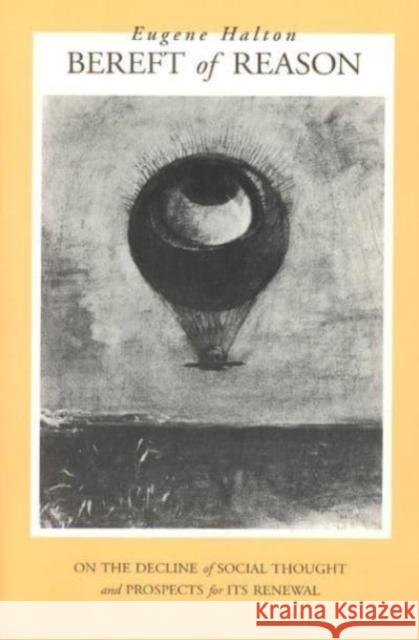
In this radical critique of contemporary social theory, Eugene Halton argues that both modernism and postmodernism are damaged philosophies whose acceptance of the myths of the mind/body dichotomy make them incapable of solving our social dilemmas. Claiming that human beings should be understood as far more than simply a form of knowledge, social construction, or contingent difference, Halton argues that contemporary thought has lost touch with the spontaneous passions or enchantment of life. Exploring neglected works in twentieth century social thought and philosophy particularly the...
In this radical critique of contemporary social theory, Eugene Halton argues that both modernism and postmodernism are damaged philosophies whose acce...
More and more information is pumped into our media-saturated world every day, yet Americans seem to know less and less. In a society where who you are is defined by what you buy, and where we prefer to experience reality by watching it on TV, Eugene Halton argues something has clearly gone wrong. Luckily Halton, with scalpel-sharp wit in one hand and the balm of wisdom in the other, is here to operate on the declining body politic. His initial diagnosis is bleak: fast food and too much time spent sitting, whether in our cars or on our couches, are ruining our bodies, while our minds are...
More and more information is pumped into our media-saturated world every day, yet Americans seem to know less and less. In a society where who you are...
In 1873, John Stuart Stuart-Glennie elaborated a theory of 'the moral revolution' to characterize the historical shift from roughly 600 BCE in a variety of civilizations, as part of a critical theory of history. This book brings light to the now eclipsed theory and offers new contexts and understandings of the phenomenon.
In 1873, John Stuart Stuart-Glennie elaborated a theory of 'the moral revolution' to characterize the historical shift from roughly 600 BCE in a varie...