Since the atomic bomb made its first appearance on the world stage in 1945, it has been clear that we possess the power to destroy our own planet. What nuclear weapons made possible, global environmental crisis, marked especially by global warming, has now made inevitable--if business as usual continues.
The roots of the present ecological crisis, John Bellamy Foster argues in The Ecological Revolution, lie in capital's rapacious expansion, which has now achieved unprecedented heights of irrationality across the globe. Foster compellingly demonstrates that the only possible...
Since the atomic bomb made its first appearance on the world stage in 1945, it has been clear that we possess the power to destroy our own planet. ...
In the fall of 2008, the United States was plunged into a financial crisis more severe than any since the Great Depression. As banks collapsed and the state scrambled to organize one of the largest transfers of wealth in history, many including economists and financial experts were shocked by the speed at which events unfolded.
In this new book, John Bellamy Foster and Fred Magdoff offer a bold analysis of the financial meltdown, how it developed, and the implications for the future. They examine the specifics of the housing bubble and the credit crunch as well as situate current...
In the fall of 2008, the United States was plunged into a financial crisis more severe than any since the Great Depression. As banks collapsed and ...
Humanity in the twenty-first century is facing what might be described as its ultimate environmental catastrophe: the destruction of the climate that has nurtured human civilization and with it the basis of life on earth as we know it. All ecosystems on the planet are now in decline. Enormous rifts have been driven through the delicate fabric of the biosphere. The economy and the earth are headed for a fateful collision if we don t alter course.
In The Ecological Rift: Capitalism s War on the Earth environmental sociologists John Bellamy Foster, Brett Clark, and Richard York offer a...
Humanity in the twenty-first century is facing what might be described as its ultimate environmental catastrophe: the destruction of the climate th...
Praise for Foster and Magdoff s The Great Financial Crisis In this timely and thorough analysis of the current financial crisis, Foster and Magdoff explore its roots and the radical changes that might be undertaken in response. . . . This book makes a valuable contribution to the ongoing examination of our current debt crisis, one that deserves our full attention. Publishers Weekly
There is a growing consensus that the planet is heading toward environmental catastrophe: climate change, ocean acidification, ozone depletion, global freshwater use, loss of biodiversity, and chemical...
Praise for Foster and Magdoff s The Great Financial Crisis In this timely and thorough analysis of the current financial crisis, Foster and Magdoff...
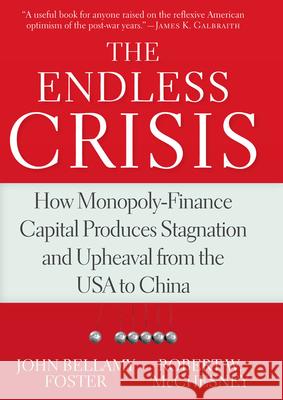
John Bellam Robert W. McChesney John Bellamy Foster
The days of boom and bubble are over, and the time has come to understand the long-term economic reality. Although the Great Recession officially ended in June 2009, hopes for a new phase of rapid economic expansion were quickly dashed. Instead, growth has been slow, unemployment has remained high, wages and benefits have seen little improvement, poverty has increased, and the trend toward more inequality of incomes and wealth has continued. It appears that the Great Recession has given way to a period of long-term anemic growth, which Foster and McChesney aptly term the Great Stagnation....
The days of boom and bubble are over, and the time has come to understand the long-term economic reality. Although the Great Recession officially ende...
In 1966, Paul Baran and Paul Sweezy published Monopoly Capital, a monumental work of economic theory and social criticism that sought to reveal the basic nature of the capitalism of their time. Their theory, and its continuing elaboration by Sweezy, Harry Magdoff, and others in Monthly Review magazine, infl uenced generations of radical and heterodox economists. They recognized that Marx's work was unfi nished and itself historically conditioned, and that any attempt to understand capitalism as an evolving phenomenon needed to take changing conditions into account. Having observed the rise of...
In 1966, Paul Baran and Paul Sweezy published Monopoly Capital, a monumental work of economic theory and social criticism that sought to reveal the ba...
Over a decade ago Foster and Burkett introduced a revolutionary understanding of the ecological foundations of Marx's thought, demonstrating that Marx's concepts of the universal metabolism of nature, social metabolism, and metabolic rift prefigured much of modern systems ecology. In this volume, Foster and Burkett expand on this analysis in the process of responding to recent ecosocialist criticisms of Marx.
Over a decade ago Foster and Burkett introduced a revolutionary understanding of the ecological foundations of Marx's thought, demonstrating that Marx...