John Finnis Joseph M. Jr. Boyle Germain Gabriel Grisez
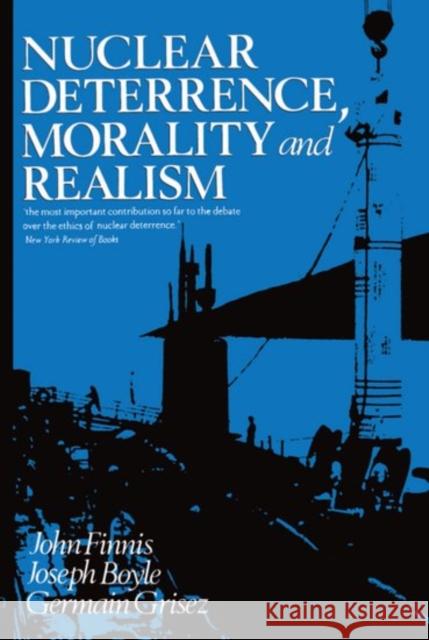
Providing a rigorous and objective ethical analysis of nuclear deterrence, this book discusses such issues as the Soviet menace, possible holocaust, and strategic imperatives. At the same time, the authors unmask types of deterrence that they perceive essentially as moral evasions, maintaining that deterrence cannot be bluffing, pure counterforce, the lesser (or greater) evil, or a step towards disarmament. Concluding that deterrence is unjustifiable, this book examines the new questions of conscience that this raises for us all.
Providing a rigorous and objective ethical analysis of nuclear deterrence, this book discusses such issues as the Soviet menace, possible holocaust, a...
A critique of recent work in moral theology illustrated with examples from the most controversial aspects of Christian moral doctrine. Finnis gives an account of the roots of the upheaval in Roman Catholic moral theology in and after the 1960s, and points to a way forward.
A critique of recent work in moral theology illustrated with examples from the most controversial aspects of Christian moral doctrine. Finnis gives an...
This Major Reference series brings together a wide range of key international articles in law and legal theory. Many of these essays are not readily accessible, and their presentation in these volumes will provide a vital new resource for both research and teaching. Each volume is edited by leading international authorities who explain the significance and context of articles in an informative and complete introduction.
This Major Reference series brings together a wide range of key international articles in law and legal theory. Many of these essays are not readil...
This Major Reference series brings together a wide range of key international articles in law and legal theory. Many of these essays are not readily accessible, and their presentation in these volumes will provide a vital new resource for both research and teaching. Each volume is edited by leading international authorities who explain the significance and context of articles in an informative and complete introduction.
This Major Reference series brings together a wide range of key international articles in law and legal theory. Many of these essays are not readil...
Are we entitled to be confident that our moral judgements can be objective? Can they express insights into aspects of reality, rather than mere feelings, tastes, desires, decisions, upbringing, or conventions? Why must we consider some of our choices to be free, and how do our free choices matter? How far should our moral judgements be based on assessments of expected consequences? Can utilitarianism, and other consequentialist or proportionalist theories, be anything more than the rationalization of positions taken on other grounds?
The main theme of this book is the challenge to...
Are we entitled to be confident that our moral judgements can be objective? Can they express insights into aspects of reality, rather than mere fee...
John Finnis has been a central figure in the fundamental re-shaping of legal philosophy over the past half-century. This volume of his Collected Essays shows the full range and power of his contributions to the philosophy of law. The volume collects nearly thirty papers: on the foundations of law's authority; major theories and theorists of law; legal reasoning; revolutions, rights and law; and the logic of law-making. The essays collected include Finnis' recent appreciations and root-and-branch critiques of Hart's legal and political theories, his engagements with other central figures and...
John Finnis has been a central figure in the fundamental re-shaping of legal philosophy over the past half-century. This volume of his Collected Essay...
First published in 1980, Natural Law and Natural Rights is widely heralded as a seminal contribution to the philosophy of law, and an authoritative restatement of natural law doctrine. It has offered generations of students and other readers a thorough grounding in the central issues of legal, moral, and political philosophy from Finnis's distinctive perspective. This new edition includes a substantial postscript by the author, in which he responds to thirty years of discussion, criticism and further work in the field to develop and refine the original theory. The book closely integrates the...
First published in 1980, Natural Law and Natural Rights is widely heralded as a seminal contribution to the philosophy of law, and an authoritative re...
Reason in Action collects John Finnis' work on the theory of practical reason and moral philosophy. The essays in the volume range from foundational issues of meta-ethics to the practical application of natural law theory to ethical problems such as nuclear deterrence, obscenity and free speech, and abortion and cloning. Defending the objectivity of some evaluative and moral judgments, the volume's meta-ethical papers debate with figures as diverse as Jurgen Habermas, Bernard Williams, David Hume, Max Weber, and Christine Korsgaard, and offer a new understanding of Wittgenstein's On...
Reason in Action collects John Finnis' work on the theory of practical reason and moral philosophy. The essays in the volume range from foundational i...
The essays in Intention and Identity explore themes in Finnis' work touched on only lightly, if at all, in Natural Law and Natural Rights, developing profound accounts of personal identity and existence; group identity and common good; and intention and choice as action- and self-shaping. In his many-faceted study of what it is to be a human person, and a human community, Finnis not only engages with contemporary philosophers and bioethicists such as Peter Singer, Michael Lockwood and John Harris, with thinkers from other traditions such as Karol Wojtyla (John Paul II), and with judges in...
The essays in Intention and Identity explore themes in Finnis' work touched on only lightly, if at all, in Natural Law and Natural Rights, developing ...
The essays in Religion and Public Reasons seek to argue for, and illustrate, a central element of John Finnis' theory of natural law: that the main tenets of personal and political morality, and of a good legal order, are taught both by reason (arguments accessible to everyone) and by authentic divine revelation (teachings accessible to all who have a reasonable faith in its witnesses). The author's main books each include arguments for rejecting atheism and agnosticism; several papers here take up these arguments and indicate ways in which they open onto the reasonable grounds for...
The essays in Religion and Public Reasons seek to argue for, and illustrate, a central element of John Finnis' theory of natural law: that the main te...