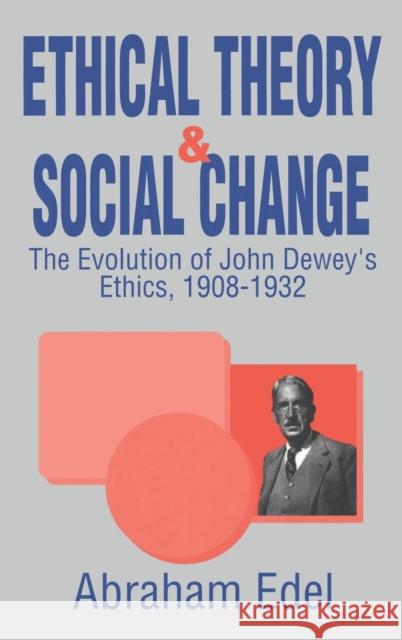
John Dewey was unique among American philosophers in his insistence that the events, the social structure, the beliefs and attitudes of a period, its models of science and human history, all have some constitutive role in its philosophical theory. This belief is amply demonstrated in Dewey's own writings. Dewey and James H. Tufts' Ethics was first published in 1908 with a revised edition appearing in 1932. Dewey's part in the latter was wholly rewritten, and in effect constituted a new work, showing that Dewey did not believe ethical beliefs were eternal and unchanging. In...
John Dewey was unique among American philosophers in his insistence that the events, the social structure, the beliefs and attitudes of a period, ...
This book presents the results of an experiment in interdisciplinary collaboration to clarify theories of morality and anthropology and philosophy, showing how each may be enriched by borrowing from the other. Pooling the resources and methods of their respective fields-anthropology and philosophy-May and Abraham Edel examine the wide range of moral differences in the world -to establish 'coordinates' for the more systematic mapping of particular moralities, to explore more explicitly the relations of morality to cultural patterns and social processes, and to see how philosophic issues of...
This book presents the results of an experiment in interdisciplinary collaboration to clarify theories of morality and anthropology and philosophy...
This volume includes all Dewey's writings for 1938 except for "Logic: The Theory of Inquiry "(Volume 12 of The Later Works), as well as his 1939 "Freedom and Culture, Theory of Valuation, "and two items from "Intelligence in the Modern World." "" "Freedom and Culture "presents, as Steven M. Cahn points out, "the essence of his philosophical position: a commitment to a free society, critical intelligence, and the education required for their advance."
This volume includes all Dewey's writings for 1938 except for "Logic: The Theory of Inquiry "(Volume 12 of The Later Works), as well as his 1939 "Free...
Abraham Edel addresses the questions of what is meant by "education," how educational institutions and processes are evaluated, and how they can be improved, and what curriculums are best and why. At a time when our ability to provide effective education can spell success or failure for individuals and society alike, Edel clears away old confusions and indicates the conditions that must be satisfied in order for education to be successful for this and future generations.
Abraham Edel addresses the questions of what is meant by "education," how educational institutions and processes are evaluated, and how they can be im...
In this stunning act of synthesis, Abraham Edel captures the entire range of Aristotle's thought in a manner that will prove attractive and convincing to a contemporary audience. Many philosophers approach Aristotle with their own, rather than his, questions. Some cast him as a partisan of a contemporary school. Even the neutral approach of classical scholarship often takes for granted questions that reflect our modern ways of dissecting the world.
Aristotle and His Philosophy shows him at work in asking and answering questions. Abraham Edel fashions a sound comparative way...
In this stunning act of synthesis, Abraham Edel captures the entire range of Aristotle's thought in a manner that will prove attractive and convinc...
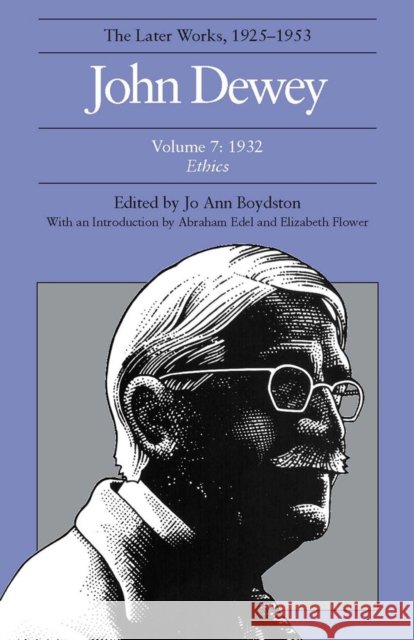
Introduction by Abraham Edel and Elizabeth FlowerThis seventh volume provides an authoritative edition of Dewey and James H. Tufts 1932 "Ethics."Dewey and Tufts state that the book s aim is: To induce a habit of thoughtful consideration, of envisaging the full meaning and consequences of individual conduct and social policies, insisting throughout that ethics must be constantly concerned with the changing problems of daily life."
Introduction by Abraham Edel and Elizabeth FlowerThis seventh volume provides an authoritative edition of Dewey and James H. Tufts 1932 "Ethics."Dewey...
There is an historical element throughout philosophy. As Edel notes, this is always in the context of problems, so emphasis will fall on the major objective of reflective analysis of ideas. The major objective of Edel's analysis in The Theory and Practice of Philosophy is the fundamental interrelatedness of problems of method, metaphysics, and value. Each part is an integral whole, complete in itself.
That philosophy has this central role in human practice indicates that it should be neither discarded nor deified. This is the explicit premise of the book. Students are likely...
There is an historical element throughout philosophy. As Edel notes, this is always in the context of problems, so emphasis will fall on the major ...
This volume, modeled after those published in The Library of Living Philosophers, attempts to provide a coherent statement of the work of Abraham Edel in moral and political theory, and on the impact of his work on such diverse areas as education, law, and social science. The methodological element of Edel's work is to see ethical and social theory in the full context of human life; specifically how twentieth-century modes of analysis impact classical concerns about right and wrong, good and evil.
The volume is tightly integrated from start to finish, and has the benefit of...
This volume, modeled after those published in The Library of Living Philosophers, attempts to provide a coherent statement of the work of A...
In the current atmosphere of controversy about modes of interpreting literature, historical influences in science, and subtle ideologies in social theory, Abraham Edel confronts the institutionalized separation of the humanities and the sciences, the segregation of disciplines through structures that rest on entrenched dualisms, and the isolations reenforced by habits of the academy and its struggles over turf. Edel's "search for connections" - carried out not only theoretically but through a series of particular studies spanning major disciplines from philosophy and social theory to...
In the current atmosphere of controversy about modes of interpreting literature, historical influences in science, and subtle ideologies in social ...
May Edel's The Chiga of Uganda is in the grand tradition of Franz Boas, Margaret Mead, and Leslie Spier. Written at a time when older ways were menaced by contact with other cultures, Edel's effort was part of a descriptive urgency that aimed to capture the past before the past disappeared. And that past should be viewed from the perspective of the people themselves, by students going into the field to observe, question, and report. This book is an enlarged and amplified edition of The Chiga of Western Uganda published in 1957 by the Oxford University Press for the International African...
May Edel's The Chiga of Uganda is in the grand tradition of Franz Boas, Margaret Mead, and Leslie Spier. Written at a time when older ways were men...