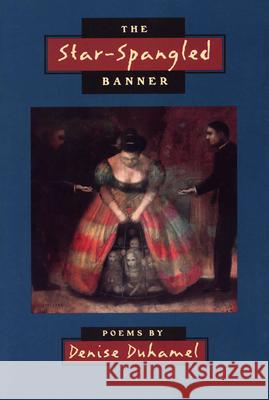
"The Star-Spangled Banner, " Denise Duhamel's sixth book of poems, is about falling in love, American-style, with someone who is not American.
In the title poem, a small American girl mishears the first line of "The Star-Spangled Banner" as "Jose, can you see?," which leads her to imagine a foreign lover of an American woman dressed in a star-spangled gown. The misunderstandings caused by language recur throughout the book: contemplating what "yes" means in different cultures; watching Nickelodeon's "Nick at Nite" with a husband who grew up in the Philippines and never saw "The Patty...
"The Star-Spangled Banner, " Denise Duhamel's sixth book of poems, is about falling in love, American-style, with someone who is not American.
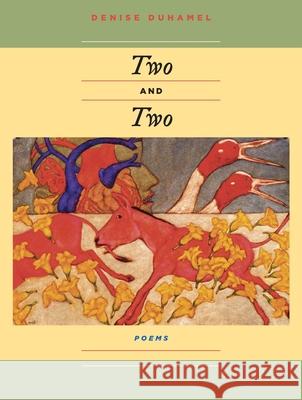
Denise Duhamel's much anticipated new collection begins with a revisionist tale--Noah is married to Joan of Arc--in a poem about America's often flawed sense of history. Throughout "Two and Two," doubles abound: Noah's animals; Duhamel's parents as Jack and Jill in a near-fatal accident; an incestuous double sestina; a male/female pantoum; a dream and its interpretation; and translations of advertisements from English to Spanish. In two Mobius strip poems (shaped like the Twin Towers), Duhamel invites her readers to get out their scissors and tape and transform her poems into 3-D...
Denise Duhamel's much anticipated new collection begins with a revisionist tale--Noah is married to Joan of Arc--in a poem about America's often fl...
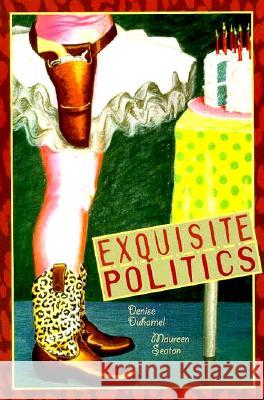
The French Surrealists invented a game called "Exquisite Corpse" to write collaborative poems, and thus the title of Denis Duhamel and Maureen Seaton's new collection, "Exquisite Politics, " hints at its collaborative nature. In poems that speak at times in a breezy, conversational style, and at other moments with taut intensity, Duhamel and Seaton probe the mysteries of relationships, personal histories, and issues of sexual and political identity.
The French Surrealists invented a game called "Exquisite Corpse" to write collaborative poems, and thus the title of Denis Duhamel and Maureen Seaton'...
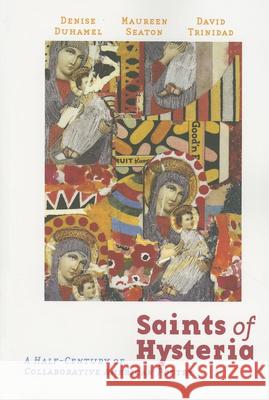
Collaborative poetry poems written by one or more people grew out of word games played by French surrealists in the 1920s. It was taken up a decade later by Japan s Vou Club and then by Charles Henri Ford, who created the chainpoem, composed by poets who mailed their lines all over the world. After WW II, the Beat writers collaborative experiments resulted in the famous Pull My Daisy. The concept was embraced in the 1970s by feminist poets as a way to find a collective female voice. Yet, for all its rich history, virtually no collections of collaborative poetry exist. This exhilarating...
Collaborative poetry poems written by one or more people grew out of word games played by French surrealists in the 1920s. It was taken up a decade la...
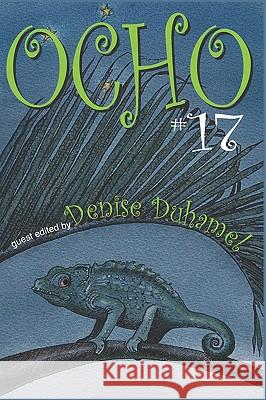
Guest edited by Denise Duhamel. Featuring poems by James Brock, Nick Carbo, Kelle Groom, Barbara Hamby, Michael Hettich, David Kirby, Campbell McGrath, Peter Meinke, Jesse Millner, Barbra Nightingale, Joseph Pacheco, Haya Pomrenze, Jay Snodgrass, Kristine Snodgrass, Emma Trelles. Cover art by Carol Todaro.
Guest edited by Denise Duhamel. Featuring poems by James Brock, Nick Carbo, Kelle Groom, Barbara Hamby, Michael Hettich, David Kirby, Campbell McGrath...
If I were Colen's agent, I'd pitch these poems to a movie producer as "David Lynch meets Gertrude Stein." Money for Sunsets, like Tender Buttons, is syntactically rich and varied, using fragments, repetition, and word associations.If I were Colen's agent, I might not mention her complicated and smartobservations on women, violence, and money - since I'm assuming that most movie producers are capitalists. In "Des Oeufs," Colen writes, "A naked woman as a motif is too easy." Too easy, indeed. Innovative and evocative, these poems have arrived at just the right cultural moment. And I, for one,...
If I were Colen's agent, I'd pitch these poems to a movie producer as "David Lynch meets Gertrude Stein." Money for Sunsets, like Tender Buttons, is s...