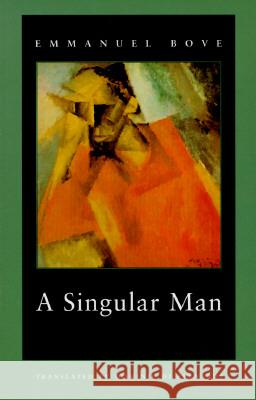
In a state of permanent tension and relieved moral paralysis, Jean-Marie Thely, an anguished bystander confined to the margins of polite society, has based the whole of his existence upon the idea that he is unlike others. He derives his singularity from his origins as an illegitimate child; bounced from one condescendingly charitable household to another only to be rejected by the bourgeois families that raised him. Restricted to an ordinary education, barred from an officer's career, he is unable to do what he wants and eventually becomes trapped in a life of utter indecision. "
In a state of permanent tension and relieved moral paralysis, Jean-Marie Thely, an anguished bystander confined to the margins of polite society, has ...
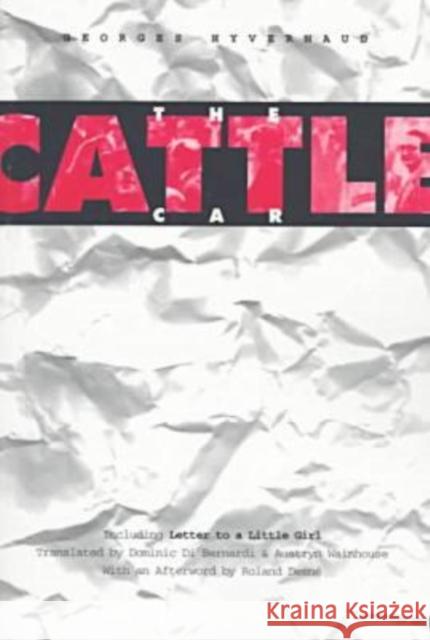
In this first English translation of Hyvernaud's novel, the narrator, who has come back to France after imprisonment in Germany, is preoccupied with the near impossibility of writing a novel about his experiences; at the same time, he attempts to function normally in a world that seems to have changed radically. The Cattle Car is devoid of heroics, portraying the protagonist as a man without a future, the ordinary guy who moves quietly among objects, without making any sort of commotion, a man who daydreams other people's lives. In Letter to a Little Girl, which precedes The Cattle Car,...
In this first English translation of Hyvernaud's novel, the narrator, who has come back to France after imprisonment in Germany, is preoccupied with t...
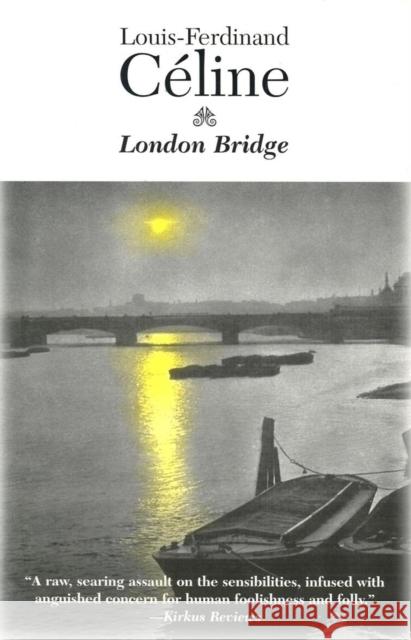
In this widely acclaimed translation, Dominic DiBernardi expertly captures C?line's trademark style of prose which has served as inspiration to such American writers as Philip Roth, Kurt Vonnegut, William Burroughs, Jack Kerouac, Charles Bukowski, Norman Mailer and Joseph Heller.
In this widely acclaimed translation, Dominic DiBernardi expertly captures C?line's trademark style of prose which has served as inspiration to suc...
In a series of comic vignettes and letters, Mordechai Schamz sets out to investigate himself, his world, and the language which makes them both intelligible. Dumbfounded at every turn and undiscouraged by -- perhaps even unaware of -- his failures, he confidently gets lost in the labyrinth of his investigations. Reminiscent of Flaubert's Bouvard and Pecuchet, Calvino's Palomar, and Beckett's Watt, Mordechai Schamz ponders the mysteries of life through cliches and solipsisms, making himself the master of the illogical and the clown of the absurd.
In a series of comic vignettes and letters, Mordechai Schamz sets out to investigate himself, his world, and the language which makes them both intell...
A professor of literature at the ecole normale in Arras, Georges Hyvernaud was called up at the start of World War II and given the rank of lieutenant. He was captured with his unit in 1940. He was impounded in one Pomeranian "oflag," then in another; finally, on January 20, 1945, he was released and together with other former prisoners made his way across northern Germany, on foot and in cattle cars. On his person, Hyvernaud carried notebooks filled with what shortly became "La Peau et les Os," a narrative of his wartime experience. Hyvernaud's account is of a failure of character, the...
A professor of literature at the ecole normale in Arras, Georges Hyvernaud was called up at the start of World War II and given the rank of lieutenant...