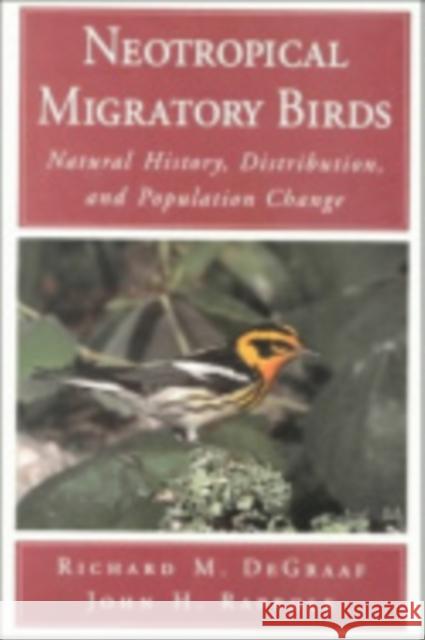
Summarizes practical data about the distribution and breeding habitat requirements of migratory birds in North and South America, with natural history accounts of some 350 species of Neotropical migrants. Entries include a brief description of each bird's range, status, habits on breeding grounds, n
Summarizes practical data about the distribution and breeding habitat requirements of migratory birds in North and South America, with natural history...
Although numerous species of amphibians and reptiles live in New England and the northeastern Untied States, few people are aware of their existence of know much about their life histories, habitats, or distributions. This illustrated work provides such information, compiling the latest data on nearly sixty species. Included is a detailed account of each species' range, relative abundance, habitat, breeding period (from egg deposition through larval period), home range and movements, and food habitats. Additional comments and selected references are provided throughout.
The book is...
Although numerous species of amphibians and reptiles live in New England and the northeastern Untied States, few people are aware of their existenc...
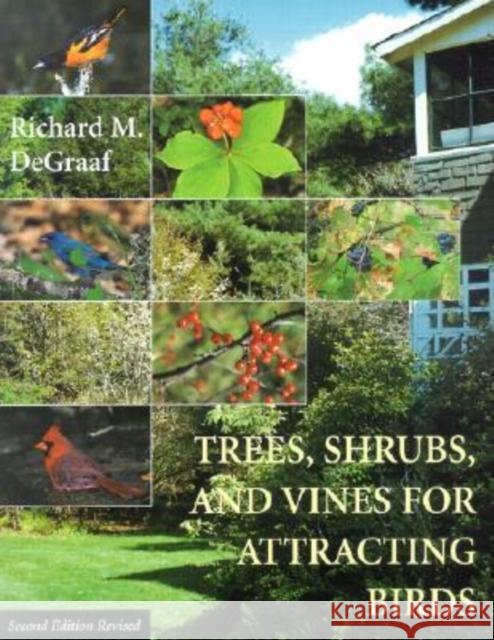
Revised and updated, this new edition of a much sought-after classic remains the best source for information about the trees, shrubs, and vines that provide bird habitats and feeding sources in the United States and Canada from the Atlantic coast to the Rocky Mountains and beyond. More than 160 species of trees, shrubs, and vines that provide food, cover, and nesting for common North American birds are highlighted, with instructions on designing a landscape habitat that attracts desired bird species. For each plant species the author provides a description, flowering and fruiting periods,...
Revised and updated, this new edition of a much sought-after classic remains the best source for information about the trees, shrubs, and vines that p...
Richard M. DeGraaf Mariko Yamasaki William B. Leak
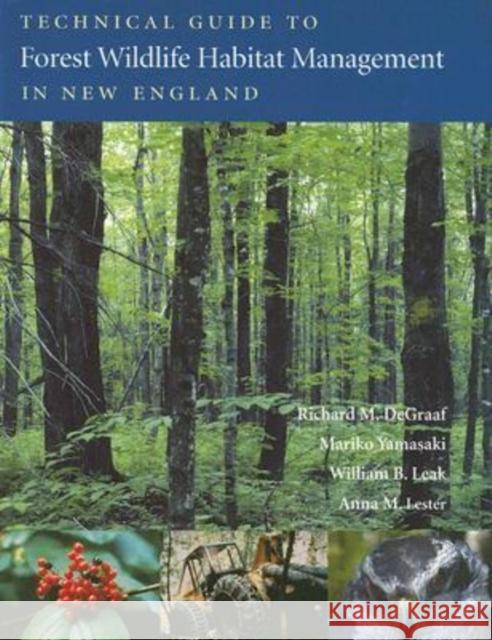
Centuries of human use and natural processes have shaped forest habitats and their wildlife populations in New England. Conditions are never static. Forest and nonforest habitats for a shifting mosaic of New England fauna were once continuously provided by wind, fire, blowdowns, forest regrowth, and other disturbances. This is no longer the case: development of historically open habitats, fire control, and the decline of agriculture have transformed the landscape. Wildlife associated with forests and woodlots--fisher and pileated woodpecker, for example--have become common. Species associated...
Centuries of human use and natural processes have shaped forest habitats and their wildlife populations in New England. Conditions are never static. F...