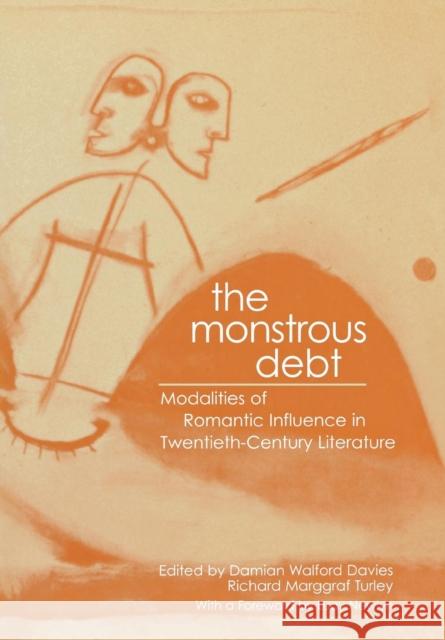
The authors in this collection join an animated debate on the persistence of Romanticism. Even as dominant twentieth-century cultural movements have contested Romantic myths of redemptive Nature, individualism, perfectibility, the transcendence of art, and the heart's affections, the Romantic legacy survives as a point of tension and of inspiration for modern writers. Rejecting the Bloomian notion of anxious revisionism, The Monstrous Debt argues that various kinds of influences, inheritances, and indebtedness exist between well-known twentieth-century authors and canonical Romantic writers....
The authors in this collection join an animated debate on the persistence of Romanticism. Even as dominant twentieth-century cultural movements have c...
This work looks at the impact of five archetypal figures on literature and culture of the 1790s in Britain. These five influential figures are associated in important ways with Wales, such as Wordsworth and Coleridge, identified with them in order to define their own ideological and emotional positions in relation to the major debates generated by the French Revolution.
This work looks at the impact of five archetypal figures on literature and culture of the 1790s in Britain. These five influential figures are associa...
The (re)turn to history in Romantic Studies in the 1980s marked the beginning of a critical orthodoxy that continues to condition, if not define, our sense of the Romantic period twenty-five years on. Romantic New Historicism's revisionary engagements have played a central role in the realignment of the field and in the expansion of the Romantic canon. In this major new collection of eleven essays, critics reflect on New Historicism's inheritance, its achievements and its limitations. Integrating a self-reflexive engagement with New Historicism's history and detailed attention to a range of...
The (re)turn to history in Romantic Studies in the 1980s marked the beginning of a critical orthodoxy that continues to condition, if not define, our ...
Maps have long been a source of inspiration for imaginative writers, and "Cartographies of Culture" offers a pioneering new examination of the long-standing links between the two. Damian Walford Davies focuses on the Anglophone literature of and offers a boldly imaginative and stringently theorized analysis of five literary maps. In the process, he sets up an innovative dialogue between literary studies and geography that generates a genuinely interdisciplinary study of literary texts in relation to the spatial aspects of culture. What emerges is nothing less than a new way of reading...
Maps have long been a source of inspiration for imaginative writers, and "Cartographies of Culture" offers a pioneering new examination of the long...