Continental Philosophy: A Critical Approach is a lucid and wide-ranging introduction to the key figures and philosophical movements of the nineteenth and twentieth centuries.
Includes chapters on Hegel; Marx and Western Marxism; Schopenhauer, Freud, and Bergson; Nietzsche; hermeneutics; phenomenology; existentialism; structuralism; poststructuralism; French feminism; and postmodernism.
Provides an ideal text or background resource for many different introductory and advanced courses on modern European philosophy.
Continental Philosophy: A Critical Approach is a lucid and wide-ranging introduction to the key figures and philosophical movements of ...
Covering the complete development of post-Kantian Continental philosophy, this volume serves as an essential reference work for philosophers and those engaged in the many disciplines that are integrally related to Continental and European Philosophy.
Covering the complete development of post-Kantian Continental philosophy, this volume serves as an essential reference work for philosophers and those...
In this collection of brief lives (and deaths) of nearly two hundred of the world's greatest thinkers, noted philosopher Simon Critchley creates a register of mortality that is tragic, amusing, absurd, and exemplary. From the self-mocking haikus of Zen masters on their deathbeds to the last words of Christian saints and modern-day sages, this irresistible book contains much to inspire both amusement and reflection.
Informed by Critchley's acute insight, scholarly intelligence, and sprightly wit, each entry tells its own tale, but collected together they add up to a profound and...
In this collection of brief lives (and deaths) of nearly two hundred of the world's greatest thinkers, noted philosopher Simon Critchley creates a ...
Intended for students of philosophy and critical theory, this book presents 13 essays by commentators on the work of Levinas and features two previously untranslated essays by Levinas and Derrida.
Intended for students of philosophy and critical theory, this book presents 13 essays by commentators on the work of Levinas and features two previous...
The question of how to lead a happy and meaningful life has been at the heart of philosophical debate since time immemorial. Today, however, these questions seem to be addressed not by philosophers but self-help gurus, who frantically champion the individual's quest for self-expression and self-realization; the desire to become authentic.
Against these new age sophistries, How to Stop Living and Start Worrying tackles the question of 'how to live' by forcing us to explore our troubling relationship with death. For Critchley, philosophy begins with the question of finitude and with...
The question of how to lead a happy and meaningful life has been at the heart of philosophical debate since time immemorial. Today, however, these que...
Impossible objects are those about which the philosopher, narrowly conceived, can hardly speak: poetry, film, music, humor. Such "objects" do not rely on philosophy for interpretation and understanding; they are already independent practices and sites of sensuous meaning production. As Elvis Costello has said, "writing about music is like dancing about architecture." We don't need literary theory in order to be riveted by the poem, nor a critic's analysis to enjoy a film. How then can philosophy speak about anything outside of itself, namely all of those things which actually matter to us in...
Impossible objects are those about which the philosopher, narrowly conceived, can hardly speak: poetry, film, music, humor. Such "objects" do not rely...
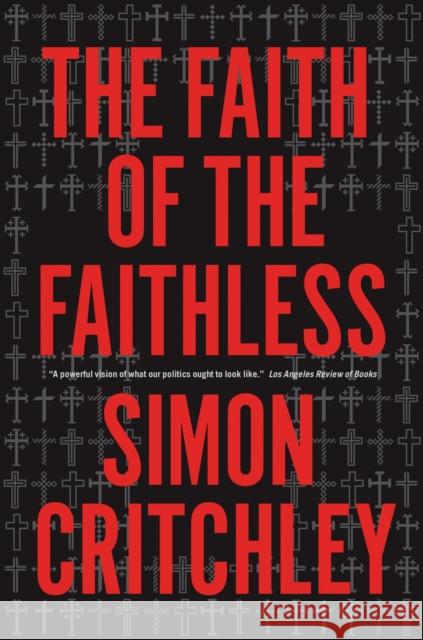
The return to religion has arguably become the dominant theme of contemporary culture. Somehow, the secular age seems to have been replaced by a new era where political action flows directly from theological, indeed cosmic, conflict. The Faith of the Faithless lays out the philosophical and political framework of this idea and seeks to find a way beyond it. Should we defend a version of secularism or quietly accept the slide into theism? Or is there another way?
The return to religion has arguably become the dominant theme of contemporary culture. Somehow, the secular age seems to have been replaced by a new e...
The figure of Hamlet haunts our culture like the Ghost haunts him. Arguably, no literary work, not even the Bible, is more familiar to us than Shakespeare's Hamlet. Everyone knows at least six words from the play; often people know many more. Yet the play--Shakespeare's longest--is more than "passing strange" and becomes deeply unfamiliar when considered closely. Reading Hamlet alongside other writers, philosophers, and psychoanalysts--Carl Schmitt, Walter Benjamin, Freud, Lacan, Nietzsche, Melville, and Joyce--Simon Critchley and Jamieson Webster consider the political context and...
The figure of Hamlet haunts our culture like the Ghost haunts him. Arguably, no literary work, not even the Bible, is more familiar to us than Shakesp...
The Ethics of Deconstruction, Simon Critchley's first book, was originally published to great acclaim in 1992. The first book to argue for the ethical turn in Derrida's work, it powerfully shows how deconstruction has persuasive ethical consequences that are vital to our thinking through of questions of politics and democracy. Moving away from using deconstruction to find the contradictions inherent in any text, Critchley concerns himself with the philosophical context the ethical impetus Derrida's ethics to be understood in relation to his engagement with the work of Levinas, and lays...
The Ethics of Deconstruction, Simon Critchley's first book, was originally published to great acclaim in 1992. The first book to argue for the ethical...