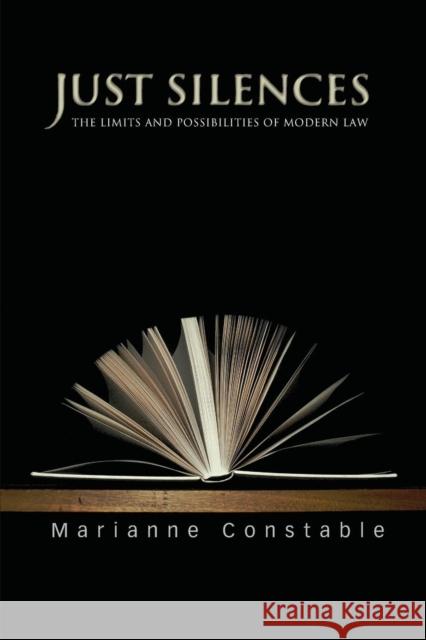
Is the Miranda warning, which lets an accused know of the right to remain silent, more about procedural fairness or about the conventions of speech acts and silences? Do U.S. laws about Native Americans violate the preferred or traditional "silence" of the peoples whose religions and languages they aim to "protect" and "preserve"? In Just Silences, Marianne Constable draws on such examples to explore what is at stake in modern law: a potentially new silence as to justice.
Grounding her claims about modern law in rhetorical analyses of U.S. law and legal texts and locating...
Is the Miranda warning, which lets an accused know of the right to remain silent, more about procedural fairness or about the conventions of speech...
Everyday Practices and Trouble Cases, the second volume in the series, asks how law helps to constitute the worlds in which we live everyday, and how law responds to disruptions and disputes that arise in various realms. Leading scholars explore the dichotomy between everyday practices and trouble cases, and the way various kinds of research have addressed that dichotomy, illuminating the pervasive role of law in social life as well as the capacity of law to respond to social conflict.
Everyday Practices and Trouble Cases, the second volume in the series, asks how law helps to constitute the worlds in which we live everyday, and how ...
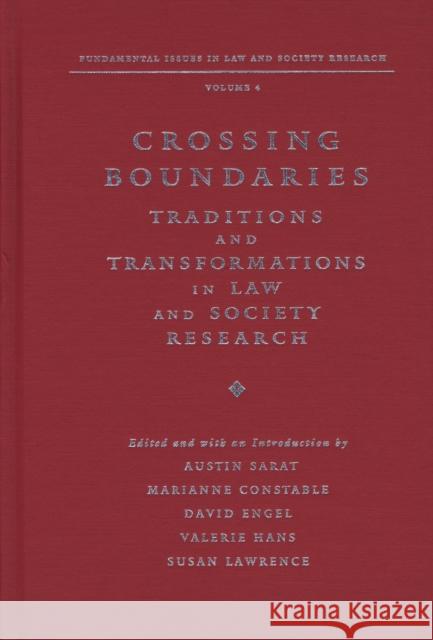
Perhaps no idea is more emblematic of the field of law and society than crossing boundaries. From the founding of the Law and Society Association in the early 1960s, participating scholars aspired to create a field that crossed boundaries in at least two senses: by undertaking research that questioned and often bridged traditional methodological and disciplinary divisions, and by using nontraditional approaches to explore the interconnections between law and its social context. These essays reflect both aspirations.
Perhaps no idea is more emblematic of the field of law and society than crossing boundaries. From the founding of the Law and Society Association in t...
Perhaps no idea is more emblematic of the field of law and society than crossing boundaries. From the founding of the Law and Society Association in the early 1960s, participating scholars aspired to create a field that crossed boundaries in at least two senses: by undertaking research that questioned and often bridged traditional methodological and disciplinary divisions, and by using nontraditional approaches to explore the interconnections between law and its social context. These essays reflect both aspirations.
Perhaps no idea is more emblematic of the field of law and society than crossing boundaries. From the founding of the Law and Society Association in t...
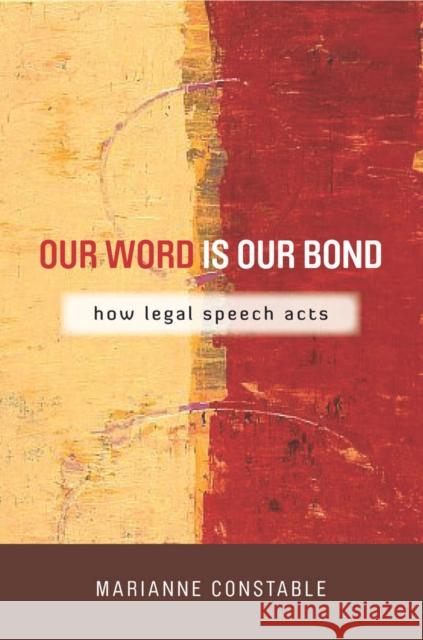
Words can be misspoken, misheard, misunderstood, or misappropriated; they can be inappropriate, inaccurate, dangerous, or wrong. When speech goes wrong, law often steps in as itself a speech act or series of speech acts. Our Word Is Our Bond offers a nuanced approach to language and its interaction and relations with modern law. Marianne Constable argues that, as language, modern law makes claims and hears claims of justice and injustice, which can admittedly go wrong. Constable proposes an alternative to understanding law as a system of rules, or as fundamentally a policy-making...
Words can be misspoken, misheard, misunderstood, or misappropriated; they can be inappropriate, inaccurate, dangerous, or wrong. When speech goes w...
Words can be misspoken, misheard, misunderstood, or misappropriated; they can be inappropriate, inaccurate, dangerous, or wrong. When speech goes wrong, law often steps in as itself a speech act or series of speech acts. Our Word Is Our Bond offers a nuanced approach to language and its interaction and relations with modern law. Marianne Constable argues that, as language, modern law makes claims and hears claims of justice and injustice, which can admittedly go wrong. Constable proposes an alternative to understanding law as a system of rules, or as fundamentally a policy-making and...
Words can be misspoken, misheard, misunderstood, or misappropriated; they can be inappropriate, inaccurate, dangerous, or wrong. When speech goes wron...