Cimbala analyzes military persuasion--the art of using armed force to support diplomacy, deterrence, crisis management, unconventional conflicts, peace operations, and other military activities short of major conventional war. As he shows, military persuasion requires that policy makers and diplomats understand the subtle interaction between force and diplomacy; each supports, or destroys, the other, depending upon the situation. Even conventional wars have aspects of armed persuasion. The Powell doctrine that calls for overwhelming force in case of any U.S. military intervention was not...
Cimbala analyzes military persuasion--the art of using armed force to support diplomacy, deterrence, crisis management, unconventional conflicts, p...
There is probably no area of more crucial concern nor one more subject to possible misunderstanding and riddled with paradox than nuclear weapons and their use, not only in war, but as deterrents to war. In Strategic Impasse, Cimbala examines the critical issues, problems, and paradoxes inherent in the current nuclear situation. It is from a fundamental contradiction--the usefulness of nuclear weapons versus the undesirability of nuclear war--that nuclear deadlock arises. Their usefulness as deterrents is based on their destructive potential and the balance of power in Europe cannot be...
There is probably no area of more crucial concern nor one more subject to possible misunderstanding and riddled with paradox than nuclear weapons a...
The transition from the end of the Cold War to a new world order is both promising and perilous. Security concerns are based more on the prevention or containment of regional and civil conflicts than on fears of nuclear or Eurasian global wars. The antagonists of the Cold War will be the collaborators of the next century in seeking to stabilize the conflict inside and outside Europe and to prevent further proliferation of nuclear weapons. Deterrence characteristics of the pre-Cold War period will in the 21st century again become normative.
The transition from the end of the Cold War to a new world order is both promising and perilous. Security concerns are based more on the prevention or...
This work attempts to clarify the major problems facing Russia's armed forces in the present and immediate future. Russia's military has been in decline since the end of the Cold War. Its fledgling democracy and struggling economy have also served as an inertial drag on military reform. Nevertheless, Russia has a strong military tradition dating back to Tsarist times, and that tradition includes World War II and Cold War achievements of the Soviet military still highly regarded by many Russians. Contributors explain the major challenges facing Russian defence and security policy with respect...
This work attempts to clarify the major problems facing Russia's armed forces in the present and immediate future. Russia's military has been in decli...
In Russia and Armed Persuasion, Stephen J. Cimbala argues that Russia's war planners and political leaders must make painful adjustments in their thinking about the relationship between military art and policy in the twenty-first century. Russia must master the use of force for persuasion, not just destruction. As the author shows, military persuasion requires that Russian leaders master the politico-military complexity of crisis management, deterrence and arms control, and the limitation of ends and means in war. Russia now has scarce resources to devote to defense and can no longer afford...
In Russia and Armed Persuasion, Stephen J. Cimbala argues that Russia's war planners and political leaders must make painful adjustments in their thin...
Coercion is persuasion supported by the threat or use of force. Just as warfare is often "diplomacy carried out by other means," coercion--the threat of combat or the threat of an escalation in the intensity of combat--is a more subtle method of dispute that shades the spectrum between diplomacy and warfare. Understanding of coercive military strategy is a prerequisite to the successful making of either policy or war. In "Coercive Military Strategy, " Stephen J. Cimbala shows that coercive military strategy is a necessary part of any diplomatic-strategic recipe for success. Few wars are...
Coercion is persuasion supported by the threat or use of force. Just as warfare is often "diplomacy carried out by other means," coercion--the threat ...
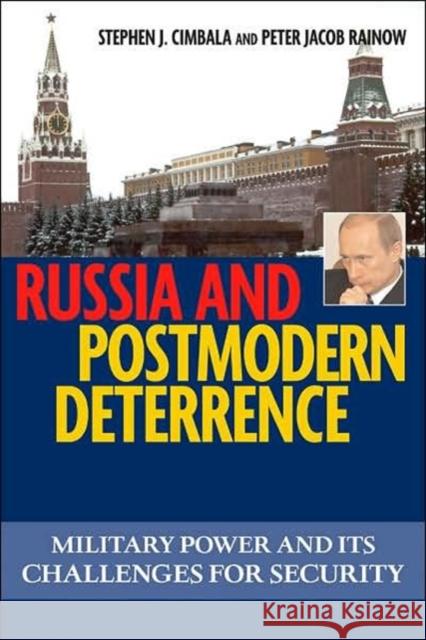
Russia is a post-communist country struggling to adapt to the modern world economically and politically. In the twenty-first century, Russia faces postmodern social, cultural, and political problems with its old policy of deterrence. For Russia's political leaders and military planners, three scenarios define their postmodern setting: 1) the world's leading military and economic powers, with the exception of China, are market-based economies and political democracies; 2) the revolution in military affairs, based on advances in information, electronics, and communications, is driving both...
Russia is a post-communist country struggling to adapt to the modern world economically and politically. In the twenty-first century, Russia faces pos...
Russia is a post-communist country struggling to adapt to the modern world economically and politically. In the twenty-first century, Russia faces postmodern social, cultural, and political problems with its old policy of deterrence. For Russia's political leaders and military planners, three scenarios define their postmodern setting: 1) the world's leading military and economic powers, with the exception of China, are market-based economies and political democracies; 2) the revolution in military affairs, based on advances in information, electronics, and communications, is driving both...
Russia is a post-communist country struggling to adapt to the modern world economically and politically. In the twenty-first century, Russia faces pos...