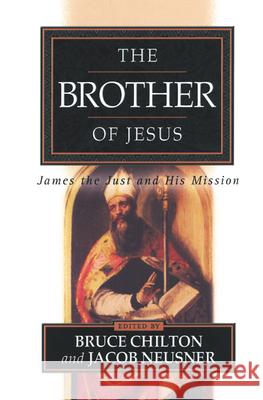
James the Just was, in the time between Jesus' resurrection and James's death, the most prominent and widely respected leader in Christendom. These essays by eight renowned scholars address such issues as the Jewish context of the early church, the person of James, his literary message and mission, and James in relation to Peter and Paul.
James the Just was, in the time between Jesus' resurrection and James's death, the most prominent and widely respected leader in Christendom. These...
Two eminent scholars, each expert in his own tradition, take Jewish-Christian dialogue to a new level. Aiming at neither mere description nor conversion, each presents the classical elements of his traditions understanding of three fundamental, common religious questions: where to meet God, how to live, and what to hope for. The other then responds. Neusner and Chilton's analytic comparisons of two great traditions intertwined at the roots serves as a primer on the defining energies of both traditions. The reader is invited to identify the traditions' unity of questions and the equally strong...
Two eminent scholars, each expert in his own tradition, take Jewish-Christian dialogue to a new level. Aiming at neither mere description nor conversi...
Studying The Historical Jesus is a new series, edited by Bruce Chilton and Craig Evans, that explores key questions concerning the historical Jesus within recent scholarly discussion. Written by authors who have already made important contributions to the study of Jesus, the volumes in this series present sound scholarship in accessible, creative, and interesting ways.
Studying The Historical Jesus is a new series, edited by Bruce Chilton and Craig Evans, that explores key questions concerning the historical Jesus wi...
Here is the second of three volumes (the first, Revelation: The Torah and the Bible, was published in 1995) whose purpose is to compare and contrast the paramount theological categories of Judaism and Christianity. The volumes provide the faithful of both Judaism and Christianity with informative, factual accounts of how Judaism and Christianity addressed the same issues and set forth their own distinctive program and set of propositions.
While religions speak to individuals in the privacy of their hearts, they also define themselves through social entities such as "church," "holy...
Here is the second of three volumes (the first, Revelation: The Torah and the Bible, was published in 1995) whose purpose is to compare and contrast t...
The author identifies and explains how Jesus practiced a unique understanding of purity. He acted to bring outcasts into solidarity with Israel in such a way that uncleanness, disease and death were overcome.>
The author identifies and explains how Jesus practiced a unique understanding of purity. He acted to bring outcasts into solidarity with Israel in suc...
There have been many studies of the doctrinal and liturgical differences and similarities between formative Judaism and early Christianity. Many of these studies examine the impact of Hellenistic culture on the development of Judaism and the consequences that such a Hellenized Judaism had for the development of Christianity. Very few books, however, have isolated particular spiritual practices as lenses through which to examine and compare these two religions. In their book, Chilton and Neusner ask simply, What are experiences both distinctive to the spiritual life of Torah and Christ,...
There have been many studies of the doctrinal and liturgical differences and similarities between formative Judaism and early Christianity. Many of th...
By placing Jesus and his movement first within Judaism and then with Hellenistic society at large, the author shows Jesus did "not" intend to refer to himself when he spoke of his 'blood' and his 'body'. He meant only to insist that his meals were a better sacrifice than what was offered in the Temple. Later traditions made Jesus himself into the sacrifice.
By placing Jesus and his movement first within Judaism and then with Hellenistic society at large, the author shows Jesus did "not" intend to refer to...
The Proclamation of Jesus seeks to place Jesus in the context of first-century Palestinian Judaism. The authors hope to discern the essence of his preaching, his concept of the kingdom of God, and the place of purity in his teaching and activities. Better methods for assessing not simply the authenticity of reported sayings and deeds, but for tracing the development of tradition are considered. The authors are convinced that most of the Synoptic tradition is authentic, but that much of it has been reinterpreted and recontextualized. Herein lies the real challenge for those...
The Proclamation of Jesus seeks to place Jesus in the context of first-century Palestinian Judaism. The authors hope to discern the essence of ...
This collection of studies offers Jesus researchers a gold mine of fresh research and critical appraisal of the assumptions and methods employed in the study of the historical Jesus. This publication has also been published in paperback, please click here for details.
This collection of studies offers Jesus researchers a gold mine of fresh research and critical appraisal of the assumptions and methods employed in th...
This volume reviews the criteria, assumptions, and methods involved in critical Jesus research. Its purpose is to clarify the procedures necessary to distinguish tradition that stems from Jesus from tradition and interpretation that stem from later tradents and evangelists. This publication has also been published in paperback, please click here for details.
This volume reviews the criteria, assumptions, and methods involved in critical Jesus research. Its purpose is to clarify the procedures necessary to ...