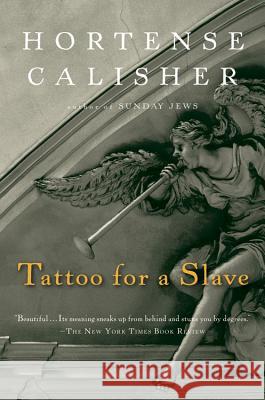
Hortense Calisher has been hailed as "stand ing] vividly with Cather and Fitzgerald" (Cynthia Ozick). In this, her latest and most lauded novel, she explores a family united in blood yet divided by ideas. Son Charles hopes to be a Supreme Court justice; family beauty Nell has children by different lovers; art expert Erika has a nose job; and artist Zach has two wives. Their mother, infamous in Israel, born of a well-to-do Boston background but no longer rich, is bound to a past that never quite dies. The buried history of this extraordinary--and very American--family comes to light...
Hortense Calisher has been hailed as "stand ing] vividly with Cather and Fitzgerald" (Cynthia Ozick). In this, her latest and most lauded novel, she e...
A "tattoo" is a bugle call, a summoning that lingers in the ear. Although Hortense Calisher's family eventually migrated north to New York City, the echoes of their days as a slave-owning Jewish family in the South still resonate with this acclaimed author, who uncovers a part of history never before so strongly and tenderly revealed. Calisher traces her family's years in the South and their transformative move up north, beautifully evoking the mood and texture of the early twentieth century. Her Virginia-born father, a perfume manufacturer, was twenty-two years older than her German-born...
A "tattoo" is a bugle call, a summoning that lingers in the ear. Although Hortense Calisher's family eventually migrated north to New York City, the e...
Introduction by Hortense Calisher Commentary by Edmund Wilson, Henry Seidel Canby, and Arthur Mizener Fitzgerald's second novel, a devastating portrait of the excesses of the Jazz Age, is a largely autobiographical depiction of a glamorous, reckless Manhattan couple and their spectacular spiral into tragedy. Published on the heels of This Side of Paradise, the story of the Harvard-educated aesthete Anthony Patch and his willful wife, Gloria, is propelled by Fitzgerald's intense romantic imagination and demonstrates an increased technical and...
Introduction by Hortense Calisher Commentary by Edmund Wilson, Henry Seidel Canby, and Arthur Mizener Fitzgerald...