Kenneth Winkler's esteemed edition of Berkeley's "Principles" is based on the second edition (London, 1734), the last one published in Berkeley's lifetime.
Life other members of Hackett's philosophical classics series, it features editorial elements found to be of particular value to students and their teachers: analytical table of contents; chronology of the author's life; selected bibliography; note on the text; glossary; and index.
Kenneth Winkler's esteemed edition of Berkeley's "Principles" is based on the second edition (London, 1734), the last one published in Berkeley's l...
Many of the earliest books, particularly those dating back to the 1900s and before, are now extremely scarce and increasingly expensive. We are republishing these classic works in affordable, high quality, modern editions, using the original text and artwork.
Many of the earliest books, particularly those dating back to the 1900s and before, are now extremely scarce and increasingly expensive. We are republ...
Contents Include: A New Theory Of Vision A Treatise Concerning Human Knowledge The Three Dialogues between Hylas and Philonous in Opposition to Sceptics and Atheists Keywords: Three Dialogues Between Hylas And Philonous Human Knowledge Atheists Dialogues Treatise Opposition
Contents Include: A New Theory Of Vision A Treatise Concerning Human Knowledge The Three Dialogues between Hylas and Philonous in Opposition to Scepti...
Through reflection or introspection it is possible to attempt to know if a sound, shape, movement, or color can exist unperceived by a mind? This book largely seeks to refute the claims made by Berkeley's contemporary John Locke about the nature of human perception. Both Locke and Berkeley agreed that there was an outside world, and it was this world which caused the ideas one has within one's mind, Berkeley sought to prove that the outside world was also composed solely of ideas.
Through reflection or introspection it is possible to attempt to know if a sound, shape, movement, or color can exist unperceived by a mind? This book...
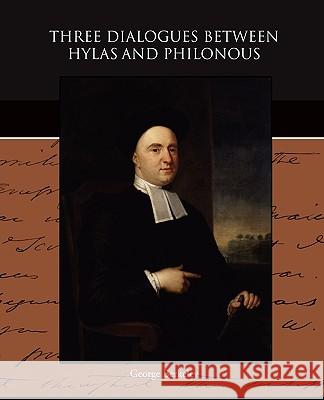
George Berkeley also known as Bishop Berkeley was an 18th century philosopher. His theory of "immaterialism" was later referred to as "subjective idealism. This theory, summed up in his dictum, "Esse est percipi," which states that individuals can only directly know sensation and ideas of objects not abstractions such as matter.
George Berkeley also known as Bishop Berkeley was an 18th century philosopher. His theory of "immaterialism" was later referred to as "subjective idea...
Forming a triangle of British empiricism with Locke and Hume, George Berkeleys direct influence on modern thought cannot be overstated. From the American Founding Fathers, who looked to him as the pioneer of their idealism, to the reality-questioning motives of quantum physics, Berkeleys odd yet profound view of the nature of human awareness, a sense he trusted implicitly, has in turn shaped our perception of the universe at large.
His 1709 "Essay Towards a New Theory of Vision" reads like the ramblings of a madman-and he was, in fact, dismissed as such in his time-but his discussion of...
Forming a triangle of British empiricism with Locke and Hume, George Berkeleys direct influence on modern thought cannot be overstated. From the Ameri...
George Berkeley also known as Bishop Berkeley was an 18th century philosopher. His theory of "immaterialism" was later referred to as subjective idealism. This theory, summed up in his dictum, "Esse est percipi," states that individuals can only directly know sensation and ideas of objects not abstractions such as matter. Berkeley wrote A Treatise Concerning the Principles of Human Knowledge (1710) and Three Dialogues between Hylas and Philonous (1713). Berkeley used the characters of Philonous and Hylas to represent himself and John Locke. Three important concepts discussed in the Three...
George Berkeley also known as Bishop Berkeley was an 18th century philosopher. His theory of "immaterialism" was later referred to as subjective ideal...
This is a reproduction of a book published before 1923. This book may have occasional imperfections such as missing or blurred pages, poor pictures, errant marks, etc. that were either part of the original artifact, or were introduced by the scanning process. We believe this work is culturally important, and despite the imperfections, have elected to bring it back into print as part of our continuing commitment to the preservation of printed works worldwide. We appreciate your understanding of the imperfections in the preservation process, and hope you enjoy this valuable book.
This is a reproduction of a book published before 1923. This book may have occasional imperfections such as missing or blurred pages, poor pictures, e...
Berkeley uses Hylas as his primary contemporary philosophical adversary, and using Philonous, he argues his own metaphysical views. Three important concepts discussed in the Three Dialogues are perceptual relativity, the conceivability/master argument, and Berkeley's phenomenalism.
Berkeley uses Hylas as his primary contemporary philosophical adversary, and using Philonous, he argues his own metaphysical views. Three important co...