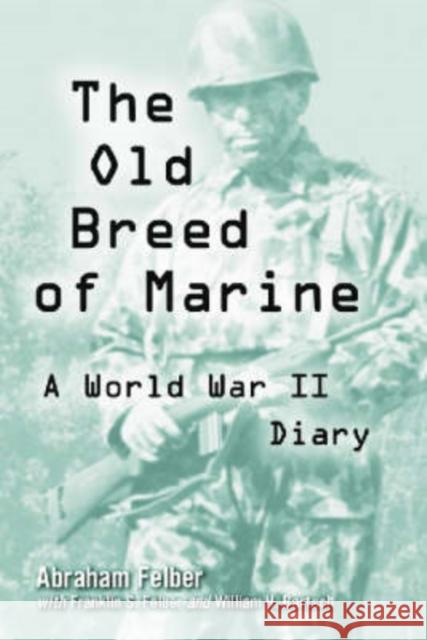
This work is part of the diary that the now 94-year-old Abraham Felber kept during his service in World War II. It begins with January 7, 1941, and ends with December 31, 1945. Felber was a keen observer, and for much of the war it was his job to keep records for his unit. As the 1st Sergeant of Headquarters Battery, 11th Marines, Felber dealt with both officers and enlisted men, which exposed him to the perspectives and insights of both. Felber was also granted the privilege of taking photographs during the Guadalcanal and Cape Gloucester campaigns, some of which are published here for the...
This work is part of the diary that the now 94-year-old Abraham Felber kept during his service in World War II. It begins with January 7, 1941, and en...
During the first three days of the Japanese assault on American Pacific bases in December of 1941, the 24th Pursuit Group, the only unit of interceptor aircraft in the Philippine Islands, was almost destroyed as an effective force. Yet the group's pilots, doomed from the start by their limited training, an inadequate air warning system, and lack of familiarity with the few flyable pursuit aircraft they had left, fought on against immensely superior number of Japanese army and navy fighters.." . . bold drama, with almost novel-like narration. This is good history. . . ." -Daniel R. Mortensen,...
During the first three days of the Japanese assault on American Pacific bases in December of 1941, the 24th Pursuit Group, the only unit of intercepto...
In December 1941, the War Department sent two transports and a freighter carrying 103 P-40 fighters and their pilots to the Philipines to bolster Gen. Douglas MacArthur's Far East Air Force. They were then diverted to Australia, with new orders to ferry the P-40s to the Philippines from Australia through the Dutch East Indies. But on the same day as the second transport reached its destination on January 12, 1942, the first of the key refueling stops in the East Indies fell to rapidly advancing Japanese forces, resulting in a break in their ferry route and another change in their orders. This...
In December 1941, the War Department sent two transports and a freighter carrying 103 P-40 fighters and their pilots to the Philipines to bolster Gen....
Following their rampage through Southeast Asia and the Pacific in the five months after Pearl Harbor, Japanese forces moved into the Solomon Islands, intending to cut off the critical American supply line to Australia. But when they began to construct an airfield on Guadalcanal in July 1942, the Americans captured the almost completed airfield for their own strategic use. The Japanese Army countered by sending to Guadalcanal a reinforced battalion under the command of Col. Kiyonao Ichiki. The attack that followed would prove to be the first of four attempts by the Japanese over six...
Following their rampage through Southeast Asia and the Pacific in the five months after Pearl Harbor, Japanese forces moved into the Solomon Islands, ...