A study of gender in the works of the Nobel Prize author. Thirteen original papers from the annual Faulkner and Yoknapatawpha Conference held in 1994 at the University of Mississippi
A study of gender in the works of the Nobel Prize author. Thirteen original papers from the annual Faulkner and Yoknapatawpha Conference held in 1994 ...
Although he belonged to an American generation of writers deeply influenced by the high modernist revolt -against nature- and against the self-imposed limits of realism to a palpable world, William Faulkner reveals throughout his work an abiding sensitivity to the natural world. He writes of the big woods, of animals, and of the human body as a ground of being that art and culture can neither transcend nor completely control. The eleven essays that make up this volume, including a paper written by the acclaimed novelist William Kennedy, explore the place of -the unbuilt world- in...
Although he belonged to an American generation of writers deeply influenced by the high modernist revolt -against nature- and against the self-imp...
With essays by Richard Godden, Catherine Gunther Kodat, Kathryn B. McKee, Peter Nicolaison, Charles A. Peek, Noel Polk, Hortense J. Spillers, Joseph R. Urgo, Linda Wagner-Martin, and Charles Reagan Wilson
William Faulkner is Mississippi's most famous author and arguably one of the country's greatest writers. But what was his relationship with America? How did he view the nation, its traditions, its issues?
In ten essays from the 1998 Faulkner and Yoknapatawpha Conference, held at the University of Mississippi, Faulkner in America looks closely at the exchange...
With essays by Richard Godden, Catherine Gunther Kodat, Kathryn B. McKee, Peter Nicolaison, Charles A. Peek, Noel Polk, Hortense J. Spillers, Jose...
With essays by Richard Godden, Catherine Gunther Kodat, Kathryn B. McKee, Peter Nicolaison, Charles A. Peek, Noel Polk, Hortense J. Spillers, Joseph R. Urgo, Linda Wagner-Martin, and Charles Reagan Wilson
William Faulkner is Mississippi's most famous author and arguably one of the country's greatest writers. But what was his relationship with America? How did he view the nation, its traditions, its issues?
In ten essays from the 1998 Faulkner and Yoknapatawpha Conference, held at the University of Mississippi, Faulkner in America looks closely at the exchange...
With essays by Richard Godden, Catherine Gunther Kodat, Kathryn B. McKee, Peter Nicolaison, Charles A. Peek, Noel Polk, Hortense J. Spillers, Jose...
There are three wars in the mind and in the art of William Faulkner--the American Civil War, World War I, and World War II. Although he did not fight in any war, he postured as a veteran flyer, for he had enlisted in the Royal Flying Corps in Canada. In his novels, short stories, essays, and letters, war remained a looming subject.
Faulkner and War, a collection of essays from the Faulkner and Yoknapatawpha Conference, held at the University of Mississippi in 2001, explores the role that war played in the life and work of a writer whose...
American Literature -- Literary Criticism
There are three wars in the mind and in the art of William Faulkner--the American Civil War, World War I,...
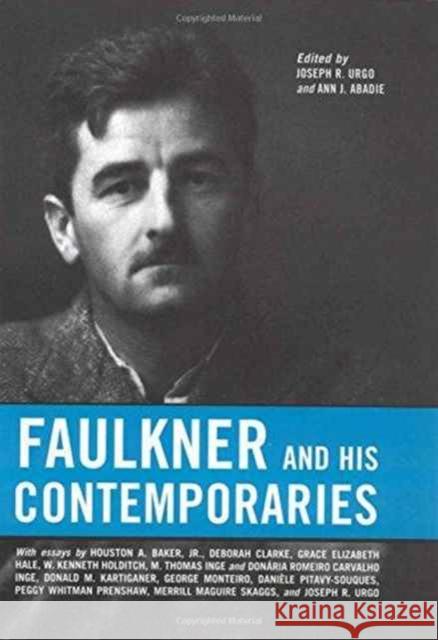
Although he spent the bulk of his life in Oxford, Mississippi-far removed from the intellectual centers of modernism and the writers who created it-William Faulkner (1897-1962) proved to be one of the American novelists who most comprehensively grasped modernism. In his fiction he tested its tenets in the most startling and insightful ways.
What, then, did such contemporaries as Ernest Hemingway, Eudora Welty, and Walker Evans think of his work? How did his times affect and accept what he wrote?
Faulkner and His Contemporaries explores the relationship between the Nobel...
Although he spent the bulk of his life in Oxford, Mississippi-far removed from the intellectual centers of modernism and the writers who created it...
In 1952, Faulkner noted the exceptional nature of the South when he characterized it as -the only really authentic region in the United States, because a deep indestructible bond still exists between man and his environment.-
The essays collected in Faulkner and the Ecology of the South explore Faulkner's environmental imagination, seeking what Ann Fisher-Wirth calls the -ecological counter-melody- of his texts. -Ecology- was not a term in common use outside the sciences in Faulkner's time. However, the word -environment- seems to have held deep meaning for Faulkner. Often he...
In 1952, Faulkner noted the exceptional nature of the South when he characterized it as -the only really authentic region in the United States, bec...
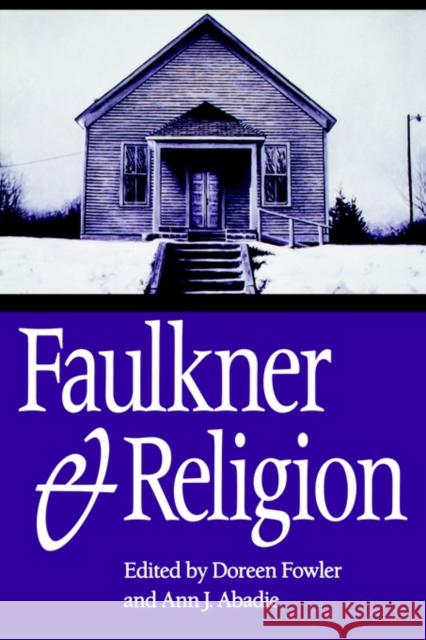
These ten essays from the annual Faulkner and Yoknapatawpha Conference, held in 1989 at the University of Mississippi, explore the religious themes in William Faulkner s fiction. The papers published here conclude that the key to religious meaning in Faulkner may be that his texts focus not so much on God but on a human aspiration of the divine.
These ten essays from the annual Faulkner and Yoknapatawpha Conference, held in 1989 at the University of Mississippi, explore the religious themes in...
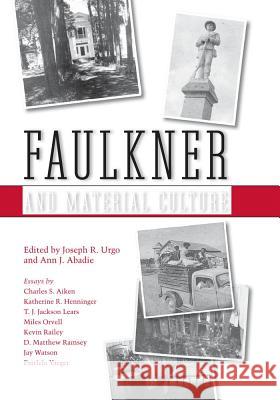
Photographs, lumber, airplanes, hand-hewn coffins--in every William Faulkner novel and short story worldly material abounds. The essays in Faulkner and Material Culture provide a fresh understanding of the things Faulkner brought from the world around him to the one he created.
Charles S. Aiken surveys Faulkner's representation of terrain and concludes, contrary to established criticism, that to Faulkner, Yoknapatawpha was not a microcosm of the South but a very particular and quite specifically located place. Jay Watson works with literary theory, philosophy, the history of...
Photographs, lumber, airplanes, hand-hewn coffins--in every William Faulkner novel and short story worldly material abounds. The essays in Faulk...
Essays by Susan V. Donaldson, Lael Gold, Adam Gussow, Martin Kreiswirth, Jay Parini, Noel Polk, Judith L. Sensibar, Jon Smith, and Priscilla Wald
William Faulkner once said that the writer -collects his material all his life from everything he reads, from everything he listens to, everything he sees, and he stores that away in sort of a filing cabinet . . . in my case it's not anything near as neat as a filing case; it's more like a junk box.- Faulkner tended to be quite casual about his influences. For example, he referred to the South as -not very important to me. I just happen to...
Essays by Susan V. Donaldson, Lael Gold, Adam Gussow, Martin Kreiswirth, Jay Parini, Noel Polk, Judith L. Sensibar, Jon Smith, and Priscilla Wald <...