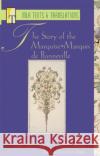
The beautiful Marquise de Banneville meets a handsome marquis, and they fall in love. But the young woman is actually a young man (brought up as a girl and completely in the dark about her--or his--true sex), while the marquis is actually a young woman who likes to cross-dress. Will they live happily ever after?
In the introduction, Joan DeJean presents the fascinating puzzle of authorship of this lighthearted gender-bending tale written in the late seventeenth century in France. Was it Francois-Timoleon de Choisy, an abbot who was happiest in drag? Marie-Jeanne L'Heritier, an...
The beautiful Marquise de Banneville meets a handsome marquis, and they fall in love. But the young woman is actually a young man (brought up as a ...
Through literary works and public appearances, Edith Bruck, born 1932 in Hungary, has devoted her life to bearing witness to what she experienced in the Nazi concentration camps. In 1954 she settled in Rome and is today the most prolific writer of Holocaust narrative in Italian. The book is composed in two parts. "Lettera alla madre"--an imaginary dialogue between Bruck and her mother, who died in Auschwitz--probes the question of self-identity, the pain of loss and displacement, the power of language to help recover the past, and the ultimate impossibility of that recovery. "Tracce," a...
Through literary works and public appearances, Edith Bruck, born 1932 in Hungary, has devoted her life to bearing witness to what she experienced i...
Set in prerevolutionary France, Histoire d'Ernestine tells of the love between an innocent young woman and an aristocrat. Ernestine, German-born and orphaned, is an apprentice painter putting the finishing touches on a portrait when the marquis de Clemengis, elegant and handsome, enters the studio. Recognizing him as the subject of the portrait, she gestures for him to be seated and goes on working, looking back and forth between him and his likeness. The world-weary aristocrat is smitten.
In graceful, understated prose, Marie Riccoboni shows how her heroine learns to...
Set in prerevolutionary France, Histoire d'Ernestine tells of the love between an innocent young woman and an aristocrat. Ernestine, German-...
"The woman poet...must sing, just as birds fly and rivers flow," wrote Carolina Coronado in 1846. In Spain of that time, a group of women had begun to publish poetry. Their verse--Romantic, predominantly lyric, and often linked to liberal reform--was novel and controversial, because few women had ventured into print. The poets collected in this anthology asserted in different ways their imagination and literary voice.
Susan Kirkpatrick provides an overview of the period, and Anna-Marie Aldaz adds a discussion of Spanish versification as well as biographical sketches of the...
"The woman poet...must sing, just as birds fly and rivers flow," wrote Carolina Coronado in 1846. In Spain of that time, a group of women had begun...
Italian poetry of the last century is far from homogeneous: genres and movements have often been at odds with one another, engaging the economic, political, and social tensions of post-Unification Italy. The thirty-eight poets included in this anthology, some of whose poems are translated here for the first time, represent this literary diversity and competition: there are symbolists (Gabriele D'Annunzio), free-verse satirists (Gian Pietro Lucini), hermetic poets (Salvatore Quasimodo), feminist poets (Sibilla Aleramo), twilight poets (Sergio Corazzini), fragmentists (Camillo Sbarbaro), new...
Italian poetry of the last century is far from homogeneous: genres and movements have often been at odds with one another, engaging the economic, p...
Women poets in nineteenth-century France made important contributions to major stylistic innovations--from the birth of elegiac Romanticism to the inauguration of free verse--and many were prominent in their lifetime, yet only a few are known today, and nearly all have been unavailable in English translation. Of the fourteen poets of this anthology some were wealthy, others struggled in poverty; some were socially conventional, others were cynical or defiant. Their poems range widely in style and idea, from Romantic to Parnassian to symbolist.
Women poets in nineteenth-century France made important contributions to major stylistic innovations--from the birth of elegiac Romanticism to the ...
A dugout canoe comes ashore on the island of Saint-Barthelemy in the Antilles; in it are a black man, Arsene, and a sleeping white child, Sarah. Seeking refuge, they are taken in by a good man, but the overseer of his plantation threatens both Arsene and Sarah with the loss of their freedom.
Deborah Jenson and Doris Kadish introduce Sarah, an 1821 novella by Desbordes-Valmore, explaining its autobiographical background, political context (the revolt of blacks against Napoleon's soldiers), and literary genre (sentimentalism). The novella was a precursor to anticolonial and...
A dugout canoe comes ashore on the island of Saint-Barthelemy in the Antilles; in it are a black man, Arsene, and a sleeping white child, Sarah. Se...
A dugout canoe comes ashore on the island of Saint-Barthelemy in the Antilles; in it are a black man, Arsene, and a sleeping white child, Sarah. Seeking refuge, they are taken in by a good man, but the overseer of his plantation threatens both Arsene and Sarah with the loss of their freedom.
Deborah Jenson and Doris Kadish introduce Sarah, an 1821 novella by Desbordes-Valmore, explaining its autobiographical background, political context (the revolt of blacks against Napoleon's soldiers), and literary genre (sentimentalism). The novella was a precursor to anticolonial and...
A dugout canoe comes ashore on the island of Saint-Barthelemy in the Antilles; in it are a black man, Arsene, and a sleeping white child, Sarah. Se...
When Soviet censors approved Mikhail Bulgakov's, a stage adaptation of Don Quixote, they were unaware that they were sanctioning a subtle but powerful criticism of Stalinist rule. The author, whose novel would eventually bring him world renown, achieved this sleight of hand through a deft interpretation of Cervantes's knight. Bulgakov's Don Quixote fits comfortably into the nineteenth-century Russian tradition of idealistic, troubled intellectuals, but Quixote's quest becomes an allegory of the artist under the strictures of Stalin's regime. Bulgakov did not live to see the play...
When Soviet censors approved Mikhail Bulgakov's, a stage adaptation of Don Quixote, they were unaware that they were sanctioning a subtle bu...
When Soviet censors approved Mikhail Bulgakov's stage adaptation of Don Quixote, they were unaware that they were sanctioning a subtle but powerful criticism of Stalinist rule. The author, whose novel The Master and Margarita would eventually bring him world renown, achieved this sleight of hand through a deft interpretation of Cervantes's knight. Bulgakov's Don Quixote fits comfortably into the nineteenth-century Russian tradition of idealistic, troubled intellectuals, but Quixote's quest becomes an allegory of the artist under the strictures of Stalin's regime. Bulgakov did...
When Soviet censors approved Mikhail Bulgakov's stage adaptation of Don Quixote, they were unaware that they were sanctioning a subtle but p...