Kuhn and Feyerabend formulated the problem. Dilworth provides the solution.
In this highly original and insightful book, Craig Dilworth answers all the questions raised by the incommensurability thesis. Logical empiricism cannot account for theory conflict. Popperianism cannot account for how one theory is a progression beyond another. Dilworth s Perspectivist conception of science does both.
While remaining within the bounds of classical philosophy of science, Dilworth does away with the logicism of his competitors. On the Perspectivist view theory conflict is not...
Kuhn and Feyerabend formulated the problem. Dilworth provides the solution.
In this highly original and insightful book, Craig Dilworth answ...
Though with considerable delay, most of the writings of Polish logicians of the inter-war period are now available in English. This is not yet true of Polish philosophy. In the present volume English-speaking readers will fmd, for the first time, a sizeable collection of the articles of one of the most original and distinguished of Poland's philosophers of the present century, Kazimierz Ajdukiewicz (1890-1963). To be sure, Ajdukiewicz was a philosopher-logician from the beginning of his career. His first work of some importance, a monograph entitled From the Methodology of the Deductive...
Though with considerable delay, most of the writings of Polish logicians of the inter-war period are now available in English. This is not yet true of...
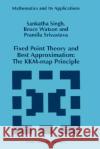
The aim of this volume is to make available to a large audience recent material in nonlinear functional analysis that has not been covered in book format before. Here, several topics of current and growing interest are systematically presented, such as fixed point theory, best approximation, the KKM-map principle, and results related to optimization theory, variational inequalities and complementarity problems. Illustrations of suitable applications are given, the links between results in various fields of research are highlighted, and an up-to-date bibliography is included to assist readers...
The aim of this volume is to make available to a large audience recent material in nonlinear functional analysis that has not been covered in book for...
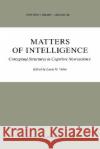
This volume is not an attempt to give a comprehensive treatment of the many facets of intelligence. Rather, the intention is to present multiple approaches to interesting and novel ways of looking at old problems. The focus is on the visual and some of the conceptual intelligences. Vision is man's primary cognitive contact with the world around him, and we are vividly reminded of this by Roman Jakobson's autobiographical note, "The Evasive Initial" with which this volume begins. That we see the world as well as we do is something of a miracle. Looking out through our eyes, our brains give us...
This volume is not an attempt to give a comprehensive treatment of the many facets of intelligence. Rather, the intention is to present multiple appro...
Klemens Szaniawski was born in Warsaw on March 3, 1925. He began to study philosophy in the clandestine Warsaw University during World War II. Tadeusz Kotarbinski, Jan Lukasiewicz, Maria and Stanislaw Ossowskis, Wladyslaw Tatarkiewicz, and Henryk Hii: were among his teachers. Sza niawski was also a member of the Polish Home Army (AK), one of the young est. He was arrested and spent the last period of the war as a prisoner in Auschwitz. After 1945, he continued his studies in the University of L6dz; his Master thesis was devoted to French moral thought of the 17th and 18th cen turies. Then he...
Klemens Szaniawski was born in Warsaw on March 3, 1925. He began to study philosophy in the clandestine Warsaw University during World War II. Tadeusz...
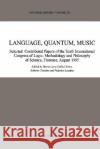
A vivid and comprehensive picture of the current state of research in all directions of logic and philosophy of science. The book presents a wide combination of papers containing relevant technical results in the foundations of science and papers devoted to conceptual analyses, deeply rooted in advanced present-day research. Audience: The volume is attractive both for specialists in foundational questions and scholars interested in general epistemology.
A vivid and comprehensive picture of the current state of research in all directions of logic and philosophy of science. The book presents a wide comb...
Surprisingly, modified versions of the confirmation theory (Carnap and Hempel) and truth approximation theory (Popper) turn out to be smoothly sythesizable. The glue between the two appears to be the instrumentalist methodology, rather than that of the falsificationalist. The instrumentalist methodology, used in the separate, comparative evaluation of theories in terms of their successes and problems (hence, even if already falsified), provides in theory and practice the straight road to short-term empirical progress in science (a la Laudan). It is also argued that...
Surprisingly, modified versions of the confirmation theory (Carnap and Hempel) and truth approximation theory (Popper) turn out to be smoothly sythesi...
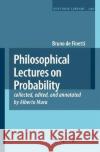
Bruno de Finetti (1906 1985) is the founder of the subjective interpretation of probability, together with the British philosopher Frank Plumpton Ramsey. His related notion of exchangeability revolutionized the statistical methodology. This book (based on a course held in 1979) explains in a language accessible also to non-mathematicians the fundamental tenets and implications of subjectivism, according to which the probability of any well specified fact F refers to the degree of belief actually held by someone, on the ground of her whole knowledge, on the truth of the assertion that F...
Bruno de Finetti (1906 1985) is the founder of the subjective interpretation of probability, together with the British philosopher Frank Plumpton R...
Mathematics has stood as a bridge between the Humanities and the Sciences since the days of classical antiquity. For Plato, mathematics was evidence of Being in the midst of Becoming, garden variety evidence apparent even to small children and the unphilosophical, and therefore of the highest educational significance. In the great central similes of The Republic it is the touchstone ofintelligibility for discourse, and in the Timaeus it provides in an oddly literal sense the framework of nature, insuring the intelligibility ofthe material world. For Descartes, mathematical ideas had a clarity...
Mathematics has stood as a bridge between the Humanities and the Sciences since the days of classical antiquity. For Plato, mathematics was evidence o...