This study of the flowering and the antecedents of the picaresque in 17th century Russia seeks to offer new insight into both the genre and its broad appeal to Russian readers. Morris resurrects 18th century picaresques, revealing their fusion of Western and indigenous aesthetics.
This study of the flowering and the antecedents of the picaresque in 17th century Russia seeks to offer new insight into both the genre and its broad ...
Although little studied in the West, Nikolai Semenovich Leskov (1831-95) is accorded a place among major nineteenth-century writers in his native Russia. Irmhild Christina Sperrle's The Organic Worldview of Nikolai Leskov draws on previously unavailable archival and primary sources to offer English-speaking readers the opportunity to appreciate the work of this neglected author.
Leskov remarked to his contemporary Anatolii Faresov, "People talk about my 'language, ' about its colorfulness and its national traits; about the richness of my plots, about my condensed way of...
Although little studied in the West, Nikolai Semenovich Leskov (1831-95) is accorded a place among major nineteenth-century writers in his native R...
In ""Writing a Usable Past," " Brintlinger considers the interactions of post-Revolutionary Russian and emigre culture with the genre of biography in its various permutations, arguing that in the years after the Revolution, Russian writers looked to the great literary figures of the past to help them construct a post-Revolutionary present. In detailed looks at the biographical writing of Yuri Tynianov, Vladislav Khodasevich, and Mikhail Bulgakov, Brintlinger follows each author's successful biography/ies and their failed attempts at biographies of Alexander Pushkin on the centennial...
In ""Writing a Usable Past," " Brintlinger considers the interactions of post-Revolutionary Russian and emigre culture with the genre of biography ...
A wildly prolific director, actor, and writer, Vasilii Shukshin (1929-74) reached more Soviets in more media than perhaps any other artist in the post-Stalinist USSR. This first English-language study of Shukshin and his work is thus a portrait of the culture of Soviet Russia after Stalin. John Givens begins with Shukshin's position between cultural realms and social strata: his abandoned peasant heritage in Siberia as the son of a purged kulak on the one hand and his life as a successful artist in Moscow on the other. Givens shows how this clash of cultures and identities was both a...
A wildly prolific director, actor, and writer, Vasilii Shukshin (1929-74) reached more Soviets in more media than perhaps any other artist in the p...
Russian life and literature of the nineteenth century abounded with scenes of gambling - nowhere more prominently than in the lives and work of three of Russia's greatest writers: Aleksandr Pushkin, Leo Tolstoy, and Fedor Dostoevsky. Focusing on the intersection of gambling performances in society and in literature, this book reveals the significance of gambling as an index of character in nineteenth-century Russia. During the reigns of Aleksandr I and Nicholas I, Ian Helfant argues, gambling became an essential proving-ground and symbolic locus for noble identity in Russia - a way for the...
Russian life and literature of the nineteenth century abounded with scenes of gambling - nowhere more prominently than in the lives and work of three ...
The evolution of Russian authorship as exemplified by Gogol's social and aesthetic reception from 1829 to 1952.
Nikolai Gogol's claim to the title of national literary classic is incontestable. Since his lifetime, every generation of Russian writers and readers has had to come to terms somehow with his ingeniously suggestive and comically virtuosic art. An exemplar for popular audiences no less than for the intelligentsia, Gogol was pressed into service under the tsarist and Soviet regimes for causes both aesthetic and political, official and unofficial. In Gogol's Afterlife, Stephen...
The evolution of Russian authorship as exemplified by Gogol's social and aesthetic reception from 1829 to 1952.
The essays in this volume seek to appreciate the literary construction of the memoir, with its dual agendas of individualized expression and reliable reportage, and explore its functions as interpretive history, social modelling, and political expression in Russian culture. The memoirs under scrutiny range widely, including those of the private person (Princess Natalia Dolgorukaia), sophisticated high culture writers (Nikolai Zabolotskii, Vladimir Nabokov, Joseph Brodsky), cultural critics and facilitators (Lidiia Ginzburg, Avdot'ia Panaeva), political dissidents (Evgeniia Ginzburg, Elena...
The essays in this volume seek to appreciate the literary construction of the memoir, with its dual agendas of individualized expression and reliable ...
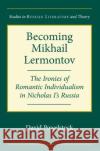
Mikhail Lermontov (1814-1841) is one of Russia's most prominent poets--and one of its most puzzling. In this radically new interpretation, David Powelstock reveals how the seeming contradictions in Lermontov's life and works can be understood as manifestations of a coherent worldview. By bringing to light Lermontov's operative version of Romantic individualism, Powelstock is able to make sense of the poet's relationship to "romantic irony," his highly modern concept of the reader (both real, and implied in the text), and his vexed passion for his predecessor Alexander Pushkin--a...
Mikhail Lermontov (1814-1841) is one of Russia's most prominent poets--and one of its most puzzling. In this radically new interpretation, David Powel...
In an ambitious reinterpretation of the premier work of Russia's national poet, J. Douglas Clayton reads "Boris Godunov" as the expression of Alexander Pushkin's thinking about the Russian state, especially the Russian state of his own time (some two hundred years distant from the events of the play), and even his own place within that state. Here we see how the play marks a sharp break with the Decembrists and Pushkin's own youthful liberalism, signaling its author's emergence as a Russian conservative. "Boris Godunov, " Clayton argues, can be best understood as an ideologically conservative...
In an ambitious reinterpretation of the premier work of Russia's national poet, J. Douglas Clayton reads "Boris Godunov" as the expression of Alexande...
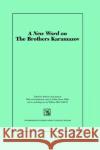
V. S. Pritchett has written of Dostoevsky that he "is still the master because] he moves forward with us as the sense of our danger changes." Nearly a century and a quarter have passed since Dostoevsky's last and greatest novel began to appear in installments in The Russian Herald. The essays in A New Word on "The Brothers Karamazov" show us that Dostoevsky does indeed continue to change with us, and that The Brothers Karamazov is very much a novel of our time. Edited by the nation's most respected senior Dostoevsky scholar, this collection brings together original...
V. S. Pritchett has written of Dostoevsky that he "is still the master because] he moves forward with us as the sense of our danger changes." Nearly ...