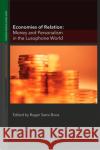
"Money does not bring happiness." For Roberto Da Matta, in Carnivals, Rogues, and Heroes (1979), this saying embodies the ambivalence surrounding money in Brazil, a legacy of a Lusophone cultural tradition that privileges personal relationships over impersonal commodified exchange. This volume of Portuguese Literary and Cultural Studies questions this tradition from the perspective of different disciplines. Does money stand in contrast to personal relations? And, if so, is this really particular to Lusophone or, more widely, Latin cultures--as opposed to, say, Anglo-American cultures or...
"Money does not bring happiness." For Roberto Da Matta, in Carnivals, Rogues, and Heroes (1979), this saying embodies the ambivalence surrounding mone...
In the last few decades, the discipline of literary history has been the subject of intense discussion: from David Perkins's provocative question, Is Literary History Possible?, to the debates generated by the volume of essays, published by Harvard University Press, dedicated to the writing of innovative national literary histories. This latest volume of Portuguese Literary & Cultural Studies reflects on the problem of literary history in the Lusophone world with emphasis on theories of literary history and literary history and empire. In addition to this thematic focus, this special issue...
In the last few decades, the discipline of literary history has been the subject of intense discussion: from David Perkins's provocative question, Is ...
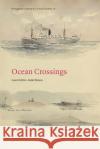
From 1550 until 1850 most of Brazil and Angola formed a system sustained by the slave trade and inter-colonial traffic that complemented, albeit often contradictorily, exchanges between these regions and Portugal. Merchants, militiamen, royal servants and missionaries fostered relations between Portuguese enclaves on either side of the ocean. However, these exchanges were interrupted by the end of the Brazilian slave trade in 1850. Nevertheless, after the independence of the Lusophone nations in Africa, direct communications and relationships were reestablished between the two sides of the...
From 1550 until 1850 most of Brazil and Angola formed a system sustained by the slave trade and inter-colonial traffic that complemented, albeit often...
With Pessoa's digitized private library online, the importance of English to Pessoa has become indisputable, particularly in his formative years: numerous English authors served as the bedrock from which his poetic sensibility emerged, developed and soared. In fact, a significant amount of Pessoa's writings in English and in Portuguese (including those attributed to his heteronyms and/or to other literary personae) were greatly informed by these (his) original sources. Fernando Pessoa as English Reader and Writer provides ample evidence of his fruitful, lifelong relationship with the English...
With Pessoa's digitized private library online, the importance of English to Pessoa has become indisputable, particularly in his formative years: nume...