The family register holds a distinctive place in American visual culture. Used to record marriages and offspring within a family through several generations, the family register also incorporates hand-illuminated decorative art. To the Latest Posterity is the first major study to explore the colorful world of Pennsylvania German family registers and their place in American social, religious, and cultural traditions.
Renowned authorities on fraktur, Russell and Corinne Earnest trace the evolution of decorative family registers from their roots in medieval European illuminated...
The family register holds a distinctive place in American visual culture. Used to record marriages and offspring within a family through several ge...
Co-published with the Library Company of Philadelphia and the Pennsylvania German Society
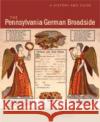
Fifteenth-century Germany was the birthplace of movable type and of one of its powerful consequences, the broadside. These mass-produced printed sheets allowed both the Renaissance and the Reformation to spread with previously unimaginable speed, and when German immigrants made their way to North America, the cultural significance of the broadside followed. Don Yoder's The Pennsylvania German Broadside examines the history and legacy of these printed sheets within the Pennsylvania...
Co-published with the Library Company of Philadelphia and the Pennsylvania German Society
Fifteenth-century Germany was the birthplace of mo...
On a May Sunday in 1927, progress and tradition collided at the Groffdale Old Order Mennonite Church in eastern Pennsylvania when half the congregation shunned the cup of wine offered by Bishop Moses Horning. The boycott of this holiest of Mennonite customs was in direct response to Horning's decision to endorse the automobile after years of debate within the church. The resulting schism over opposing views of technology produced the group known as the Wenger Mennonites.
In the nearly eighty years since the establishment of this church, the initial group of fifty dissenters has...
On a May Sunday in 1927, progress and tradition collided at the Groffdale Old Order Mennonite Church in eastern Pennsylvania when half the congrega...
On a May Sunday in 1927, progress and tradition collided at the Groffdale Old Order Mennonite Church in eastern Pennsylvania when half the congregation shunned the cup of wine offered by Bishop Moses Horning. The boycott of this holiest of Mennonite customs was in direct response to Horning's decision to endorse the automobile after years of debate within the church. The resulting schism over opposing views of technology produced the group known as the Wenger Mennonites.
In the nearly eighty years since the establishment of this church, the initial group of fifty dissenters has...
On a May Sunday in 1927, progress and tradition collided at the Groffdale Old Order Mennonite Church in eastern Pennsylvania when half the congrega...
How did a mid-eighteenth-century group, the so-called Pennsylvania Germans, build their cultural identity in the face of ethnic stereotyping, nostalgic ideals, and the views imposed by outside contemporaries? Numerous forces create a group's identity, including the views of outsiders, insiders, and the shaping pressure of religious beliefs, but to understand the process better, we must look to clues from material culture.
Cynthia Falk explores the relationship between ethnicity and the buildings, personal belongings, and other cultural artifacts of early Pennsylvania German...
How did a mid-eighteenth-century group, the so-called Pennsylvania Germans, build their cultural identity in the face of ethnic stereotyping, nosta...
At the turn of the twentieth century, American popular literary magazines and journals pulsed with local-color fiction, seeking to satisfy a national hunger for American identity. Anxiety over increasing numbers of "new stock" immigrants--and the changing face of an industrializing America--gave rise to greater popular interest in stories with a simple focus on localized folk culture and "old stock" immigrant tradition. In the footsteps of writers like Harriet Beecher Stowe and Sarah Orne Jewett, the Pennsylvania German writings of Elsie Singmaster emerged to great popularity and acclaim....
At the turn of the twentieth century, American popular literary magazines and journals pulsed with local-color fiction, seeking to satisfy a nation...
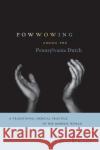
Known in Pennsylvania Dutch as Brauche or Braucherei, the folk-healing practice of powwowing was thought to draw upon the power of God to heal all manner of physical and spiritual ills. Yet some people believed--and still believe today--that this power to heal came not from God, but from the devil. Controversy over powwowing came to a climax in 1929 with the York Hex Murder Trial, in which one powwower killed another who, he believed, had placed a hex on him.
Based on seven years of fieldwork and extensive interviews, David Kriebel's study reveals the vibrant world,...
Known in Pennsylvania Dutch as Brauche or Braucherei, the folk-healing practice of powwowing was thought to draw upon the power o...