Detroit is the world capital of the coney island hot dog-a natural-casing hot dog topped with an all-meat beanless chili, chopped white onions, and yellow mustard. In Coney Detroit, authors Katherine Yung and Joe Grimm investigate all aspects of the beloved regional delicacy, which was created by Greek immigrants in the early 1900s. "Coney Detroit" traces the history of the coney island restaurant, which existed in many cities but thrived nowhere as it did in Detroit, and surveys many of the hundreds of independent and chain restaurants in business today. In more than 150 mouth-watering...
Detroit is the world capital of the coney island hot dog-a natural-casing hot dog topped with an all-meat beanless chili, chopped white onions, and...
In the three decades between 1920 and 1950, the Detroit Tigers won four American League pennants, the first world championship in team history in 1935, and a second world crown ten years later. Star players of this era-including Ty Cobb, Harry Heilmann, Charlie Gehringer, Hank Greenberg, Mickey Cochrane, George Kell, and Hal Newhouser-represent the majority of Tigers players inducted into the Hall of Fame. Sports writers followed the team feverishly, and fans packed Navin Field (later Briggs Stadium) to cheer on the high-flying Tigers, with the first record season attendance of one million...
In the three decades between 1920 and 1950, the Detroit Tigers won four American League pennants, the first world championship in team history in 1...
In Detroit's Historic Places of Worship, authors Marla O. Collum, Barbara E. Krueger, and Dorothy Kostuch profile 37 architecturally and historically significant houses of worship that represent 8 denominations and nearly 150 years of history. The authors focus on Detroit's most prolific era of church building, the 1850s to the 1930s, in chapters that are arranged chronologically. Entries begin with each building's founding congregation and trace developments and changes to the present day. Full-color photos by Dirk Bakker bring the interiors and exteriors of these amazing buildings...
In Detroit's Historic Places of Worship, authors Marla O. Collum, Barbara E. Krueger, and Dorothy Kostuch profile 37 architecturally and his...
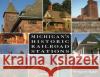
When the railroad revolutionized passenger travel in the nineteenth century, architects were forced to create from scratch a building to accommodate the train's sudden centrality in social and civic life. The resulting depots, particularly those built in the glory days from 1890 to 1925, epitomize the era's optimism and serve as physical anchors to both the past and the surrounding urban fabric. In "Michigan's Historic Railroad Stations" writer and photographer Michael H. Hodges presents depots ranging from functioning Amtrak stops (Jackson) to converted office buildings (Battle Creek) and...
When the railroad revolutionized passenger travel in the nineteenth century, architects were forced to create from scratch a building to accommodat...
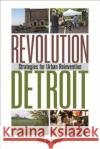
After decades of suburban sprawl, job loss, and lack of regional government, Detroit has become a symbol of post-industrial distress and also one of the most complex urban environments in the world. In Revolution Detroit: Strategies for Urban Reinvention, John Gallagher argues that Detroit's experience can offer valuable lessons to other cities that are, or will soon be, dealing with the same broken municipal model. A follow-up to his award-winning 2010 work, Reimagining Detroit, this volume looks at Detroit's successes and failures in confronting its considerable...
After decades of suburban sprawl, job loss, and lack of regional government, Detroit has become a symbol of post-industrial distress and also one o...
In the late nineteenth century and early twentieth century, the look and feel of cemeteries in the United States changed dramatically, from utilitarian burial grounds to the serene parklike spaces that we know today. The so-called park cemetery was innovative not only for its distinctive landscape architecture but also because its staff designed, ran, and maintained the cemetery, which led to a very consistent appearance. By the mid-1800s, the influence of park cemeteries began to spread from big cities on the East Coast to the Midwest-eventually producing fifteen transitional examples in...
In the late nineteenth century and early twentieth century, the look and feel of cemeteries in the United States changed dramatically, from utilita...
Although his best-known project was the World Trade Center in New York City, Japanese American architect Minoru Yamasaki (1912-1986) worked to create moments of surprise, serenity, and delight in distinctive buildings around the world. In his adopted home of Detroit, where he lived and worked for the last half of his life, Yamasaki produced many important designs that range from public buildings to offices and private residences. In Yamasaki in Detroit: A Search for Serenity, author John Gallagher presents both a biography of Yamasaki-or Yama as he was known-and an examination of...
Although his best-known project was the World Trade Center in New York City, Japanese American architect Minoru Yamasaki (1912-1986) worked to crea...
After several years as a small-town lawyer in Alpena, Frank J. Kelley was unexpectedly appointed Michigan's attorney general at the end of 1961. He never suspected that he would continue to serve until 1999, a national record. During that time, he worked with everyone from John and Bobby Kennedy to Bill Clinton and jump-started the careers of dozens of politicians and public figures, including U.S. Senator Carl Levin and Governors James Blanchard and Jennifer Granholm. In "The People's Lawyer: The Life and Times of Frank J. Kelley, the Nation's Longest-Serving Attorney General, " Kelley...
After several years as a small-town lawyer in Alpena, Frank J. Kelley was unexpectedly appointed Michigan's attorney general at the end of 1961. He...
Since 1887, Detroit's Eastern Market, the largest open-air market of its kind in the United States, has been home to an amazing community of farmers, merchants, and food lovers. Specialty shops, bakeries, spice companies, meat and poultry markets, restaurants, jazz cafEs, old-time saloons, produce firms, gourmet shops, and cold-storage warehouses cover Eastern Market's three square miles. Its many streets and vendors reflect the varied cultures and ethnicities that have shaped the city of Detroit.
In this third edition of Detroit's Eastern Market, authors Lois Johnson...
Since 1887, Detroit's Eastern Market, the largest open-air market of its kind in the United States, has been home to an amazing community of farmer...