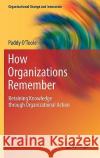
How an organization works is largely a function of what it knows-i.e., the collective knowledge about all aspects of the enterprise, from competitive intelligence to formal systems and policies to the ways in which individuals solve problems and share their expertise. Organizational knowledge is not to be found in manuals and web sites, but in the day-to-day interactions among employees, suppliers, customers, investors, and other stakeholders. How Organizations Remember is based on a 10-month study of a technology firm with locations in three countries (Australia, US, and Ireland); the...
How an organization works is largely a function of what it knows-i.e., the collective knowledge about all aspects of the enterprise, from competitive ...
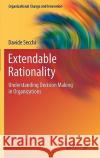
"How do people make decisions in organizations?" is the question at the core of this book. Do people act rationally? Under what conditions can information and knowledge be shared to improve decision making? Davide Secchi applies concepts and theories from cognitive science, organizational behavior, and social psychology to explore the dynamics of decision making. In particular, he integrates "bounded rationality" (people are only partly rational; they have (a) limited computational capabilities and (b) limited access to information) and "distributed cognition" (knowledge is not confined to an...
"How do people make decisions in organizations?" is the question at the core of this book. Do people act rationally? Under what conditions can informa...
"How do people make decisions in organizations?" is the question at the core of this book. Do people act rationally? Under what conditions can information and knowledge be shared to improve decision making? Davide Secchi applies concepts and theories from cognitive science, organizational behavior, and social psychology to explore the dynamics of decision making. In particular, he integrates "bounded rationality" (people are only partly rational; they have (a) limited computational capabilities and (b) limited access to information) and "distributed cognition" (knowledge is not confined to an...
"How do people make decisions in organizations?" is the question at the core of this book. Do people act rationally? Under what conditions can informa...
How an organization works is largely a function of what it knows-i.e., the collective knowledge about all aspects of the enterprise, from competitive intelligence to formal systems and policies to the ways in which individuals solve problems and share their expertise. Organizational knowledge is not to be found in manuals and web sites, but in the day-to-day interactions among employees, suppliers, customers, investors, and other stakeholders. How Organizations Remember is based on a 10-month study of a technology firm with locations in three countries (Australia, US, and Ireland); the...
How an organization works is largely a function of what it knows-i.e., the collective knowledge about all aspects of the enterprise, from competitive ...