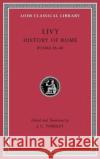
Livy (Titus Livius, 64 or 59 BC AD 12 or 17), the Roman historian, presents a vivid narrative of Rome's rise from the traditional foundation of the city in 753 or 751 BC to 9 BC and illustrates the virtues necessary to achieve such greatness. The books of the fourth decad (31 40) focus on Rome's growing hegemony in the East in the years 200 180.
Livy (Titus Livius, 64 or 59 BC AD 12 or 17), the Roman historian, presents a vivid narrative of Rome's rise from the traditional foundation of the ci...
Galen of Pergamum (129-?199/216), physician to the court of the emperor Marcus Aurelius, was a philosopher, scientist, medical historian, theoretician, and practitioner who wrote forcefully and prolifically on an astonishing range of subjects and whose impact on later eras rivaled that of Aristotle. Galen synthesized the entirety of Greek medicine as a basis for his own doctrines and practice, which comprehensively embraced theory, practical knowledge, experiment, logic, and a deep understanding of human life and society.
His treatise Hygiene, also known as "On the...
Galen of Pergamum (129-?199/216), physician to the court of the emperor Marcus Aurelius, was a philosopher, scientist, medical historian, theoretic...
Galen of Pergamum (129-?199/216), physician to the court of the emperor Marcus Aurelius, was a philosopher, scientist, medical historian, theoretician, and practitioner who wrote forcefully and prolifically on an astonishing range of subjects and whose impact on later eras rivaled that of Aristotle. Galen synthesized the entirety of Greek medicine as a basis for his own doctrines and practice, which comprehensively embraced theory, practical knowledge, experiment, logic, and a deep understanding of human life and society.
His treatise Hygiene, also known as "On the...
Galen of Pergamum (129-?199/216), physician to the court of the emperor Marcus Aurelius, was a philosopher, scientist, medical historian, theoretic...
Quintus Ennius (239 169), widely regarded as the father of Roman literature, was instrumental in creating a new Roman literary identity, domesticating the Greek forms of epic and drama, and pursuing a range of other literary and intellectual pursuits. He inspired major developments in Roman religion, social organization, and popular culture.
Quintus Ennius (239 169), widely regarded as the father of Roman literature, was instrumental in creating a new Roman literary identity, domesticating...
Quintus Ennius (239 169), widely regarded as the father of Roman literature, was instrumental in creating a new Roman literary identity, domesticating the Greek forms of epic and drama, and pursuing a range of other literary and intellectual pursuits. He inspired major developments in Roman religion, social organization, and popular culture.
Quintus Ennius (239 169), widely regarded as the father of Roman literature, was instrumental in creating a new Roman literary identity, domesticating...
Albert's Anthology comprises 76 brief and informal reflections on a line or two of Greek or Latin poetry--and a few prose quotations and artistic objects--composed by colleagues and students of Albert Henrichs on the occasion of his retirement in Spring 2017. Appointed Professor of Greek and Latin at Harvard University at the age of thirty in 1973 and Eliot Professor of Greek in 1984, Professor Henrichs has devoted his scholarly career to Greek literature and religion--especially his favorite Greek god, Dionysos--and to incomparably enthusiastic teaching of countless students at both...
Albert's Anthology comprises 76 brief and informal reflections on a line or two of Greek or Latin poetry--and a few prose quotations and artist...
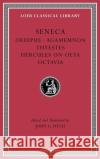
Seneca (ca. AD 4 65) authored verse tragedies that strongly influenced Shakespeare and other Renaissance dramatists. Plots are based on myth, but themes reflect imperial Roman politics. John G. Fitch has thoroughly revised his two-volume edition to take account of scholarship that has appeared since its initial publication.
Seneca (ca. AD 4 65) authored verse tragedies that strongly influenced Shakespeare and other Renaissance dramatists. Plots are based on myth, but them...
Seneca (ca. AD 4 65) authored verse tragedies that strongly influenced Shakespeare and other Renaissance dramatists. Plots are based on myth, but themes reflect imperial Roman politics. John G. Fitch has thoroughly revised his two-volume edition to take account of scholarship that has appeared since its initial publication.
Seneca (ca. AD 4 65) authored verse tragedies that strongly influenced Shakespeare and other Renaissance dramatists. Plots are based on myth, but them...
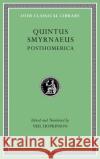
Quintus Smyrnaeus' Posthomerica, composed between the late second and mid-fourth centuries AD, boldly adapts Homeric diction and style to fill in the story of the Trojan expedition between the end of the Iliad and the beginning of the Odyssey. This edition replaces the earlier Loeb Classical Library edition by A. S. Way (1913).
Quintus Smyrnaeus' Posthomerica, composed between the late second and mid-fourth centuries AD, boldly adapts Homeric diction and style to fill in the ...