Most cultures ostracize people who do not fit within their norms. They pressure abnormal people to change their appearance, fix what bothers other, or stay out of sight--a pressure Leslie Fiedler has named "The Tyranny of the Normal." This anthology examines the experiences of those who live outside social norms for attractiveness, size, and shape; it also explores the reactions of "normal" people to those who seem grotesque. Among the questions raised are who decided what is normal and abnormal; who has the right or authority to decide what efforts, if any, should be made to normalize...
Most cultures ostracize people who do not fit within their norms. They pressure abnormal people to change their appearance, fix what bothers other, or...
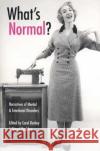
What's Normal?, examines the issues of "abnormalities" in mental health, intelligence, and sexual behavior.
The first section of What's Normal? presents a wide-ranging collection of essays and articles written by renowned clinicians who address clinical, ethical, and social issues related to mental illness and disorders. The second section uses fiction, poetry, and drama to portray mental and behavioral abnormalities, sometimes from "inside" the perspective of the deviant and sometimes from the experiences of family, friends, and other engaged observers. Excerpts...
What's Normal?, examines the issues of "abnormalities" in mental health, intelligence, and sexual behavior.
Carol Donley & Martin Kohn believe that "physicians stand at a unique vantage point as observers of the human condition." In Recognitions: Doctors and Their Stories, the fourth volume in the Literature and Medicine Series, contributors such as Richard Selzer, Robert Coles, Perri Klass, and Jack Coulehan prove this assertion through their moving and enlightening prose.
Carol Donley & Martin Kohn believe that "physicians stand at a unique vantage point as observers of the human condition." In Recognitions: Doctors and...
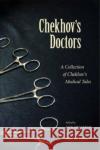
In his brief but distinguished life, Anton Chekhov was a doctor, a documentary essayist, an admired dramatist, and a humanitarian. He remains a nineteenth-century Russian literary giant whose prose continues to offer moral insight and to resonate with readers across the world.
Chekhov experienced no conflict between art and science or art and medicine. He believed that knowledge of one complemented the other. Chekhov brought medical knowledge and sensitivity to his creative writing--he had an intimate knowledge of the world of medicine and the skills of doctoring, and he utilized...
In his brief but distinguished life, Anton Chekhov was a doctor, a documentary essayist, an admired dramatist, and a humanitarian. He remains a nin...
"I approached the study of historical and contemporary nurses with my sleeves rolled up, pencil sharpened, and camera loaded. What draws a person to those who are ill and keeps us at the bedside? Every question I asked the nurses, I asked myself. Heart first, I plunged into stories about historical nurses whose names I had never heard. Somehow, they chose me as the vehicle for retelling their remarkable story. As I conducted interview after interview, I found threads of sameness in the the lives of my nurses. In childhood, illness and often death was a member of their family. They had...
"I approached the study of historical and contemporary nurses with my sleeves rolled up, pencil sharpened, and camera loaded. What draws a person t...
So much written about literature and medicine has been from the perspective of physicians. But in the last few years nurses have found their voices and are making important contributions to the field of biomedical and nursing humanities. These men and women professionals see different things and experience patients and health care issues in different contexts.
Judy Schaefer has compiled this anthology of contemporary nurse-poets' work, which is accompanied by their commentaries about their poetry, their work, and their lives. She has gathered contributions from some of the...
So much written about literature and medicine has been from the perspective of physicians. But in the last few years nurses have found their voices...
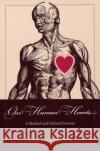
Reflections on the cultural and biomedical understandings of the human heart
"Humans from ancient times have interpreted the heart in many ways: as the home of the soul, the seat of love, the place of wisdom and justice, the symbol of our vitality. No other human organ has had as many meanings attached to it." --from the Introduction
Our Human Hearts is a nonfiction exploration of the meanings of the human heart as interpreted by two traditions: medical science, which has made possible dramatic cardiac surgery and sophisticated drug treatments, and the much...
Reflections on the cultural and biomedical understandings of the human heart
"Humans from ancient times have interpreted the heart ...
"Plunging into one of Jay Baruch's stories is like finding yourself in a busy Emergency Room at two in the morning--here you will meet characters whose lives are urgent and not always what they seem on the surface. Like his characters, Baruch's writing is vibrant and intense, and his vision is prismatic. He speaks in many voices, among them doctor, patient, family member, medical student, and even ER janitor, and so examines the world of health and illness from many points of view. I appreciate the way Baruch acknowledges the complexity of life, and then dissects it for us into so many...
"Plunging into one of Jay Baruch's stories is like finding yourself in a busy Emergency Room at two in the morning--here you will meet characters w...
A revealing perspective on how Emily Dickinson helps readers cope with suffering
Emily Dickinson is known as a poet who presses at the limits of perception and expresses in brilliantly compact, memorable language extremes of both anguish and ecstasy. Her frequent attention to pain and death, like her reclusive tendencies, has led many to dismiss her as "morbid." Biographers and critics, however, have shown how she used her writing and her own acquaintance with pain to reach out consolingly to sufferers. In a widely varied collection of personal reminiscences,...
A revealing perspective on how Emily Dickinson helps readers cope with suffering
Dramatic pieces that raise issues of humanity in medicine
Bodies and Barriers offers a collection of dramatic pieces of our time that provide an aesthetic perspective from which we view today's vital health issues. With each play exploring a different medical crisis, the collection covers a range of issues common to a diverse population, irrespective of gender or race. Included are works examining how individuals confront the challenges posed by physical disability, aging, and terminal illness. These plays take as their subject the human form and its...
Dramatic pieces that raise issues of humanity in medicine
Bodies and Barriers offers a collection of dramatic piec...