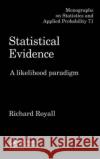
Interpreting statistical data as evidence, Statistical Evidence: A Likelihood Paradigm focuses on the law of likelihood, fundamental to solving many of the problems associated with interpreting data in this way. Statistics has long neglected this principle, resulting in a seriously defective methodology. This book redresses the balance, explaining why science has clung to a defective methodology despite its well-known defects. After examining the strengths and weaknesses of the work of Neyman and Pearson and the Fisher paradigm, the author proposes an alternative paradigm which provides, in...
Interpreting statistical data as evidence, Statistical Evidence: A Likelihood Paradigm focuses on the law of likelihood, fundamental to solving many o...
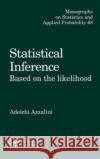
The Likelihood plays a key role in both introducing general notions of statistical theory, and in developing specific methods. This book introduces likelihood-based statistical theory and related methods from a classical viewpoint, and demonstrates how the main body of currently used statistical techniques can be generated from a few key concepts, in particular the likelihood.Focusing on those methods, which have both a solid theoretical background and practical relevance, the author gives formal justification of the methods used and provides numerical examples with real data.
The Likelihood plays a key role in both introducing general notions of statistical theory, and in developing specific methods. This book introduces li...
This book provides a general framework for learning sparse graphical models with conditional independence tests. It includes complete treatments for Gaussian, Poisson, multinomial, and mixed data; unified treatments for covariate adjustments, data integration, and network comparison.
This book provides a general framework for learning sparse graphical models with conditional independence tests. It includes complete treatments for G...
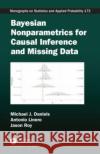
Bayesian Nonparametric Methods for Missing Data and Causal Inference provides an overview of flexible Bayesian nonparametric (BNP) methods for modeling joint or conditional distributions and functional relationships, and their interplay with causal inference and missing data. This book emphasizes the importance of making untestable assumptions to identify estimands of interest, such as missing at random assumption for missing data and unconfoundedness for causal inference in observational studies. The BNP approach can account for possible violations of assumptions and minimize concerns about...
Bayesian Nonparametric Methods for Missing Data and Causal Inference provides an overview of flexible Bayesian nonparametric (BNP) methods for modelin...