How can the life of one relatively unknown man change our understanding of Texas history and the American West? Peter Ellis Bean, a fairly minor but fascinating character, casts unexpected light on conflicts, famous characters, and events from the time of Mexican rule through the years of the Republic. Bean's role in Mexico's revolution against Spain and his service as an agent of the Mexican government, especially as Indian agent in eastern Texas, provide an unusually vivid picture of Mexican Texas, as well as new information about the Indians in his region. More explosively, Jackson's...
How can the life of one relatively unknown man change our understanding of Texas history and the American West? Peter Ellis Bean, a fairly minor but f...
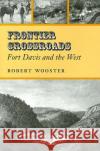
The idea of the West conjures exciting images of tenacious men and women, huge expanses of unclaimed territory, and feelings of both adventure and lonesome isolation. Located astride communication lines linking San Antonio, El Paso, Presidio, and Chihuahua City, the United States Army's post at Fort Davis commanded a strategic position at a military, cultural, and economic crossroads of nineteenth-century Texas. Using extensive research and careful scrutiny of long forgotten records, Robert Wooster brings his readers into the world of Fort Davis, a place of encounter, conquest, and...
The idea of the West conjures exciting images of tenacious men and women, huge expanses of unclaimed territory, and feelings of both adventure and ...
In 1863 the Union capture of Texas was viewed as crucial to the strategy to deny the Confederacy the territory west of the Mississippi and thus to break the back of Southern military force. Overland, Texas supplied Louisiana and points east with needed goods; by way of Mexico, Texas offered a detour around the blockade of Southern ports and thus an economic link to England and France. But Union forces had no good base from which to interdict either part of the Texas trade. Their efforts were characterized by short, unsuccessful forays, primarily in East and South Texas. One of these,...
In 1863 the Union capture of Texas was viewed as crucial to the strategy to deny the Confederacy the territory west of the Mississippi and thus to bre...
If president Lincoln could have unmade a general, perhaps he would have started with Samuel Peter "Sourdough" Heintzelman, whose early military successes were overshadowed by repeated Union defeats in the Civil War and his own argumentative nature. Perhaps this personality was the reason Heintzelman once said, "I have no hesitation in leaving my reputation . . . in the hands of the future historian" (Washington Daily National Intelligencer August 9, 1865). On the other hand, perhaps his hindsight told him that his was a life worth studying. By the time his friend Robert E. Lee left Arlington...
If president Lincoln could have unmade a general, perhaps he would have started with Samuel Peter "Sourdough" Heintzelman, whose early military succes...
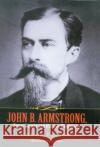
"Texas, by God " cried notorious killer John Wesley Hardin when he saw a Colt .45 pointed at him on a train in Florida. At the other end of the pistol stood Texas Ranger John B. Armstrong. Hardin's arrest assured Armstrong a place in history, but his story is larger, fuller, and even more important--and until now it has never been told. Serving in the Rangers' famed Frontier Battalion from 1875 to 1878, Armstrong rode with Captain L. H. McNelly in the capture of King Fisher, was called to Round Rock when Sam Bass was cornered, and helped patrol the region caught in the Taylor-Sutton...
"Texas, by God " cried notorious killer John Wesley Hardin when he saw a Colt .45 pointed at him on a train in Florida. At the other end of the pistol...
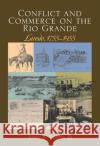
Laredo is a city at the crossroads of North American history. Founded by the Spanish in 1755, it has stood at the intersection of regional commerce since its earliest days. Now, John A. Adams, Jr. provides the first-ever panoramic business and economic history of Laredo. He traces the evolution of the region from its early days as a ranching center into the mid-twentieth century, when Laredo had become what it remains today: a booming port of trade and a principal center of commerce and financial services on the southern border of the United States. In Commerce and Conflict on the Rio...
Laredo is a city at the crossroads of North American history. Founded by the Spanish in 1755, it has stood at the intersection of regional commerce si...
Ward Loren Schrantz, of Carthage, Missouri, entered the U.S. Army in 1912, at a time when military leaders were still seriously debating the future of the horse cavalry. He left active military service in 1946, after the United States dropped the atomic bomb on Japan. Schrantz served capably at a time when the U.S. military was undergoing rapid technological and strategic transformation and, as a journalist and attentive observer, left a vivid personal account of his time in the Army and Missouri National Guard. Editor Jeff Patrick has woven three undated versions of Schrantz's memoir into a...
Ward Loren Schrantz, of Carthage, Missouri, entered the U.S. Army in 1912, at a time when military leaders were still seriously debating the future of...
In 1849, a young German bride and her husband stepped off a ship in Corpus Christi Bay to establish their home in the new frontier settlement. For the next three decades Maria von Blucher wrote letters home describing the hardships of droughts and Indian and bandit raids, the chaos of the American Civil War, the discomforts of pioneer living, the joys and heartbreaks of family life, and the development of a town that her descendants would help to build into a thriving city. Her letters record above all the woman's side of pioneer life. Although they offer insight into political events and...
In 1849, a young German bride and her husband stepped off a ship in Corpus Christi Bay to establish their home in the new frontier settlement. For the...
"Texas, by God " cried notorious killer John Wesley Hardin when he saw a Colt .45 pointed at him on a train in Florida. At the other end of the pistol stood Texas Ranger John B. Armstrong. Hardin's arrest assured Armstrong a place in history, but his story is larger, fuller, and even more important-and until now it has never been told. As Elmer Kelton notes in his afterword to this book, "Chuck Parsons's biography is a long-delayed and much-justified tribute to Armstrong's service to Texas." Parsons fills in the missing details of a Ranger and rancher's life, correcting some common...
"Texas, by God " cried notorious killer John Wesley Hardin when he saw a Colt .45 pointed at him on a train in Florida. At the other end of the pistol...