• Wyszukiwanie zaawansowane
  • Kategorie
  • Kategorie BISAC
  • Książki na zamówienie
  • Promocje
  • Granty
  • Książka na prezent
  • Opinie
  • Pomoc
  • Załóż konto
  • Zaloguj się

Dynamic Network Representation Based on Latent Factorization of Tensors » książka


zaloguj się | załóż konto
Logo Krainaksiazek.pl

koszyk

konto

szukaj
topmenu
Księgarnia internetowa
Szukaj
Książki na zamówienie
Promocje
Granty
Książka na prezent
Moje konto
Pomoc
 
 
Wyszukiwanie zaawansowane
Pusty koszyk
Bezpłatna dostawa dla zamówień powyżej 20 złBezpłatna dostawa dla zamówień powyżej 20 zł

Kategorie główne

• Nauka
 [2952079]
• Literatura piękna
 [1850969]

  więcej...
• Turystyka
 [71058]
• Informatyka
 [151066]
• Komiksy
 [35579]
• Encyklopedie
 [23181]
• Dziecięca
 [620496]
• Hobby
 [139036]
• AudioBooki
 [1646]
• Literatura faktu
 [228729]
• Muzyka CD
 [379]
• Słowniki
 [2932]
• Inne
 [445708]
• Kalendarze
 [1409]
• Podręczniki
 [164793]
• Poradniki
 [480107]
• Religia
 [510956]
• Czasopisma
 [511]
• Sport
 [61267]
• Sztuka
 [243299]
• CD, DVD, Video
 [3411]
• Technologie
 [219640]
• Zdrowie
 [100984]
• Książkowe Klimaty
 [124]
• Zabawki
 [2281]
• Puzzle, gry
 [3363]
• Literatura w języku ukraińskim
 [258]
• Art. papiernicze i szkolne
 [8020]
Kategorie szczegółowe BISAC

Dynamic Network Representation Based on Latent Factorization of Tensors

ISBN-13: 9789811989339 / Angielski / Miękka / 2023 / 98 str.
Hao Wu; Xuke Wu; Xin Luo
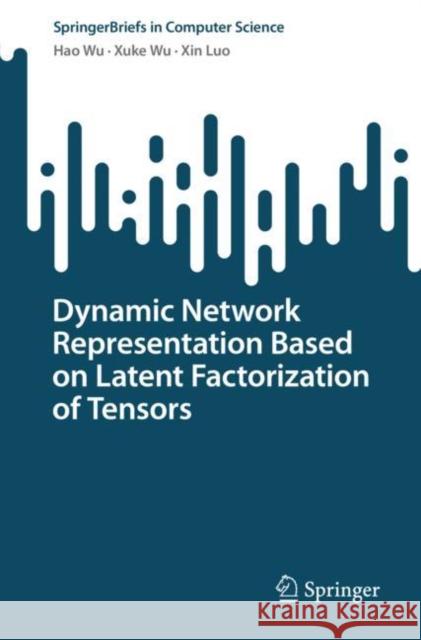
Dynamic Network Representation Based on Latent Factorization of Tensors Hao Wu Xuke Wu Xin Luo 9789811989339 Springer - książkaWidoczna okładka, to zdjęcie poglądowe, a rzeczywista szata graficzna może różnić się od prezentowanej.

Dynamic Network Representation Based on Latent Factorization of Tensors

ISBN-13: 9789811989339 / Angielski / Miękka / 2023 / 98 str.

Hao Wu; Xuke Wu; Xin Luo
cena 201,24
(netto: 191,66 VAT:  5%)

Najniższa cena z 30 dni: 192,74
Termin realizacji zamówienia:
ok. 22 dni roboczych.

Darmowa dostawa!

A dynamic network is frequently encountered in various real industrial applications, such as the Internet of Things. It is composed of numerous nodes and large-scale dynamic real-time interactions among them, where each node indicates a specified entity, each directed link indicates a real-time interaction, and the strength of an interaction can be quantified as the weight of a link. As the involved nodes increase drastically, it becomes impossible to observe their full interactions at each time slot, making a resultant dynamic network High Dimensional and Incomplete (HDI). An HDI dynamic network with directed and weighted links, despite its HDI nature, contains rich knowledge regarding involved nodes’ various behavior patterns. Therefore, it is essential to study how to build efficient and effective representation learning models for acquiring useful knowledge.In this book, we first model a dynamic network into an HDI tensor and present the basic latent factorization of tensors (LFT) model. Then, we propose four representative LFT-based network representation methods. The first method integrates the short-time bias, long-time bias and preprocessing bias to precisely represent the volatility of network data. The second method utilizes a proportion-al-integral-derivative controller to construct an adjusted instance error to achieve a higher convergence rate. The third method considers the non-negativity of fluctuating network data by constraining latent features to be non-negative and incorporating the extended linear bias. The fourth method adopts an alternating direction method of multipliers framework to build a learning model for implementing representation to dynamic networks with high preciseness and efficiency.


A dynamic network is frequently encountered in various real industrial applications, such as the Internet of Things. It is composed of numerous nodes and large-scale dynamic real-time interactions among them, where each node indicates a specified entity, each directed link indicates a real-time interaction, and the strength of an interaction can be quantified as the weight of a link. As the involved nodes increase drastically, it becomes impossible to observe their full interactions at each time slot, making a resultant dynamic network High Dimensional and Incomplete (HDI). An HDI dynamic network with directed and weighted links, despite its HDI nature, contains rich knowledge regarding involved nodes’ various behavior patterns. Therefore, it is essential to study how to build efficient and effective representation learning models for acquiring useful knowledge.In this book, we first model a dynamic network into an HDI tensor and present the basic latent factorization of tensors (LFT) model. Then, we propose four representative LFT-based network representation methods. The first method integrates the short-time bias, long-time bias and preprocessing bias to precisely represent the volatility of network data. The second method utilizes a proportion-al-integral-derivative controller to construct an adjusted instance error to achieve a higher convergence rate. The third method considers the non-negativity of fluctuating network data by constraining latent features to be non-negative and incorporating the extended linear bias. The fourth method adopts an alternating direction method of multipliers framework to build a learning model for implementing representation to dynamic networks with high preciseness and efficiency.

Kategorie:
Informatyka, Bazy danych
Kategorie BISAC:
Computers > Information Theory
Computers > Artificial Intelligence - General
Mathematics > Prawdopodobieństwo i statystyka
Wydawca:
Springer
Seria wydawnicza:
Springerbriefs in Computer Science
Język:
Angielski
ISBN-13:
9789811989339
Rok wydania:
2023
Dostępne języki:
Numer serii:
000444178
Ilość stron:
98
Oprawa:
Miękka
Dodatkowe informacje:
Wydanie ilustrowane


Hao Wu received a Ph.D. degree in Computer Science from the University of Chinese Academy of Sciences, Beijing, China, in 2022. He is currently an Associate Professor of Data Science with the College of Computer and Information Science, Southwest University, Chongqing, China. His research interests include big data analytics and tensor methods.

Xuke Wu is currently pursuing a Ph.D. degree from the College of Computer Science and Technology, Chongqing University of Posts and Telecommunications, Chongqing, China. His current research interests include data mining and intelligent transportation systems.

Xin Luo received a Ph.D. degree in computer science from Beihang University, Beijing, China, in 2011. He is currently a Professor of Data Science and Computational Intelligence with the College of Computer and Information Science, Southwest University, Chongqing, China. He has authored or coauthored over 200 papers (including over 90 IEEE Transactions papers) in the areas of his interests. His research interests include big data analysis and intelligent control.

A dynamic network is frequently encountered in various real industrial applications, such as the Internet of Things. It is composed of numerous nodes and large-scale dynamic real-time interactions among them, where each node indicates a specified entity, each directed link indicates a real-time interaction, and the strength of an interaction can be quantified as the weight of a link. As the involved nodes increase drastically, it becomes impossible to observe their full interactions at each time slot, making a resultant dynamic network High Dimensional and Incomplete (HDI). An HDI dynamic network with directed and weighted links, despite its HDI nature, contains rich knowledge regarding involved nodes’ various behavior patterns. Therefore, it is essential to study how to build efficient and effective representation learning models for acquiring useful knowledge.

In this book, we first model a dynamic network into an HDI tensor and present the basic latent factorization of tensors (LFT) model. Then, we propose four representative LFT-based network representation methods. The first method integrates the short-time bias, long-time bias and preprocessing bias to precisely represent the volatility of network data. The second method utilizes a proportion-al-integral-derivative controller to construct an adjusted instance error to achieve a higher convergence rate. The third method considers the non-negativity of fluctuating network data by constraining latent features to be non-negative and incorporating the extended linear bias. The fourth method adopts an alternating direction method of multipliers framework to build a learning model for implementing representation to dynamic networks with high preciseness and efficiency.




Udostępnij

Facebook - konto krainaksiazek.pl


Opinie o Krainaksiazek.pl na Opineo.pl

Partner Mybenefit

Krainaksiazek.pl w programie rzetelna firma Krainaksiaze.pl - płatności przez paypal

Czytaj nas na:

Facebook - krainaksiazek.pl
  • książki na zamówienie
  • granty
  • książka na prezent
  • kontakt
  • pomoc
  • opinie
  • regulamin
  • polityka prywatności

Zobacz:

  • Księgarnia czeska

  • Wydawnictwo Książkowe Klimaty

1997-2026 DolnySlask.com Agencja Internetowa

© 1997-2022 krainaksiazek.pl
     
KONTAKT | REGULAMIN | POLITYKA PRYWATNOŚCI | USTAWIENIA PRYWATNOŚCI
Zobacz: Księgarnia Czeska | Wydawnictwo Książkowe Klimaty | Mapa strony | Lista autorów
KrainaKsiazek.PL - Księgarnia Internetowa

Polityka prywatnosci - link
Krainaksiazek.pl - płatnośc Przelewy24
Przechowalnia Przechowalnia



