• Wyszukiwanie zaawansowane
  • Kategorie
  • Kategorie BISAC
  • Książki na zamówienie
  • Promocje
  • Granty
  • Książka na prezent
  • Opinie
  • Pomoc
  • Załóż konto
  • Zaloguj się

Methods of Preparation for Electron Microscopy: An Introduction for the Biomedical Sciences » książka


zaloguj się | załóż konto
Logo Krainaksiazek.pl

koszyk

konto

szukaj
topmenu
Księgarnia internetowa
Szukaj
Książki na zamówienie
Promocje
Granty
Książka na prezent
Moje konto
Pomoc
 
 
Wyszukiwanie zaawansowane
Pusty koszyk
Bezpłatna dostawa dla zamówień powyżej 20 złBezpłatna dostawa dla zamówień powyżej 20 zł

Kategorie główne

• Nauka
 [2946912]
• Literatura piękna
 [1852311]

  więcej...
• Turystyka
 [71421]
• Informatyka
 [150889]
• Komiksy
 [35717]
• Encyklopedie
 [23177]
• Dziecięca
 [617324]
• Hobby
 [138808]
• AudioBooki
 [1671]
• Literatura faktu
 [228371]
• Muzyka CD
 [400]
• Słowniki
 [2841]
• Inne
 [445428]
• Kalendarze
 [1545]
• Podręczniki
 [166819]
• Poradniki
 [480180]
• Religia
 [510412]
• Czasopisma
 [525]
• Sport
 [61271]
• Sztuka
 [242929]
• CD, DVD, Video
 [3371]
• Technologie
 [219258]
• Zdrowie
 [100961]
• Książkowe Klimaty
 [124]
• Zabawki
 [2341]
• Puzzle, gry
 [3766]
• Literatura w języku ukraińskim
 [255]
• Art. papiernicze i szkolne
 [7810]
Kategorie szczegółowe BISAC

Methods of Preparation for Electron Microscopy: An Introduction for the Biomedical Sciences

ISBN-13: 9783540175926 / Angielski / Miękka / 1987 / 190 str.
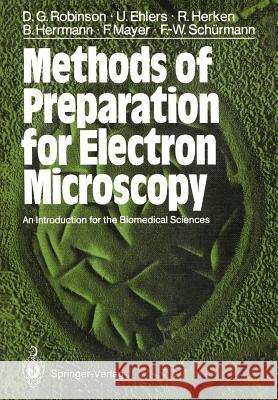
David G. Robinson;Ulrich Ehlers;Rainer Herken
Methods of Preparation for Electron Microscopy: An Introduction for the Biomedical Sciences David G. Robinson, Ulrich Ehlers, Rainer Herken, Bernd Herrmann, Frank Mayer, Friedrich-Wilhelm Schürmann, K. Mühlethale 9783540175926 Springer-Verlag Berlin and Heidelberg GmbH &  - książkaWidoczna okładka, to zdjęcie poglądowe, a rzeczywista szata graficzna może różnić się od prezentowanej.

Methods of Preparation for Electron Microscopy: An Introduction for the Biomedical Sciences

ISBN-13: 9783540175926 / Angielski / Miękka / 1987 / 190 str.

David G. Robinson;Ulrich Ehlers;Rainer Herken
cena 401,58
(netto: 382,46 VAT:  5%)

Najniższa cena z 30 dni: 385,52
Termin realizacji zamówienia:
ok. 22 dni roboczych
Dostawa w 2026 r.

Darmowa dostawa!

In 1939, when the electron optics laboratory of Siemens & Halske Inc. began to manufacture the first electron microscopes, the biological and medical profes sions had an unexpected instrument at their disposal which exceeded the reso lution of the light microscope by more than a hundredfold. The immediate and broad application of this new tool was complicated by the overwhelming prob lems inherent in specimen preparation for the investigation of cellular struc tures. The microtechniques applied in light microscopy were no longer appli cable, since even the thinnest paraffin layers could not be penetrated by electrons. Many competent biological and medical research workers expressed their anxiety that objects in high vacuum would be modified due to complete dehydration and the absorbed electron energy would eventually cause degrada tion to rudimentary carbon backbones. It also seemed questionable as to whether it would be possible to prepare thin sections of approximately 0. 5 11m from heterogeneous biological specimens. Thus one was suddenly in posses sion of a completely unique instrument which, when compared with the light microscope, allowed a 10-100-fold higher resolution, yet a suitable preparation methodology was lacking. This sceptical attitude towards the application of electron microscopy in bi ology and medicine was supported simultaneously by the general opinion of colloid chemists, who postulated that in the submicroscopic region of living structures no stable building blocks existed which could be revealed with this apparatus."


Kategorie:
Nauka, Biologia i przyroda
Kategorie BISAC:
Science > Cytologia
Science > Biologia molekularna
Wydawca:
Springer-Verlag Berlin and Heidelberg GmbH &
Język:
Angielski
ISBN-13:
9783540175926
Rok wydania:
1987
Dostępne języki:
Angielski
Wydanie:
Softcover Repri
Ilość stron:
190
Waga:
0.44 kg
Wymiary:
24.424.4 x 17.0
Oprawa:
Miękka
Wolumenów:
01

1 An Introduction to Electron Microscopy (EM).- 1.1 Imaging Methods in Electron Microscopy.- 1.1.1 Conventional Transmission Electron Microscopy (TEM).- 1.1.1.1 Bright Field Electron Microscopy.- 1.1.1.2 Low Dose Transmission Electron Microscopy.- 1.1.1.3 Dark Field Electron Microscopy.- 1.1.2 Conventional Scanning Electron Microscopy (SEM).- 1.1.2.1 Imaging with Secondary and Back-Scattered Electrons.- 1.1.2.2 Scanning Electron Microscopy at Low Accelerating Voltages.- 1.2 Preparation Procedures in TEM.- 1.2.1 Overview.- 1.2.2 Structural Preservation During Fixation, Dehydration and Embedding of Biological Objects.- 1.3 Imaging Problems.- 1.3.1 On the Interpretation of TEM Images.- 1.3.2 On the Interpretation of SEM Images.- 1.4 Support Films.- 1.4.1 Grids for TEM and Their Pretreatment.- 1.4.2 Formvar Films.- 1.4.3 Collodion Films.- 1.4.4 Hydrophilisation of Films.- 1.4.5 Support Films with Holes.- 1.4.6 Carbon Films.- 2 Methods for TEM.- 2.1 Fixation, Dehydration and Embedding.- 2.1.1 Chemical Fixations.- 2.1.1.1 General Comments.- 2.1.1.2 Fixatives: Properties and Preparation.- 2.1.1.3 Composition of Fixation Solutions.- 2.1.1.4 The Fixation of Animal Cells.- 2.1.1.5 The Fixation of Plants and Microorganisms.- 2.1.1.6 The Fixation of Isolated Organelles.- 2.1.1.7 Fixing for Immunocytochemistry.- 2.1.2 Dehydration.- 2.1.3 Embedding.- 2.1.3.1 Embedding Media: General Usage and Precautions.- 2.1.3.2 Conventional Embedding.- 2.1.3.3 Water-Soluble Embedding Media.- 2.1.3.4 Embedding for Immunocytochemistry.- 2.1.3.5 Embedding Moulds and Specimen Orientation.- 2.1.3.6 Embedding of Monolayer Cell Cultures.- 2.2 Ultramicrotomy.- 2.2.1 Trimming of Blocks.- 2.2.1.1 General.- 2.2.1.2 Controlled Trimming: Production and Staining of Semi-Thin Sections.- 2.2.2 Preparing Glass Knives.- 2.2.2.1 Preparation of the Glass Strips.- 2.2.2.2 Breaking Glass Squares.- 2.2.2.3 Making Knives.- 2.2.2.4 Judging the Quality of a Glass Knife.- 2.2.2.5 Attaching Troughs.- 2.2.2.6 Storing Glass Knives.- 2.2.3 Diamond Knives and Their Care.- 2.2.4 Conventional Sectioning.- 2.2.4.1 Trough Liquids.- 2.2.4.2 Using an Ultramicrotome.- 2.2.4.3 Section Thickness.- 2.2.4.4 Picking Up Sections.- 2.2.4.5 Sectioning Problems.- 2.2.5 Cryo-ultramicrotomy.- 2.2.5.1 Freezing the Sample.- 2.2.5.2 Sectioning the Frozen Sample.- 2.2.5.3 Picking up Frozen Sections.- 2.2.6 Staining Sections.- 2.2.6.1 Staining Solutions.- 2.2.6.2 Procedure for Double Staining Sections.- 2.2.6.3 Staining Sections of Material Embedded for Immunocytochemical Purposes.- 2.2.6.4 Staining Cryosections.- 2.2.6.5 Block Staining.- 2.3 Macromolecular EM.- 2.3.1 Isolated Proteins and Protein Aggregates.- 2.3.1.1 Preparation of Specimens.- 2.3.1.2 Negative Staining Techniques.- 2.3.1.3 High Resolution Metal Shadowing.- 2.3.1.4 Preparation and Imaging of Two-Dimensional Protein Crystals.- 2.3.1.5 Making a “Tilt Series”.- 2.3.2 Isolated Nucleic Acids.- 2.3.2.1 Problems and Aims.- 2.3.2.2 Specimen Preparation.- 2.3.2.3 Spreading and Diffusion Techniques Which Employ Cytochrome c.- 2.3.2.4 “BAC” Technique.- 2.3.2.5 Partial Denaturating, Heteroduplex and R-Loop Techniques.- 2.3.3 Nucleic Acid-Protein Complexes.- 2.3.3.1 Specimen Preparation.- 2.3.3.2 Production and Staining of NA-Protein Complexes.- 2.4 Immunoelectron Microscopy (I EM).- 2.4.1 Principle Requirements.- 2.4.1.1 Antigens.- 2.4.1.2 Antibodies.- 2.4.2 Labelling of Antigens in Cells and Cell Fractions.- 2.4.2.1 Ferritin-Labelled Antibodies.- 2.4.2.2 Immunolabelling with Protein A-Gold.- 2.4.3 Localization of Protein Subunits with Specific IgG Antibodies.- 2.4.3.1 Preparation and Visualization of the Protein-Antibody Complex.- 2.5 Autoradiography.- 2.5.1 General Background.- 2.5.1.1 Physical Basis.- 2.5.1.2 Chemical Basis.- 2.5.2 Choice and Dosis of Radioactive Compounds.- 2.5.2.1 Choosing a Radioactive Precursor.- 2.5.2.2 Dosage.- 2.5.3 Working with Isotopes-Radiation Protection.- 2.5.4 Preparation of Radio-Labelled Cells/Tissues for Electron Microscopy.- 2.5.5 Photographic Emulsions and Autoradiography.- 2.5.5.1 Apparatus Required.- 2.5.5.2 Choice of Emulsion; Consequences for Resolution.- 2.5.5.3 Preparation of Sections.- 2.5.5.4 LM Autoradiography.- 2.5.5.5 Emulsion, Coating Techniques.- 2.5.6 Exposing, Developing and Fixing.- 2.5.6.1 Exposing.- 2.5.6.2 Developing and Fixing.- 2.5.6.3 Future Developments in Autoradiography.- 2.6 Freeze (Fracturing) Etching.- 2.6.1 Introduction.- 2.6.2 Freezing.- 2.6.2.1 Theoretical Background.- 2.6.2.2 Cyroprotectants.- 2.6.2.3 Supports.- 2.6.2.4 Cryogens and Freezing Methods.- 2.6.2.5 Storage of Frozen Specimens.- 2.6.3 Fracturing.- 2.6.3.1 Transfer of the Object into the Vacuum Recipient.- 2.6.3.2 The Fracturing Process.- 2.6.3.3 Fracture Planes in Biological Material.- 2.6.4 Etching.- 2.6.4.1 The Purpose of Etching.- 2.6.4.2 Theory and Practice.- 2.6.5 Shadowing and Replica Formation.- 2.6.5.1 Resistance-Heating Evaporation.- 2.6.5.2 Electron Beam Evaporation.- 2.6.5.3 Measurement of Replica Thickness.- 2.6.6 Cleaning the Replica.- 2.6.7 Artifacts in Freeze Etching.- 2.6.8 Using a Freeze-Etch Machine: a Practical Description.- 3 Methods for SEM.- 3.1 Conventional Methods of Preparation.- 3.1.1 Introduction.- 3.1.2 Specimen Size; Handling Specimens and Exposing Surfaces.- 3.1.2.1 Cleaning Surfaces.- 3.1.3 Stabilization.- 3.1.3.1 Chemical Fixations.- 3.1.3.2 Cryofixation.- 3.1.4 Dehydration.- 3.1.5 Drying.- 3.1.5.1 Critical Point Drying.- 3.1.5.2 Freeze Drying.- 3.1.6 Mounting Specimens.- 3.1.7 Increasing Conductivity.- 3.1.7.1 Sputtering.- 3.1.7.2 Evaporating.- 3.2 Storage of Specimens.- 3.3 Demonstration of Surfaces via Replicas and Casts.- 3.4 Visualization of Internal Surfaces Through Sectioning and Dry-Fracturing (Dry-Cleaving).- 3.5 Element Analysis.- 4 Evaluation of Micrographs.- 4.1 Morphometry.- 4.1.1 Problems and Solutions.- 4.1.2 Measurement: Some General Points.- 4.1.3 Stereology: General Principles.- 4.1.4 Collection and Evaluation of Data; Statistical Treatments.- 4.2 Averaging and Image Reconstruction.- 4.2.1 General.- 4.2.2 Markham Rotation.- 4.2.3 Principles of Light Optical Diffraction.- 4.2.4 Principles of Computer-Assisted Image Reconstruction.- Appendix: Buffers in Electron Microscopy.


Udostępnij

Facebook - konto krainaksiazek.pl


Opinie o Krainaksiazek.pl na Opineo.pl

Partner Mybenefit

Krainaksiazek.pl w programie rzetelna firma Krainaksiaze.pl - płatności przez paypal

Czytaj nas na:

Facebook - krainaksiazek.pl
  • książki na zamówienie
  • granty
  • książka na prezent
  • kontakt
  • pomoc
  • opinie
  • regulamin
  • polityka prywatności

Zobacz:

  • Księgarnia czeska

  • Wydawnictwo Książkowe Klimaty

1997-2025 DolnySlask.com Agencja Internetowa

© 1997-2022 krainaksiazek.pl
     
KONTAKT | REGULAMIN | POLITYKA PRYWATNOŚCI | USTAWIENIA PRYWATNOŚCI
Zobacz: Księgarnia Czeska | Wydawnictwo Książkowe Klimaty | Mapa strony | Lista autorów
KrainaKsiazek.PL - Księgarnia Internetowa

Polityka prywatnosci - link
Krainaksiazek.pl - płatnośc Przelewy24
Przechowalnia Przechowalnia





