Science in France in the Revolutionary Era » książka





Science in France in the Revolutionary Era
ISBN-13: 9780262523653 / Angielski / Miękka / 2003 / 258 str.
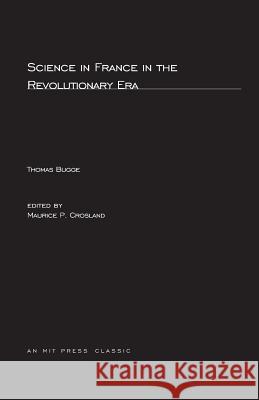
Thomas Bugge, Danish Astronomer Royal, spent six months in France in 1798-99 as his country's delegate to the International Commission on the Metric System, and while there he made a close study of the postrevolutionary scientific and cultural scene. Written up in the form of "letters," these observations were later published as Travels in the French Republic. The present work includes much of this material, some published in English for the first time, the rest unavailable except in a scarce English edition of 1801. The editor's principle of selection has been to include, among others, those sections that relate in particular to the institutions of science in France, and he provides a commentary introducing each section.The institutions of modern science, and their relation to the state, were to a considerable extent developed or perfected in the France of the First Republic. The conference on the metric system mentioned earlier might be described as the world's first international scientific meeting. Specialized technical schools were being established in numerous fields as whole new technologies were developed. The government, for the first time in history, had begun to support science financially on a large scale and to employ scientists engaged in both military research and "pure" pursuits. Some prominent men of science held positions as ministers of state, while others were highly influential advisers to the government. And in many other ways science matured in this period, taking on the institutional form it retains to this day. There are a number of reasons why the state supported sci- ence so lavishly, among them its desire to expiate for the early excesses of the Revolution, marked by the disbanding of the Academie des sciences and the execution of Lavoisier. Also, science had proved its worth to the military: the work of such men as Monge, Fourcroy, de Morveau, and Berthollet in directing the manufacture of gunpowder and cannon helped stave off an invasion by foreign armies in 1793-94.Among the institutions of which Bugge gives a detailed account are the Ecole normale, the ecoles centrales, the Ecole poly technique; schools for public service including the naval schools, the Ecole d'artillerie, and the Ecole des mines; the schools of medicine and pha acy; the College de France; the Military Hospital for Instruction, and other medical institutions; the National Institute; the National Observatory and the Board of Longitude; the School of Military Ballooning; the Conservatoire des arts et metiers. Bugge also had interesting comments on the Louvre and the Bibliotheque Nationale.Other concerns taken up by Bugge and reprinted here are state expenditures on scientific and allied institutions for the year 1799, instruments and instrument makers, steam engines, powder factories, the metric system, and revolutionary festivals.




Czytaj nas na:
KrainaKsiazek.PL - Księgarnia Internetowa


