• Wyszukiwanie zaawansowane
  • Kategorie
  • Kategorie BISAC
  • Książki na zamówienie
  • Promocje
  • Granty
  • Książka na prezent
  • Opinie
  • Pomoc
  • Załóż konto
  • Zaloguj się

The Syntax and Semantics of the Perfect Active in Literary Koine Greek » książka

zaloguj się | załóż konto
Logo Krainaksiazek.pl

koszyk

konto

szukaj
topmenu
Księgarnia internetowa
Szukaj
Książki na zamówienie
Promocje
Granty
Książka na prezent
Moje konto
Pomoc
 
 
Wyszukiwanie zaawansowane
Pusty koszyk
Bezpłatna dostawa dla zamówień powyżej 20 złBezpłatna dostawa dla zamówień powyżej 20 zł

Kategorie główne

• Nauka
 [2950560]
• Literatura piękna
 [1849509]

  więcej...
• Turystyka
 [71097]
• Informatyka
 [151150]
• Komiksy
 [35848]
• Encyklopedie
 [23178]
• Dziecięca
 [617388]
• Hobby
 [139064]
• AudioBooki
 [1657]
• Literatura faktu
 [228597]
• Muzyka CD
 [383]
• Słowniki
 [2855]
• Inne
 [445295]
• Kalendarze
 [1464]
• Podręczniki
 [167547]
• Poradniki
 [480102]
• Religia
 [510749]
• Czasopisma
 [516]
• Sport
 [61293]
• Sztuka
 [243352]
• CD, DVD, Video
 [3414]
• Technologie
 [219456]
• Zdrowie
 [101002]
• Książkowe Klimaty
 [124]
• Zabawki
 [2311]
• Puzzle, gry
 [3459]
• Literatura w języku ukraińskim
 [254]
• Art. papiernicze i szkolne
 [8079]
Kategorie szczegółowe BISAC

The Syntax and Semantics of the Perfect Active in Literary Koine Greek

ISBN-13: 9781119243540 / Angielski / Miękka / 2016 / 288 str.
Robert Crellin
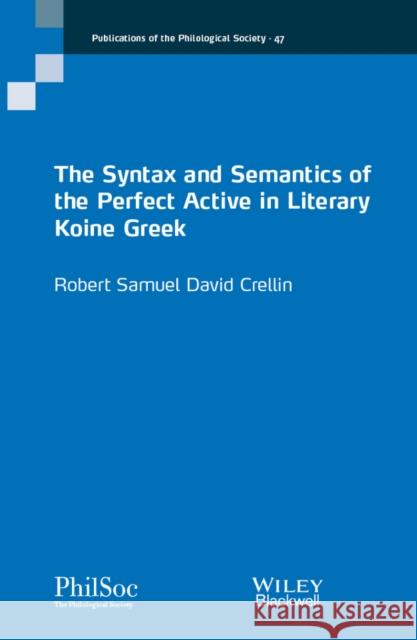
The Syntax and Semantics of the Perfect Active in Literary Koine Greek Robert Crellin 9781119243540 Wiley-Blackwell - książkaWidoczna okładka, to zdjęcie poglądowe, a rzeczywista szata graficzna może różnić się od prezentowanej.

The Syntax and Semantics of the Perfect Active in Literary Koine Greek

ISBN-13: 9781119243540 / Angielski / Miękka / 2016 / 288 str.

Robert Crellin
cena 117,56
(netto: 111,96 VAT:  5%)

Najniższa cena z 30 dni: 116,83
Termin realizacji zamówienia:
ok. 30 dni roboczych
Dostawa w 2026 r.

Darmowa dostawa!

The Syntax and Semantics of the Perfect Active in Literary Koine Greek incorporates linguistic insights from both neo-Davidsonian and Chomskyan traditions to present a unified semantic description of the perfect and pluperfect in literary Koine Greek.

  • Offers a comprehensive and unified account of the Greek perfect that considers its behaviour in terms of tense and aspect, as well as voice (or diathesis)
  • Features insights from the neo-Davidsonian and Chomskyan semantic traditions while addressing the perfect tense in Koine Greek
  • Incorporates syntactic and semantic frameworks to provide an account of the perfect in terms of the causative alternation and aspectual classes of predicate
  • Utilizes a large corpus of material that has not been previously discussed in a linguistic sense relating to the question of the semantics of the Greek perfect


Kategorie:
Nauka, Językoznawstwo
Kategorie BISAC:
Language Arts & Disciplines > Linguistics - Sociolinguistics
Foreign Language Study > Greek (Modern)
Language Arts & Disciplines > Linguistics - Semantics
Wydawca:
Wiley-Blackwell
Język:
Angielski
ISBN-13:
9781119243540
Rok wydania:
2016
Ilość stron:
288
Waga:
0.38 kg
Wymiary:
22.86 x 15.24 x 1.52
Oprawa:
Miękka
Wolumenów:
01
Dodatkowe informacje:
Bibliografia
Wydanie ilustrowane

Introduction

1.1 Problem of the Greek perfect active

1.2 Existing frameworks for understanding the perfect

1.3 Existing frameworks for understanding the Greek perfect

1.4 Critical assessment of existing studies

1.5 Aims and approach

1.6 Corpus

1.7 Outline

2. The perfect and lexical aspect

2.1 Introduction

2.1.1 Events and the Greek perfect

2.1.2 The true domain of events

2.1.3 Aspect: semantic, pragmatic or morphological?

2.1.4 Viewpoint aspect, situation aspect and telicity

2.1.5 Tense and aspect in terms of Utterance Time and

Topic Time

2.1.6 Viewpoint aspect in Greek

2.1.7 Lexical aspectual categories: Aristotle, Kenny and Vendler

2.1.8 The domain of situation aspect: syntax or lexis?

2.1.9 Developing a lexical aspectual framework for Greek

2.2 Perfect of homogeneous verbs

2.2.1 Introduction

2.2.2 Non–durative state verbs

2.2.3 Durative state verbs

2.2.4 Terminative state verbs

2.2.5 Non–state homogeneous verbs

2.2.6 Conclusion

2.3 Non–durative terminative verbs (describing achievements)

2.4 Non–homogeneous durative verbs (describing activities

and accomplishments)

2.4.1 Introduction

2.4.2 Non–COS verbs

2.4.3 COS verbs

2.4.4 Verbs with two perfect active stems

2.4.5 Verbs alternating between COS and non–COS readings

without specialised stems

2.4.6 Conclusion

2.5 Noise verbs

2.6 Conclusion

3. Syntactic theoretical frameworks

3.1 Introduction

3.2 Neo–Davidsonian tradition

3.2.1 Event semantics in the Davidsonian tradition

3.2.2 Argument projection in a neo–Davidsonian framework

3.2.3 Semantic roles and grammatical relations

3.2.4 Determining the number of arguments

3.2.5 Formally representing semantic roles in a neo–Davidsonian

framework

3.2.6 Are states predicates of eventualities?

3.2.7 Theme hierarchies and thematic proto–roles

3.3 Government–Binding (GB) theory

3.3.1 Introduction

3.3.2 Unaccusativity hypothesis and (causative) change of state

3.3.3 X–bar theory

3.3.4 Status of the subject as a verbal argument

3.3.5 Subject of state sentences

3.3.6 Combining Davidsonian semantics with GB theory

3.4 Predicate types

3.4.1 Introduction

3.4.2 State predicates

3.4.3 Change of state and causative change of state

3.4.4 Change of state and change of location

3.4.5 Accomplishment predicates

3.4.6 Activity predicates

3.5 Voice alternations and the resultative

3.5.1 Passive voice

3.5.2 Resultative

3.5.3 The middle

3.6 Conclusion

4. The causative alternation

4.1 Introduction

4.1.1 Transitivity in traditional Greek grammar passive

4.1.2 The function and development of the Greek middle and passive

4.1.3 Voice and argument projection in Greek

4.1.4 Transitivity and the Greek perfect

4.2 Labile transitivity outside of the perfect

4.2.1 Introduction

4.2.2 Verbs fully participating in the causative alternation

4.2.3 Anticausative denoted by infl ection

4.2.4 Anticausative perfective with a root stem

4.2.5 Semantic distinction determining participation in the

causative alternation

4.2.6 Conclusion

4.3 Labile transitivity in the perfect

4.3.1 Introduction

4.3.2 Causative/anticausative distinctions in the perfect

4.3.3 Re–expression of external cause argument by means of

an adjunct phrase

4.3.4 Productivity of the specialised causative/anticausative

perfect stems

4.3.5 Implications for the meaning of the perfect

4.4 Conclusion

5. The interaction of the perfect with different predicate types

5.1 Introduction: tense and aspect in a neo–Davidsonian

framework

5.1.1 Approach

5.1.2 Aspectual Interface Hypothesis (AIH)

5.1.3 Situation aspect

5.1.4 Tense and aspect in a Government–Binding (GB) and

neo– Davidsonian framework

5.1.5 Constructing the path of an event

5.1.6 Role of VAspP

5.1.7 Resultative and perfect in English

5.1.8 Outline of the present chapter

5.2 Homogeneous eventualities

5.2.1 Non–durative predicates

5.2.2 Durative predicates

5.2.3 Conclusion

5.3 Non–homogeneous non–COS eventualities

5.3.1 Introduction

5.3.2 Activity predicates

5.3.3 Accomplishment predicates

5.3.4 Conclusion

5.4 COS accomplishment predicates

5.4.1 Introduction

5.4.2 Unaccusative and anticausative predicates

5.4.3 Causative COS predicates

5.4.4 Unaccusativised activity predicates

5.4.5 Delimiting the post–state

5.5 COS achievement predicates

5.5.1 COS predicates

5.5.2 Causative COS predicates

5.6 Conclusion

6. The interaction of the perfect with COS predicates

6.1 Introduction

6.2 Extent predicates

6.2.1 COS and extent predicates

6.2.2 Achievements in a difference scale framework

6.2.3 Non–COS extent predicates

6.2.4 Disambiguation of extent and temporal readings

6.2.5 Viewpoint aspect and difference scales

6.2.6 Tense and extent predicates

6.2.7 The resultative construction

6.2.8 Extent predicates in Greek

6.2.9 Implications for the semantics of the perfect

6.3 Temporal versus extent readings of perfect predicates

6.3.1 Introduction

6.3.2 Prestate not logically present in time

6.3.3 Prestate logically present in time

6.3.4 Metaphorical extension of extent predicates to

non–distance scales

6.4 Suppression of the internal argument in non–causative COS predicates

6.5 Suppression of the external argument

6.6 A special case

6.7 Conclusion

7. Deriving homogeneous atelic eventualities from states and non–states

7.1 Introduction

7.2 Deriving a homogeneous atelic eventuality by negation

7.3 Telic state predicates

7.4 Activity predicates

7.5 Non–COS accomplishment predicates

7.6 Causative COS predicates

7.7 Deriving states from states: the perfect of atelic state predicates

7.7.1 Introduction

7.7.2 Pure state predicates

7.7.3 Continued state predicates

7.7.4 COS predicates

7.8 Obligatory anteriority in derived states

7.9 Semantic contribution of the Greek perfect

7.10 Tense and the time adverbial problem

7.11 Noise predicates

7.12 Conclusion

8. Conclusion: the semantics of the Greek perfect 

Robert Crellin works for the Greek Lexicon Project, based in the Classics Faculty at the University of Cambridge, UK, and is a former Lecturer in New Testament Greek at the Greek Bible College in Athens, Greece. 

While linguists and scholars have been poring over Koine Greek literary works for centuries, the semantics of the perfect tense continues to be a vexing issue in ancient Greek linguistics. Incorporating the most recent linguistic insights from both the neo–Davidsonian and Chomskyan traditions, The Syntax and Semantics of the Perfect Active in Literary Koine Greek offers a unified, comprehensive semantic description of the perfect and pluperfect in literary Koine Greek. In addition to consolidating material from contemporary authors, noted classical scholar Robert Crellin draws on a large corpus of extant Koine Greek works including the writings of Josephus, Polybius, Appian, and Plutarch to address temporal problems of the perfect and pluperfect in Koine Greek, as well as linguistic issues relating to transitivity. After examining the behaviour of the perfect form from a lexical semantic standpoint, chapters incorporate syntactic and semantic frameworks to provide an account of the perfect in terms of the causative alternation and aspectual classes of predicate. Revelatory and thought–provoking, The Syntax and Semantics of the Perfect Active in Literary Koine Greek offers illuminating insights into the precise meanings of the literary and scholarly writings of the ancient Greeks.


Udostępnij

Facebook - konto krainaksiazek.pl


Opinie o Krainaksiazek.pl na Opineo.pl

Partner Mybenefit

Krainaksiazek.pl w programie rzetelna firma Krainaksiaze.pl - płatności przez paypal

Czytaj nas na:

Facebook - krainaksiazek.pl
  • książki na zamówienie
  • granty
  • książka na prezent
  • kontakt
  • pomoc
  • opinie
  • regulamin
  • polityka prywatności

Zobacz:

  • Księgarnia czeska

  • Wydawnictwo Książkowe Klimaty

1997-2025 DolnySlask.com Agencja Internetowa

© 1997-2022 krainaksiazek.pl
     
KONTAKT | REGULAMIN | POLITYKA PRYWATNOŚCI | USTAWIENIA PRYWATNOŚCI
Zobacz: Księgarnia Czeska | Wydawnictwo Książkowe Klimaty | Mapa strony | Lista autorów
KrainaKsiazek.PL - Księgarnia Internetowa

Polityka prywatnosci - link
Krainaksiazek.pl - płatnośc Przelewy24
Przechowalnia Przechowalnia







