• Wyszukiwanie zaawansowane
  • Kategorie
  • Kategorie BISAC
  • Książki na zamówienie
  • Promocje
  • Granty
  • Książka na prezent
  • Opinie
  • Pomoc
  • Załóż konto
  • Zaloguj się

Quantitative Methods for Current Environmental Issues » książka


zaloguj się | załóż konto
Logo Krainaksiazek.pl

koszyk

konto

szukaj
topmenu
Księgarnia internetowa
Szukaj
Książki na zamówienie
Promocje
Granty
Książka na prezent
Moje konto
Pomoc
 
 
Wyszukiwanie zaawansowane
Pusty koszyk
Bezpłatna dostawa dla zamówień powyżej 20 złBezpłatna dostawa dla zamówień powyżej 20 zł

Kategorie główne

• Nauka
 [2952079]
• Literatura piękna
 [1850969]

  więcej...
• Turystyka
 [71058]
• Informatyka
 [151066]
• Komiksy
 [35579]
• Encyklopedie
 [23181]
• Dziecięca
 [620496]
• Hobby
 [139036]
• AudioBooki
 [1646]
• Literatura faktu
 [228729]
• Muzyka CD
 [379]
• Słowniki
 [2932]
• Inne
 [445708]
• Kalendarze
 [1409]
• Podręczniki
 [164793]
• Poradniki
 [480107]
• Religia
 [510956]
• Czasopisma
 [511]
• Sport
 [61267]
• Sztuka
 [243299]
• CD, DVD, Video
 [3411]
• Technologie
 [219640]
• Zdrowie
 [100984]
• Książkowe Klimaty
 [124]
• Zabawki
 [2281]
• Puzzle, gry
 [3363]
• Literatura w języku ukraińskim
 [258]
• Art. papiernicze i szkolne
 [8020]
Kategorie szczegółowe BISAC

Quantitative Methods for Current Environmental Issues

ISBN-13: 9781447111719 / Angielski / Miękka / 2011 / 270 str.
Clive W. Anderson; Vic Barnett; Philip C. Chatwin
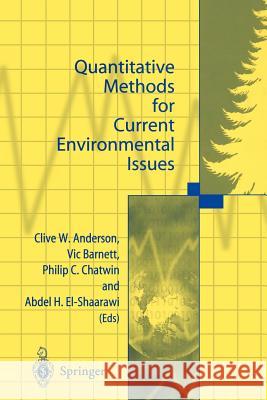
Quantitative Methods for Current Environmental Issues Clive W. Anderson Vic Barnett Philip C. Chatwin 9781447111719 Springer - książkaWidoczna okładka, to zdjęcie poglądowe, a rzeczywista szata graficzna może różnić się od prezentowanej.

Quantitative Methods for Current Environmental Issues

ISBN-13: 9781447111719 / Angielski / Miękka / 2011 / 270 str.

Clive W. Anderson; Vic Barnett; Philip C. Chatwin
cena 201,72
(netto: 192,11 VAT:  5%)

Najniższa cena z 30 dni: 192,74
Termin realizacji zamówienia:
ok. 22 dni roboczych.

Darmowa dostawa!

It is increasingly clear that good quantitative work in the environmental sciences must be genuinely interdisciplinary. This volume, the proceedings of the first combined TIES/SPRUCE conference held at the University of Sheffield in September 2000, well demonstrates the truth of this assertion, highlighting the successful use of both statistics and mathematics in important practical problems.
It brings together distinguished scientists and engineers to present the most up-to-date and practical methods for quantitative measurement and prediction and is organised around four themes:
- spatial and temporal models and methods;
- environmental sampling and standards;
- atmosphere and ocean;
- risk and uncertainty.
Quantitative Methods for Current Environmental Issues is an invaluable resource for statisticians, applied mathematicians and researchers working on environmental problems, and for those in government agencies and research institutes involved in the analysis of environmental issues.


Kategorie:
Nauka, Matematyka
Kategorie BISAC:
Mathematics > Matematyka stosowana
Science > Environmental Science (see also Chemistry - Environmental)
Mathematics > Prawdopodobieństwo i statystyka
Wydawca:
Springer
Język:
Angielski
ISBN-13:
9781447111719
Rok wydania:
2011
Wydanie:
Softcover Repri
Ilość stron:
270
Waga:
1.01 kg
Wymiary:
23.5 x 15.5
Oprawa:
Miękka
Wolumenów:
01

I. Spatial and Temporal Models and Methods.- 1 Modeling Spatio-Temporally Misaligned Areal and Point Process Environmental Data.- 1.1 Introduction.- 1.2 Misaligned Areal Data Model Development.- 1.3 Example: Radon Exposure near an Ohio Contamination Source.- 1.4 Misaligned Point-Block Data Model Development.- 1.5 Example: Ozone Exposure by Zip Code in Atlanta.- 1.6 Summary and Discussion.- References.- 2 Space and Space-Time Modeling using Process Convolutions.- 2.1 Introduction.- 2.2 Constructing Spatial Models via Moving Averages.- 2.3 Basic Spatial Model.- 2.4 A Multiresolution Model.- 2.5 Building Space-Time Models.- 2.6 Discussion.- References.- 3 Multivariate Kriging for Interpolating with Data from Different Sources.- 3.1 Introduction.- 3.2 Data from Different Sources.- 3.3 Simple and Ordinary Cokriging.- 3.4 Cokriging with External Drifts.- 3.5 Cokriging Neighborhood.- 3.6 Ebro Case Study.- References.- II. Environmental Sampling and Standards.- 4 Distance Sampling: Recent Advances and Future Directions.- 4.1 Introduction.- 4.2 Standard Distance Sampling Methods.- 4.3 Covariate Models for the Detection Function.- 4.4 Double-Platform Methods.- 4.5 Spatial Distance Sampling Models.- 4.6 Indirect Distance Sampling Surveys.- 4.7 Automated Design Algorithms.- 4.8 Adaptive Distance Sampling.- 4.9 The Software Distance.- 4.10 State-Space Models for Trend.- 4.11 Discussion.- References.- 5 Setting Environmental Standards: A Statistical Approach.- 5.1 Background.- 5.2 Setting a Statistically Verifiable Ideal Standard.- 5.3 A Best Linear Unbiased Quantile Estimator.- 5.4 Example: Copper Levels in River Water.- 5.5 Conclusion.- References.- III. Atmosphere and Ocean.- 6 The Interpretation and Validation of Measurements of the Ocean Wave Directional Spectrum.- 6.1 Introduction.- 6.2 The Statistical Description of the Sea Surface.- 6.3 Measurement Techniques.- 6.4 Validation/Intercomparison Issues.- 6.5 Methods Used and their Application.- 6.6 Concluding Remarks.- References.- 7 Thermal Energy Emission and Propagation from Accidents.- 7.1 Introduction.- 7.2 Heat Transfer Theory.- 7.3 Global Radiative Model Architecture and Application.- 7.4 Comments on Model Results.- 7.5 Conclusions.- References.- 8 Development and Application of an Extended Methodology to Validate Short-Range Atmospheric Dispersion Models.- 8.1 Introduction.- 8.2 Model Validation Tool.- 8.3 Descriptions of Dispersion Models Tadmod and Tstep.- 8.4 Results and Discussion.- 8.5 Conclusions.- Appendices.- References.- 9 Uncertainty and Sensitivity of Dispersion Model Results to Meteorological Inputs: Two Case Studies.- 9.1 Introduction.- 9.2 Model Evaluation and Sensitivity Study with Dipole Pride 26.- 9.3 Persian Gulf War Exposure Study.- 9.4 Conclusions.- References.- IV. Risk and Uncertainty.- 10 Statistics and the Environmental Sciences: Approaches to Model Combination.- 10.1 Introduction.- 10.2 Statistical Framework.- 10.3 Examples.- 10.4 Discussion.- References.- 11 Bayesian Analysis of Computer Code Outputs.- 11.1 Analysis of Computer Code Outputs.- 11.2 Bayesian Methods.- 11.3 Windscale Nuclear Accident.- 11.4 Discussion.- References.- 12 The Realities of Decision Making on Risks.- 12.1 Introduction.- 12.2 Decision Making on Health and Safety.- 12.3 Changing Nature of Risk Debates.- 12.4 Changing Influence of Science.- 12.5 Public Responses to Risk Issues.- 12.6 Features of the Public Debate on Risk Decision Making.- 12.7 Risk-Based Approach to Regulation.- 12.8 Risk Assessment.- 12.9 Strengths and Limitations of Risk Assessment.- 12.10 Concluding Remarks.- References.


Udostępnij

Facebook - konto krainaksiazek.pl


Opinie o Krainaksiazek.pl na Opineo.pl

Partner Mybenefit

Krainaksiazek.pl w programie rzetelna firma Krainaksiaze.pl - płatności przez paypal

Czytaj nas na:

Facebook - krainaksiazek.pl
  • książki na zamówienie
  • granty
  • książka na prezent
  • kontakt
  • pomoc
  • opinie
  • regulamin
  • polityka prywatności

Zobacz:

  • Księgarnia czeska

  • Wydawnictwo Książkowe Klimaty

1997-2025 DolnySlask.com Agencja Internetowa

© 1997-2022 krainaksiazek.pl
     
KONTAKT | REGULAMIN | POLITYKA PRYWATNOŚCI | USTAWIENIA PRYWATNOŚCI
Zobacz: Księgarnia Czeska | Wydawnictwo Książkowe Klimaty | Mapa strony | Lista autorów
KrainaKsiazek.PL - Księgarnia Internetowa

Polityka prywatnosci - link
Krainaksiazek.pl - płatnośc Przelewy24
Przechowalnia Przechowalnia





