• Wyszukiwanie zaawansowane
  • Kategorie
  • Kategorie BISAC
  • Książki na zamówienie
  • Promocje
  • Granty
  • Książka na prezent
  • Opinie
  • Pomoc
  • Załóż konto
  • Zaloguj się

Nectaries and Nectar » książka


zaloguj się | załóż konto
Logo Krainaksiazek.pl

koszyk

konto

szukaj
topmenu
Księgarnia internetowa
Szukaj
Książki na zamówienie
Promocje
Granty
Książka na prezent
Moje konto
Pomoc
 
 
Wyszukiwanie zaawansowane
Pusty koszyk
Bezpłatna dostawa dla zamówień powyżej 20 złBezpłatna dostawa dla zamówień powyżej 20 zł

Kategorie główne

• Nauka
 [2949965]
• Literatura piękna
 [1857847]

  więcej...
• Turystyka
 [70818]
• Informatyka
 [151303]
• Komiksy
 [35733]
• Encyklopedie
 [23180]
• Dziecięca
 [617748]
• Hobby
 [139972]
• AudioBooki
 [1650]
• Literatura faktu
 [228361]
• Muzyka CD
 [398]
• Słowniki
 [2862]
• Inne
 [444732]
• Kalendarze
 [1620]
• Podręczniki
 [167233]
• Poradniki
 [482388]
• Religia
 [509867]
• Czasopisma
 [533]
• Sport
 [61361]
• Sztuka
 [243125]
• CD, DVD, Video
 [3451]
• Technologie
 [219309]
• Zdrowie
 [101347]
• Książkowe Klimaty
 [123]
• Zabawki
 [2362]
• Puzzle, gry
 [3791]
• Literatura w języku ukraińskim
 [253]
• Art. papiernicze i szkolne
 [7933]
Kategorie szczegółowe BISAC

Nectaries and Nectar

ISBN-13: 9789048174812 / Angielski / Miękka / 2010 / 396 str.
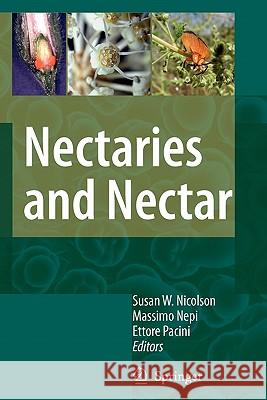
Susan W. Nicolson; Massimo Nepi; Ettore Pacini
Nectaries and Nectar Susan W. Nicolson Massimo Nepi Ettore Pacini 9789048174812 Springer - książkaWidoczna okładka, to zdjęcie poglądowe, a rzeczywista szata graficzna może różnić się od prezentowanej.

Nectaries and Nectar

ISBN-13: 9789048174812 / Angielski / Miękka / 2010 / 396 str.

Susan W. Nicolson; Massimo Nepi; Ettore Pacini
cena 806,99
(netto: 768,56 VAT:  5%)

Najniższa cena z 30 dni: 771,08
Termin realizacji zamówienia:
ok. 22 dni roboczych
Bez gwarancji dostawy przed świętami

Darmowa dostawa!

Nectar is the most important reward offered by plants to pollinating animals. This book is a modern and interdisciplinary text on nectar and nectaries, prompted by the expansion of knowledge, especially in the more ecological and now molecular fields, and the strong recent interest in pollination biology. The topics covered vary widely: they include historical aspects, the structure and ultrastructure of nectaries and relationships to plant systematics, the dynamics of nectar secretion, nectar chemistry and the molecular biology of defence proteins, adaptations to insect and vertebrate nectar consumers and consequences for pollination ecology, and broad-scale studies of nectar resources at the community level.


Kategorie:
Nauka, Biologia i przyroda
Kategorie BISAC:
Science > Botanika
Science > Life Sciences - Ecology
Science > Biologia i przyroda
Wydawca:
Springer
Język:
Angielski
ISBN-13:
9789048174812
Rok wydania:
2010
Ilość stron:
396
Waga:
0.58 kg
Wymiary:
23.39 x 15.6 x 2.16
Oprawa:
Miękka
Wolumenów:
01

From the reviews:

"Nectaries and nectar is a welcome effort that provides a comprehensive review of the advances made in the last three decades in the study of nectary systematics, structure, and ultrastructure, as well as nectar production, presentation, chemistry, molecular biology, nectar consumers, and ecology. ... the big advantage of this book is that it is written by experts in the field. ... Overall there is much to recommend this book as a major reference text and resource for the many biologists ... ." (Lynn S. Adler, Ecology, Vol. 89 (4), 2008)

Contributing Authors. Preface. 1. Introduction; E. Pacini, S.W. Nicolson. 1.1 Evolutionary origins. 1.2 Secretions analogous to nectar. 1.3 Floral and extrafloral nectarines. 1.4 Nectar components. 1.5 Organization of this volume. 2. A Systematic Survey of Floral Nectaries; G. Bernardello. 2.1 Introduction. 2.2 Nectaries in gymnosperms. 2.3 Nectaries in angiosperms. 2.3.1 Diversity. 2.3.1.1 Nectar presentation. 2.3.1.2 Structure. 2.3.1.3 Fate. 2.3.1.4 Symmetry. 2.3.1.5 Number. 2.3.1.6 Colour. 2.3.2 Factors influencing nectary diversity. 2.3.3 Basic types of floral nectarines. 2.3.4 Nectariferous spurs. 2.3.5 Patterns of variability in nectarines. 2.3.5.1 Asteraceae. 2.3.5.2 Brassicaceae. 2.3.5.3 Cucurbitaceae. 2.3.5.4 Euphorbiaceae. 2.3.5.5 Ranunculaceae. 2.3.5.6 Solanaceae. 2.3.6 Nectaries and deceit pollination. 2.3.6.1 Apocynaceae. 2.3.6.2 Bignoniaceae. 2.3.6.3 Orchidaceae. 2.3.7 Relictual nectarines in anemophilous species. 2.3.8 Distribution of nectary types. 2.3.8.1 Early-branching lineages. 2.3.8.2 Magnoliids. 2.3.8.3 Early-branching monocots. 2.3.8.4 Monocots. 2.3.8.5 Commelinids. 2.3.8.6 Ceratophyllales. 2.3.8.7 Eudicots. 2.3.8.8 Core Eudicots. 2.3.8.9 Rosids. 2.3.8.10 Eurosids I. 2.3.8.11 Eurosids II. 2.3.8.12 Asterids. 2.3.8.13 Euasterids I. 2.3.8.14 Euasterids II. 2.3.9 Evolutionary trends. 3. Nectary Structure and Ultrastructure; M. Nepi. 3.1 Introduction. 3.2 Nectary structure and ultrastructure. 3.2.1 Epidermis. 3.2.1.1 Secretory trichomes. 3.2.1.2 Nectary-modified stomata. 3.2.2 Nectary parenchyma. 3.2.2.1 Patterns of plastid development in nectary parenchyma cells. 3.2.3 Subnectary parenchyma. 3.2.4 Nectary vasculature. 3.3 Gynopleural (septal) nectarines. 3.4 Extrafloral nectarines. 3.5 Nectary histochemistry. 4. Nectar Production and Presentation; E. Pacini, M. Nepi. 4.1 Introduction. 4.2 Nectar secretion mechanism and models of nectary function. 4.3 Dynamics of nectar components. 4.3.1 Nectar reabsortion: resource recovery and homeostasis. 4.3.2 Nectar standing crop. 4.4 The source of nectar components. 4.5 Ecophysiological significance of parenchyma plastids. 4.6 Nectar presentation. 4.6.1 Floral nectarines. 4.6.2 Extrafloral nectarines. 4.7 Fate of nectar and nectarines. 4.8 Variability of nectar characteristics. 4.8.1 Environmental variables. 4.8.2 Intraspecies variability. 4.8.3 Interpopulation differences. 4.8.4 Variability and experimental design. 5. Nectar Chemistry; S.W. Nicolson, R.W. Thornburg. 5.1 Introduction. 5.2 Water. 5.2.1 Nectar concentration. 5.2.2 Chemical and microclimatic influences on nectar concentration. 5.2.3 Viscosity and feeding rates. 5.3 Sugars. 5.3.1 Constancy of sugar composition within species. 5.3.2 The use of sugar ratios can be misleading. 5.3.3 Is sugar composition determined by floral visitors or common ancestry? 5.4 Inorganic ions. 5.5 Amino acids. 5.5.1 Non-protein amino acids. 5.5.2 Nectar amino acids are under the control of environmental factors. 5.5.3 Contribution of amino acids to the taste of nectar. 5.6 Proteins. 5.6.1 Proteins in leek nectar. 5.6.2 Nectar redox cycle. 5.7 Other nectar constituents. 5.7.1 Lipids. 5.7.2 Organic acids. 5.7.3 Phenolics. 5.7.4 Alkaloids. 5.7.5 Terpenoids. 5.8 Conclusion. 6. Molecular Biology of the Nicotiana Floral Nectary; R.W. Thornburg. 6.1 Introduction. 6.2 The ornamental tobacco nectary. 6.3 Developmental processes. 6.3.1 Origin of the floral nectary. 6.3.2 Conversion of chloroplasts into chromoplasts. 6.3.3 Filling of the nectary. 6.4 Protection of the gynoecium. 6.5 Gene expression. 6.5.1 Macroarray analysis indentifies defence genes. 6.5.1.1 Role of hydrogen peroxide in plant stress and defence. 6.5.1.2 Role of ascorbate in plant stress and defence. 6.5.2 EST analysis. 6.5.3 Nectary-specific gene expression. 6.6 Nectary molecular biology in other species. 6.6.1 Other n

Sue Nicolson is a New Zealander who obtained her PhD in insect physiology from the University of Cambridge. She is a professor in the Department of Zoology and Entomology at the University of Pretoria, South Africa, and her main research interest is in ecophysiological aspects of nectar feeding in insects and birds.

Massimo Nepi was awarded a PhD in agricultural biology in 1995. He is currently employed as researcher at the Department of Environmental Sciences of the University of Siena, where he carries out studies concerning the reproductive biology of angiosperms. In recent years his main research interest has been nectar and nectary biology.

Ettore Pacini graduated in botany in 1967 at the University of Siena, where he is still engaged as full professor of Botany. His main research interest has been higher plant reproduction, first from a cytological point of view and also from an ecological point of view during the last two decades. Recently he became a member of the prestigious Accademia dei Lincei, the first Scientific Academy, founded in 1604.

Nectar is the most important reward offered by plants to pollinating animals. This book is a modern and interdisciplinary text on nectar and nectaries, prompted by the expansion of knowledge, especially in the more ecological and now molecular fields, and the strong recent interest in pollination biology. The topics covered vary widely: they include historical aspects, the structure and ultrastructure of nectaries and relationships to plant systematics, the dynamics of nectar secretion, nectar chemistry and the molecular biology of defence proteins, adaptations to insect and vertebrate nectar consumers and consequences for pollination ecology, and broad-scale studies of nectar resources at the community level.




Udostępnij

Facebook - konto krainaksiazek.pl


Opinie o Krainaksiazek.pl na Opineo.pl

Partner Mybenefit

Krainaksiazek.pl w programie rzetelna firma Krainaksiaze.pl - płatności przez paypal

Czytaj nas na:

Facebook - krainaksiazek.pl
  • książki na zamówienie
  • granty
  • książka na prezent
  • kontakt
  • pomoc
  • opinie
  • regulamin
  • polityka prywatności

Zobacz:

  • Księgarnia czeska

  • Wydawnictwo Książkowe Klimaty

1997-2025 DolnySlask.com Agencja Internetowa

© 1997-2022 krainaksiazek.pl
     
KONTAKT | REGULAMIN | POLITYKA PRYWATNOŚCI | USTAWIENIA PRYWATNOŚCI
Zobacz: Księgarnia Czeska | Wydawnictwo Książkowe Klimaty | Mapa strony | Lista autorów
KrainaKsiazek.PL - Księgarnia Internetowa

Polityka prywatnosci - link
Krainaksiazek.pl - płatnośc Przelewy24
Przechowalnia Przechowalnia



