• Wyszukiwanie zaawansowane
  • Kategorie
  • Kategorie BISAC
  • Książki na zamówienie
  • Promocje
  • Granty
  • Książka na prezent
  • Opinie
  • Pomoc
  • Załóż konto
  • Zaloguj się

Selling Your Business: The Transition from Entrepreneur to Investor » książka


zaloguj się | załóż konto
Logo Krainaksiazek.pl

koszyk

konto

szukaj
topmenu
Księgarnia internetowa
Szukaj
Książki na zamówienie
Promocje
Granty
Książka na prezent
Moje konto
Pomoc
 
 
Wyszukiwanie zaawansowane
Pusty koszyk
Bezpłatna dostawa dla zamówień powyżej 20 złBezpłatna dostawa dla zamówień powyżej 20 zł

Kategorie główne

• Nauka
 [2939893]
• Literatura piękna
 [1808953]

  więcej...
• Turystyka
 [70366]
• Informatyka
 [150555]
• Komiksy
 [35137]
• Encyklopedie
 [23160]
• Dziecięca
 [608786]
• Hobby
 [136447]
• AudioBooki
 [1631]
• Literatura faktu
 [225099]
• Muzyka CD
 [360]
• Słowniki
 [2914]
• Inne
 [442115]
• Kalendarze
 [1068]
• Podręczniki
 [166599]
• Poradniki
 [468390]
• Religia
 [506548]
• Czasopisma
 [506]
• Sport
 [61109]
• Sztuka
 [241608]
• CD, DVD, Video
 [3308]
• Technologie
 [218981]
• Zdrowie
 [98614]
• Książkowe Klimaty
 [124]
• Zabawki
 [2174]
• Puzzle, gry
 [3275]
• Literatura w języku ukraińskim
 [260]
• Art. papiernicze i szkolne
 [7376]
Kategorie szczegółowe BISAC

Selling Your Business: The Transition from Entrepreneur to Investor

ISBN-13: 9780471486237 / Angielski / Twarda / 2004 / 352 str.
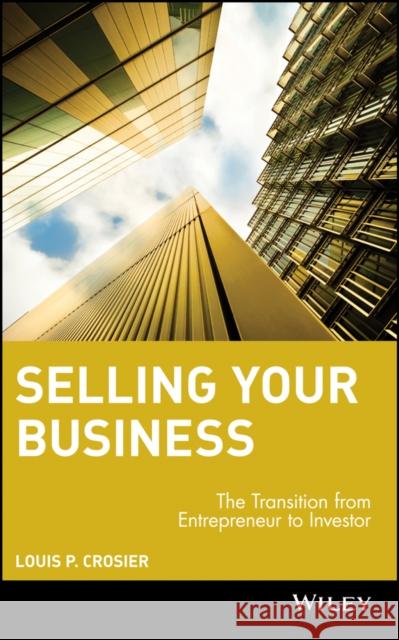
Louis P. Crosier
Selling Your Business: The Transition from Entrepreneur to Investor Crosier, Louis P. 9780471486237 John Wiley & Sons - książkaWidoczna okładka, to zdjęcie poglądowe, a rzeczywista szata graficzna może różnić się od prezentowanej.

Selling Your Business: The Transition from Entrepreneur to Investor

ISBN-13: 9780471486237 / Angielski / Twarda / 2004 / 352 str.

Louis P. Crosier
cena 182,54
(netto: 173,85 VAT:  5%)

Najniższa cena z 30 dni: 180,05
Termin realizacji zamówienia:
ok. 16-18 dni roboczych.

Darmowa dostawa!

Twenty-three top advisors from leading firms show entrepreneurs how to transition their business
The Entrepreneur's Transition provides an all-in-one handbook for entrepreneurs and corporate insiders seeking advice on their personal financial planning prior to selling or taking a business public. It provides a concise, easy-to-read blueprint that can help business leaders navigate before and after a transaction-so they are well positioned and can avoid costly mistakes. The Entrepreneur's Transition is organized chronologically beginning with the issues a business owner should be concerned with prior to a transaction. It then moves, step by step, through the transaction process and into post transaction diversification, reinvestment, and philanthropy.
Louis Crosier (Boston, MA) is a principal at Windward Investment Management and serves as a member of Windward's Investment Committee. His responsibilities include managing client portfolios and overseeing the firm's investment consulting practice.


Kategorie:
Nauka, Ekonomia i biznes
Kategorie BISAC:
Business & Economics > Ekonomia
Wydawca:
John Wiley & Sons
Język:
Angielski
ISBN-13:
9780471486237
Rok wydania:
2004
Ilość stron:
352
Waga:
0.56 kg
Wymiary:
23.67 x 15.39 x 2.97
Oprawa:
Twarda
Wolumenów:
01
Dodatkowe informacje:
Obwoluta
Wydanie ilustrowane

Foreword (Edward I. Rudman, Co–Founder and Chairman, Pell Rudman, now Atlantic Trust Pell Rudman).

Introduction (Louis P. Crosier).

Part I: Before Selling Your Business.

Chapter 1: Pre–IPO/Presale Planning (William R. Fleming, Director; and Daniel Carbonneau, Senior Manager; with Richard L. Kohan, Partner, PricewaterhouseCoopers).

Setting the Stage.

Choosing a Business Structure.

Building a Professional Service Team.

Obtaining Financing.

Sharing Ownership with Employees.

Company Benefits and Policies.

Conclusion.

Chapter 2: Trust and Estate Basics (A. Silvana Giner, Senior Partner; and Kimberly Cohen, Junior Partner, Hale & Dorr).

Basic Wealth Transfer Tools.

Presale and Pre–IPO Planning.

Complex Wealth Transfer and Estate Planning Issues.

Summary.

Chapter 3: Life Insurance: From the Basics to the Advanced (Herbert K. Daroff, J.D., CFP®, Baystate Financial Services).

Permanent Insurance.

Term Insurance.

What Product Is Best?

Buying Term and Investing the Difference, but in a Tax–Advantaged Manner.

How Your Money Gets Invested.

Expenses.

Assessing Cash Value During Lifetime.

Selecting the Right Premium Amount.

Selecting the Right Premium Payer.

Who Should Own the Insurance?

Who Should Be Insured?

Conclusion.

Chapter 4: Negotiating the Deal (F. George Davitt, Partner, Testa, Hurwitz & Thibeault; and Barry Nalebuff, Ph.D., Milton Steinbach Professor of Management, Yale University School of Management).

Sell Your Company Right.

An Open Selling Process.

A Closed Selling Process.

Paying Bidders to Play.

Right of First Refusal.

Right of First Offer.

An Offer You Can t Refuse.

Professional Help.

Earn–Outs.

Earn–Ins.

Commonly Mistaken Assumptions.

Sale or IPO?

The IPO Route.

Selling Rather Than Going Public.

Sale for Cash or Stock.

Conclusion.

Part II: After Selling Your Business.

Chapter 5: How Your Life Changes: Psychology of a Windfall (Marty Carter, Family Wealth Counselor, Charles D. Haines LLC; and Charles W. Collier, Senior Philanthropic Advisor, Harvard University).

Impact of the Sale on the Entrepreneur.

Impact of Wealth on the Entire Family.

Conclusion.

Chapter 6: Overview of the Wealth Management Industry (David M. Spungen, Managing Partner, Hillview Capital Advisors).

Investment Office.

One–Stop Shop.

Hybrid.

How to Evaluate Wealth Management Firms.

Chapter 7: Managing Concentrated and Restricted Stock Positions (David N. Elan, CFA).

Restricted Stock and Equity Risk Management.

Definitions and Examples.

Public Policy and Rule 144 of the Securities Act of 1933.

Registration Rights.

Hedging and Taxation.

Derivative Strategies.

Nonderivative Strategies.

Negotiating with Broker–Dealers and Finding the Best Counterparty.

Philanthropic Strategies.

Professional Advice.

Chapter 8: Asset Allocation (Stephen J. Cucchiaro, President and Chief Investment Officer, Windward Investment Management).

Conclusion.

Chapter 9: Developing an Investment Policy Statement (Ramelle M. Hieronymus, Principal, Prime, Buchholz & Associates).

Investment Objectives.

Spending Guidelines.

Asset Allocation.

Rebalancing.

Manager Selection and Evaluation.

Limitations and Restrictions.

Communication and Reporting.

Summary.

Sample Statement of Investment Objectives, Goals, and Policy Guidelines.

Part III: Investing for the Long Term.

Chapter 10: Selecting Investment Managers (Paul Greenwood, Director of US Equity Investment Management & Research, Russell Investment Group).

Active or Passive?

Four Ps.

People and Organization.

Portfolios.

Performance 163

Summary 164

Chapter 11: Risk: How Much Should You Take? (Paula Boyer Kennedy, CPA, CFP®).

Risks of Specific Asset Classes.

Market Timing.

Measuring Risk.

Risk–Adjusted Returns.

Tax Risk.

How Do You Minimize Risk?

How Do You Maximize Return While Minimizing Risk?

Time and Risk.

The Psychology of Risk.

How Much Risk Should You Take?

Chapter 12: Fixed Income (Peter B. Coffin, President, Breckinridge Capital Advisors).

Municipal Market Inefficiencies.

Portfolio Construction.

Duration A Portfolio s Sensitivity to Changes in Interest Rates.

Ladders versus Barbells.

Credit Quality and Default Risk.

Ratings and Bond Insurance.

Pre–Refunded/Escrowed Municipal Bonds.

High–Yield Municipal Bonds.

Premium versus Discount Bonds.

Call (Early Redemption).

Conclusion.

Chapter 13: Global Investing (Lindsey A. Richardson, Principal, State Street Global Advisors).

Theoretical Benefits of Non–U.S. Investing.

Forces of Globalization.

American Depository Receipts versus Local Stocks.

Diversification and Returns.

Opportunity Set.

Global Mandates.

Currency.

Selecting Managers.

Conclusion.

Chapter 14: Real Estate (Nicholas Bienstock, Managing Partner, Savanna Partners; with Laura Corwin Burkhart, Founder, Slate Capital).

Why Invest in Real Estate?

Real Estate Asset Classes.

Real Estate Investment Options.

Conclusion.

Chapter 15: Private Equity (Sallie Shuping Russell, General Partner, Intersouth Partners).

Types of Private Equity Investments.

Who Will Invest My Money?

Common Terms and Conditions.

Portfolio Example.

Conclusion.

Chapter 16: Hedge Funds (DeFred G. Folts III, President, Mettowee Capital Advisors).

Industry Characteristics and Background.

Different Types of Hedge Fund Strategies.

Risk–Adjusted Rates of Return Among Hedge Fund Strategies.

Variability of Returns Among Hedge Fund Strategies.

Why Invest in Hedge Funds?

How to Think About Incorporating Hedge Funds into a Portfolio.

How to Invest in Hedge Funds: Funds of Funds versus Individual Managers.

What to Look for in a Hedge Fund Manager.

Conclusion.

Chapter 17: Performance (Robert E. Phillips, Ph.D., President, R.E. Phillips Systems).

Single–Period Return Calculations.

Multiperiod Return Calculations.

Comparing Portfolio Returns.

Composite Performance.

Adjusting Returns for Risk.

Estimating Risk–Adjusted Return.

Comparative Evaluation of Investment Performance.

Chapter 18: Ongoing Management and Accountability (Douglas Ederle, Managing Director, SCS Financial and; Todd Millay, Partner, CCC Alliance).

Range of Structures for Ongoing Management.

Basic Monitoring Criteria for External Providers.

Reviewing Your Provider s Peformance over Time.

Provider–Specific Issues to Watch.

Summary.

Part IV: Philanthropy.

Chapter 19: Philanthropy and the Venturesome Donor (Stephen P. Johnson, Vice President, The Philanthropic Initiative).

Why Give?

Getting Started Some Definitions.

Getting Started The Advisor s Role.

Getting Started Some Questions.

Giving Well Qualities of Effective Philanthropy.

Vehicles for Giving.

Direct Gifts.

Conclusion.

Conclusion Getting It Right: The Key Decisions You Will Make (Louis P. Crosier).

Index.

LOUIS P. CROSIER is a Principal at Windward Investment Management and serves as a member of Windward s Investment Committee. His responsibilities include managing client portfolios and overseeing the firm s investment consulting practice. Prior to joining Windward, Crosier worked in the investment management and consulting industries, most recently as a vice president in the Private Client Group at Goldman Sachs. His experience includes advising clients with regard to single stock risk management, asset allocation, portfolio construction, and manager selection. Prior to Goldman Sachs, Crosier worked as a manager of business development and product manager at Cambridge Energy Research Associates, an international energy research and consulting firm. Crosier earned a BA in French literature and psychology at Dartmouth College, a master s in education from Harvard University, and an MBA from the Amos Tuck School.

Praise for Selling Your Business

"After selling the business, an entrepreneur suddenly becomes the newly appointed CEO of My Wealth Inc. To avoid being a sitting duck for the skilled sales pitch, this book should prove invaluable. The experts assembled by Louis Crosier address all the key challenges, and importantly, avoid pat answers instead they provide the entrepreneur with the right questions to ask."
Charlotte B. Beyer, Founder and CEO
The Institute for Private Investors

"An outstanding personal–wealth–management handbook for entrepreneurs. I will give it to founders and early employees of my portfolio companies."
A. Dana Callow Jr., Managing General Partner
Boston Millennia Partners

"Successful entrepreneurship does not imply expertise in personal financial planning. Twenty–five years of experience as a planner has convinced me that even the best and brightest will be well served by an education in personal planning. Selling Your Business delivers a terrific educational guide for anyone transitioning from entrepreneur to investor. In business terms, Selling Your Business s return on investment is first–class."
Harold R. Evensky, Chairman
Evensky, Brown & Katz

"This is a terrific, no–holds–barred manual on how to sell your business and manage financial success. Many have written about how to put money into a company. Selling Your Business describes the nuts and bolts of something more important how to get your money back out and what to do once you ve gotten it."
David Roux, Managing Director
Silver Lake Partners

"This book should be required reading for entrepreneurs and family business owners. As Louis Crosier points out so well, preparing for wealth is a complex process and should begin early. If you are a senior level manager or a founder of a venture–backed company, you will benefit from the collective wisdom of this book. It is an excellent resource one you will refer to time and again."
Alan Spoon, Managing General Partner
Polaris Venture Partners

Crosier, Louis P. LOUIS P. CROSIER is a Principal at Windward Invest... więcej >


Udostępnij

Facebook - konto krainaksiazek.pl


Opinie o Krainaksiazek.pl na Opineo.pl

Partner Mybenefit

Krainaksiazek.pl w programie rzetelna firma Krainaksiaze.pl - płatności przez paypal

Czytaj nas na:

Facebook - krainaksiazek.pl
  • książki na zamówienie
  • granty
  • książka na prezent
  • kontakt
  • pomoc
  • opinie
  • regulamin
  • polityka prywatności

Zobacz:

  • Księgarnia czeska

  • Wydawnictwo Książkowe Klimaty

1997-2026 DolnySlask.com Agencja Internetowa

© 1997-2022 krainaksiazek.pl
     
KONTAKT | REGULAMIN | POLITYKA PRYWATNOŚCI | USTAWIENIA PRYWATNOŚCI
Zobacz: Księgarnia Czeska | Wydawnictwo Książkowe Klimaty | Mapa strony | Lista autorów
KrainaKsiazek.PL - Księgarnia Internetowa

Polityka prywatnosci - link
Krainaksiazek.pl - płatnośc Przelewy24
Przechowalnia Przechowalnia





