The Changing Status of Arable Habitats in Europe: A Nature Conservation Review » książka





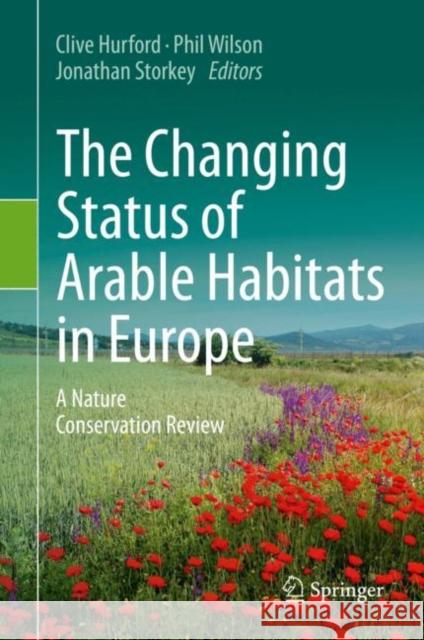
The Changing Status of Arable Habitats in Europe: A Nature Conservation Review
ISBN-13: 9783030598747 / Angielski / Twarda / 2021 / 364 str.
The Changing Status of Arable Habitats in Europe: A Nature Conservation Review
ISBN-13: 9783030598747 / Angielski / Twarda / 2021 / 364 str.
(netto: 674,69 VAT: 5%)
Najniższa cena z 30 dni: 655,41
ok. 16-18 dni roboczych.
Darmowa dostawa!
Preface
PART I: Introduction
Chapter 1 – An Introduction to Arable Habitats
Phil Wilson and Chris Stoate
PART II: The Status of Arable Plants in European Regions
Chapter 2 – The Status of Arable Plant Habitats in Eastern Europe
Gyula Pinke
Chapter 3 – The Status of Arable Plant Habitats in North West Europe
Guillaume Fried
Chapter 4 - The Status of Arable Plant Habitats in Mediterranean Countries
Jordi Recesens
Chapter 5 – The Status of Arable Plant Habitats in Central Europe
Stefan Meyer
Chapter 6 – The Status of Arable Plant Habitats in the UK
Jonathan Storkey
Chapter 7 – The Status of Arable Plant Habitats in Scandinavian Countries
Terho Hyvonen
Chapter 8 – The Status of Arable Plant Habitats in Baltic States
Tsipe Aavik
PART III: Habitat and Species Case Studies
Chapter 9 – The Changing Status of the Little Bustard (Tetrax Tetrax) and Other Steppe Bird Species in Spain
Santi Mañosa
Chapter 10 – Managing Agro-Ecosystems for Farmland Bird Conservation: Success Stories
Will Peach
Chapter 11 – The History, Current State and Conservation Perspectives of the Czech Grey Partridge (Perdix Perdix) Population
Miroslav Salek and Mirek Zámečník
Chapter 12 – The Impact of Land Use Change on Arable Plants and Farmland Bird Populations on a Farm in SW Wales
Clive Hurford
Chapter 13 – Pollinators in Arable Habitats
Sandrine Petit
Chapter 14 - Agricultural Intensification, Environmental-Friendly Farming ̶̶̶ and the Fate of Arable Bryophytes in Switzerland
Irene Bisang and Ariel Bergamini
Chapter 15 – The Ex-Situ Conservation and Subsequent Reintroduction of the Most Vulnerable Arable Plants In Skåne, Sweden
Gabrielle Rosquist
Chapter 16 – The Ex-Situ Conservation of Darnel (Lolium Temulentum) In the UK
Dominic Price
PART IV: Long-Term Studies
Chapter 17 – The Evolution in Time and Space of the Flora and Fauna Associated to the Huelva Countryside (SW Spain) through its Agricultural Changes
Enrique Sánchez Gullón and Adolfo Muñoz Rodriguez
Chapter 18 – Long-Term Trends In Grey Partridges (Perdix Perdix) In Southern England. Unprecedented Declines And Population Recovery
N.J. Aebischer, J.A. Ewald, J.A., and N.W. Sotherton
Chapter 19 – The Impacts of Farming Practices on Invertebrates Over the Last 50 Years
J. A. Ewald and N.J. Aebischer
Chapter 20 – Lessons From 25 Years of Ecological Monitoring of a Farmed Landscape
Vincent Bretagnolle and Sabrina Gaba
PART V: Looking Ahead: Considerations, Applications and Recommendations
Chapter 21 – The Use of Open Source Satellite Images for Monitoring Land-Use and Condition
Alan Brown
Chapter 22 – The Contributions of Earth Observation to the Conservation of Arable Habitats
Richard Lucas and Clive Hurford
Chapter 23 – The Art of Agri-Environment in the UK
Emily Swan
Chapter 24 – Research and Management Needs: Looking Ahead
Phil Wilson, Chris Stoate, et al.
Clive Hurford is a botanist who has worked in the field of nature conservation since the late 1970s, initially as an ornithologist with the Royal Society for the Protection of Birds and then as a botanical surveyor for the Countryside Council for Wales (CCW). Since 1992 he has focused primarily on habitat monitoring and led a field team to demonstrate the links between conservation management and monitoring on Natura 2000 sites for an EU/CCW Life Project. More recently he was ‘Conservation Monitoring Advisor for International Sites’ for CCW and Natural Resources Wales. He is the lead editor / author of two edited volumes on monitoring nature conservation and regularly coordinates international workshops on the subject. He has a long-standing interest in habitats with a cultural history, especially arable habitats. After 27 years working for the Welsh conservation agencies, he is now the founder and director of Serapias; an ecological monitoring consultancy.
Dr Jonathan Storkey is a plant ecologist working in agro-ecosystems. His research focusses on applying ecological principles to the management and conservation of non-crop biodiversity in agricultural landscapes while maintaining crop productivity. Work in this area is increasingly showing that the ‘choice’ between managing arable habitats for optimal productivity or conservation of biodiversity is a false dichotomy and sustainable cropping systems cannot be maintained in the absence of a healthy ecosystem. Jonathan’s work on the drivers of declines in arable plant communities based on an understanding of the response plant traits and the implications for higher trophic groups is internationally recognized and he is currently working with colleagues in the UK and Europe to use this knowledge to design more sustainable agricultural landscapes for the future.
Phil Wilson has been studying the ecology of Britain’s arable flora since the 1980s, and was awarded a PhD for his pioneering work on the conservation of this neglected group of plants in 1990. He has continued this work to the present day, and has been involved in the design and monitoring of agri-environment scheme options for arable plants, has co-authored a field-guide, worked with Plantlife on methods for the assessment of Important Arable Plant Areas and runs regular training courses. He has been a freelance vegetation ecologist for 30 years and has a comprehensive knowledge of British plant communities, their ecology and their management. His work has also included investigations into the conservation ecology of a range of rare grassland plants. He lives in the south-west of England and is the co-owner of a small farm with species-rich grassland managed by native breed cattle and sheep.
This edited volume documents the current nature conservation status of arable habitats in Europe. Arable farming systems have evolved in the European landscape over more than ten thousand years and now occupy nearly 30% of the European land area. They support species that have life cycles closely synchronised with traditional cereal growing, many of which have experienced massive declines throughout Europe. For example, in Britain, of the 100 plant species exhibiting the greatest declines in the latter half of the 20th century, 47 were typical of arable land. Despite this the habitat and many of the species associated with it remains unprotected across much of Europe.
In 22 chapters a range of topics are covered including:
- · Regional accounts describing the impact of changing agricultural practices on the arable flora;
- · The results of research and surveillance projects on the soil organisms, bryophyte flora, invertebrate fauna and pollinators of arable habitats;
- · The potential for designing multifunctional and resilient agricultural landscapes;
- · The use of ex situ conservation to aid the reintroduction of rare arable plants;
- · Case studies illustrating how changing agricultural practices have impacted on bird populations in Europe;
- · The roles of remote sensing in monitoring agricultural systems;
- · How agri-environment schemes can help restore the biodiversity in arable habitats; and
- · A look forward at ways to help ensure the future security of the species associated with arable habitats.
It is clear that the biodiversity of arable land throughout Europe has undergone major changes, particularly during the second half of the 20th century, and that these changes are continuing into the 21st century. We need to develop a deeper appreciation of farmland wildlife and its integration into farming systems to ensure its future security in a world where value is increasingly expressed in terms of material profit.
This book is particularly relevant to practitioners, policy-makers and managers working in the fields of nature conservation, agri-environment schemes and land management, and to researchers working in the fields of conservation biology, terrestrial ecology, nature conservation, applied ecology, biodiversity, agriculture, agricultural ethics and environmental studies.




Czytaj nas na:
1997-2026 DolnySlask.com Agencja Internetowa
KrainaKsiazek.PL - Księgarnia Internetowa


