• Wyszukiwanie zaawansowane
  • Kategorie
  • Kategorie BISAC
  • Książki na zamówienie
  • Promocje
  • Granty
  • Książka na prezent
  • Opinie
  • Pomoc
  • Załóż konto
  • Zaloguj się

Source Code Optimization Techniques for Data Flow Dominated Embedded Software » książka


zaloguj się | załóż konto
Logo Krainaksiazek.pl

koszyk

konto

szukaj
topmenu
Księgarnia internetowa
Szukaj
Książki na zamówienie
Promocje
Granty
Książka na prezent
Moje konto
Pomoc
 
 
Wyszukiwanie zaawansowane
Pusty koszyk
Bezpłatna dostawa dla zamówień powyżej 20 złBezpłatna dostawa dla zamówień powyżej 20 zł

Kategorie główne

• Nauka
 [2950560]
• Literatura piękna
 [1849509]

  więcej...
• Turystyka
 [71097]
• Informatyka
 [151150]
• Komiksy
 [35848]
• Encyklopedie
 [23178]
• Dziecięca
 [617388]
• Hobby
 [139064]
• AudioBooki
 [1657]
• Literatura faktu
 [228597]
• Muzyka CD
 [383]
• Słowniki
 [2855]
• Inne
 [445295]
• Kalendarze
 [1464]
• Podręczniki
 [167547]
• Poradniki
 [480102]
• Religia
 [510749]
• Czasopisma
 [516]
• Sport
 [61293]
• Sztuka
 [243352]
• CD, DVD, Video
 [3414]
• Technologie
 [219456]
• Zdrowie
 [101002]
• Książkowe Klimaty
 [124]
• Zabawki
 [2311]
• Puzzle, gry
 [3459]
• Literatura w języku ukraińskim
 [254]
• Art. papiernicze i szkolne
 [8079]
Kategorie szczegółowe BISAC

Source Code Optimization Techniques for Data Flow Dominated Embedded Software

ISBN-13: 9781441952547 / Angielski / Miękka / 2011 / 226 str.
Heiko Falk;Peter Marwedel
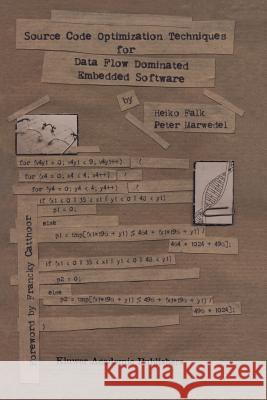
Source Code Optimization Techniques for Data Flow Dominated Embedded Software Heiko Falk, Peter Marwedel 9781441952547 Springer-Verlag New York Inc. - książkaWidoczna okładka, to zdjęcie poglądowe, a rzeczywista szata graficzna może różnić się od prezentowanej.

Source Code Optimization Techniques for Data Flow Dominated Embedded Software

ISBN-13: 9781441952547 / Angielski / Miękka / 2011 / 226 str.

Heiko Falk;Peter Marwedel
cena 622,31
(netto: 592,68 VAT:  5%)

Najniższa cena z 30 dni: 597,43
Termin realizacji zamówienia:
ok. 22 dni roboczych
Dostawa w 2026 r.

Darmowa dostawa!

This book focuses on source-to-source code transformations that remove addressing-related overhead present in most multimedia or signal processing application programs. This approach is complementary to existing compiler technology. What is particularly attractive about the transformation flow pre- sented here is that its behavior is nearly independent of the target processor platform and the underlying compiler. Hence, the different source code trans- formations developed here lead to impressive performance improvements on most existing processor architecture styles, ranging from RISCs like ARM7 or MIPS over Superscalars like Intel-Pentium, PowerPC, DEC-Alpha, Sun and HP, to VLIW DSPs like TI C6x and Philips TriMedia. The source code did not have to be modified between processors to obtain these results. Apart from the performance improvements, the estimated energy is also significantly reduced for a given application run. These results were not obtained for academic codes but for realistic and rep- resentative applications, all selected from the multimedia domain. That shows the industrial relevance and importance of this research. At the same time, the scientific novelty and quality of the contributions have lead to several excellent papers that have been published in internationally renowned conferences like e. g. DATE. This book is hence of interest for academic researchers, both because of the overall description of the methodology and related work context and for the detailed descriptions of the compilation techniques and algorithms.


Kategorie:
Technologie
Kategorie BISAC:
Computers > Software Development & Engineering - General
Computers > Computer Science
Technology & Engineering > Electrical
Wydawca:
Springer-Verlag New York Inc.
Język:
Angielski
ISBN-13:
9781441952547
Rok wydania:
2011
Dostępne języki:
Angielski
Wydanie:
Softcover Repri
Ilość stron:
226
Waga:
0.39 kg
Wymiary:
23.523.5 x 15.5
Oprawa:
Miękka
Wolumenów:
01

List Of Figures. List Of Tables. Acknowledgments. Foreword. 1. Introduction. 1.1. Why Source Code Optimization? 1.1.1. Abstraction Levels Of Code Optimization. 1.1.2. Survey Of The Traditional Code Optimization Process. 1.1.3. Scopes For Code Optimization. 1.2. Target Application Domain. 1.3. Goals And Contributions. 1.4. Outline Of The Book. 2. Existing Code Optimization Techniques. 2.1. Description Optimization. 2.2. Algorithm Selection. 2.3. Memory Hierarchy Exploitation. 2.4. Processor ­Independent Source Code Optimizations. 2.5. Processor­ Specific Source Code Optimizations. 2.6. Compiler Optimizations. 2.6.1. Loop Optimizations For High Performance Computing. 2.6.2. Code Generation For Embedded Processors. 3. Fundamental Concepts For Optimization And Evaluation. 3.1. Polyhedral Modeling. 3.2. Optimization Using Genetic Algorithms. 3.3. Benchmarking Methodology. 3.3.1. Profiling Of Pipeline And Cache Performance. 3.3.2. Compilation For Runtime And Code Size Measurement. 3.3.3. Estimation Of Energy Dissipation. 3.4. Summary. 4. Intermediate Representations. 4.1. Low-Level Intermediate Representations. 4.1.1. GNU RTL. 4.1.2. Trimaran ELCOR IR. 4.2. Medium-Level Intermediate Representations. 4.2.1. Sun IR. 4.2.2. IR-C / LANCE. 4.3. High­ Level Intermediate Representations. 4.3.1. SUIF. 4.3.2. IMPACT. 4.4. Selection Of An IR For Source Code Optimization. 4.5. Summary. 5. Loop Nest Splitting. 5.1. Introduction. 5.1.1. Control Flow Overhead In Data Dominated Software. 5.1.2. Control Flow Overhead Caused By Data Partitioning. 5.1.3. Splitting Of Loop Nests For Control Flow Optimization. 5.2. Related Work. 5.3. Analysis And Optimization Techniques For Loop Nest Splitting. 5.3.1. Preliminaries. 5.3.2. Condition Satisfiability. 5.3.3. Condition Optimization. 5.3.3.1. Chromosomal Representation. 5.3.3.2. Fitness Function. 5.3.3.3. Polytope Generation. 5.3.4. Global Search Space Construction. 5.3.5. Global Search Space Exploration. 5.3.5.1. Chromosomal Representation. 5.3.5.2. Fitness Function. 5.3.6. Source Code Transformation. 5.3.6.1. Generation Of The Splitting If-Statement. 5.3.6.2. Loop Nest Duplication. 5.4. Extensions For Loops With Non-Constant Bounds. 5.5. Experimental Results. 5.5.1. Stand-Alone Loop Nest Splitting. 5.5.1.1. Pipeline And Cache Performance. 5.5.1.2. Execution Times And Code Sizes. 5.5.1.3. Energy Consumption. 5.5.2. Combined Data Partitioning And Loop Nest Splitting For Energy-Efficient Scratchpad Utilization. 5.5.2.1. Execution Times And Code Sizes. 5.5.2.2. Energy Consumption. 5.6. Summary. 6. Advanced Code Hoisting. 6.1. A Motivating Example. 6.2. Related Work. 6.3. Analysis Techniques For Advanced Code Hoisting. 6.3.1. Common Subexpression Identification. 6.3.1.1. Collection Of Equivalent Expressions. 6.3.1.2. Computation Of Live Ranges Of Expressions. 6.3.2. Determination Of The Outermost Loop For A CSE. 6.3.3. Computation Of Execution Frequencies Using Polytope Models. 6.4. Experimental Results. 6.4.1. Pipeline And Cache Performance. 6.4.2. Execution Times And Code Sizes. 6.4.3. Energy Consumption. 6.5. Summary. 7. Ring Buffer Replacement. 7.1. Motivation. 7.2. Optimization Steps. 7.2.1. Ring Buffer Scalarization. 7.2.2. Loop Unrolling For Ring Buffers. 7.3. Experimental Results. 7.3.1. Pipeline And Cache Performance. 7.3.2. Execution Times And Code Sizes. 7.3.3. Energy Consumption. 7.4. Summary. 8. Summary And Conclusions. 8.1. Summary And Contribution To Research. 8.2. Future Work. Appendices: Experimental Comparison Of SUIF And IR-C / LANCE. Benchmarking Data For Loop Nest Splitting. B.1. Values Of Performance-Monitoring Counters. B.1.1. Intel Pentium III. B.1.2. Sun Ultrasparc III. B.1.3. MIPS R10000. B.2. Execution Times And Code Sizes. B.3. Energy Consumption Of An ARM7TDMI Core. B.4. Combined Data Partitioning And Loop Nest Split

Dr. Peter Marwedel received his PhD in Physics from the University of Kiel in 1974. He is one of the early researchers in high level synthesis, working on the MIMOLA system for a number of years. Dr. Marwedel is a professor at the University of Dortmund since 1989. He has served as the chairman of the computer science department, has played a leading role in establishing the Design, Automation and Test in Europe (DATE) conference and is the chairman of the Informatik Centrum Dortmund (ICD), a technology transfer centre.


Udostępnij

Facebook - konto krainaksiazek.pl


Opinie o Krainaksiazek.pl na Opineo.pl

Partner Mybenefit

Krainaksiazek.pl w programie rzetelna firma Krainaksiaze.pl - płatności przez paypal

Czytaj nas na:

Facebook - krainaksiazek.pl
  • książki na zamówienie
  • granty
  • książka na prezent
  • kontakt
  • pomoc
  • opinie
  • regulamin
  • polityka prywatności

Zobacz:

  • Księgarnia czeska

  • Wydawnictwo Książkowe Klimaty

1997-2025 DolnySlask.com Agencja Internetowa

© 1997-2022 krainaksiazek.pl
     
KONTAKT | REGULAMIN | POLITYKA PRYWATNOŚCI | USTAWIENIA PRYWATNOŚCI
Zobacz: Księgarnia Czeska | Wydawnictwo Książkowe Klimaty | Mapa strony | Lista autorów
KrainaKsiazek.PL - Księgarnia Internetowa

Polityka prywatnosci - link
Krainaksiazek.pl - płatnośc Przelewy24
Przechowalnia Przechowalnia





