• Wyszukiwanie zaawansowane
  • Kategorie
  • Kategorie BISAC
  • Książki na zamówienie
  • Promocje
  • Granty
  • Książka na prezent
  • Opinie
  • Pomoc
  • Załóż konto
  • Zaloguj się

Risk Management of Chemicals in the Environment » książka


zaloguj się | załóż konto
Logo Krainaksiazek.pl

koszyk

konto

szukaj
topmenu
Księgarnia internetowa
Szukaj
Książki na zamówienie
Promocje
Granty
Książka na prezent
Moje konto
Pomoc
 
 
Wyszukiwanie zaawansowane
Pusty koszyk
Bezpłatna dostawa dla zamówień powyżej 20 złBezpłatna dostawa dla zamówień powyżej 20 zł

Kategorie główne

• Nauka
 [2952079]
• Literatura piękna
 [1850969]

  więcej...
• Turystyka
 [71058]
• Informatyka
 [151066]
• Komiksy
 [35579]
• Encyklopedie
 [23181]
• Dziecięca
 [620496]
• Hobby
 [139036]
• AudioBooki
 [1646]
• Literatura faktu
 [228729]
• Muzyka CD
 [379]
• Słowniki
 [2932]
• Inne
 [445708]
• Kalendarze
 [1409]
• Podręczniki
 [164793]
• Poradniki
 [480107]
• Religia
 [510956]
• Czasopisma
 [511]
• Sport
 [61267]
• Sztuka
 [243299]
• CD, DVD, Video
 [3411]
• Technologie
 [219640]
• Zdrowie
 [100984]
• Książkowe Klimaty
 [124]
• Zabawki
 [2281]
• Puzzle, gry
 [3363]
• Literatura w języku ukraińskim
 [258]
• Art. papiernicze i szkolne
 [8020]
Kategorie szczegółowe BISAC

Risk Management of Chemicals in the Environment

ISBN-13: 9781468456066 / Angielski / Miękka / 2012 / 227 str.
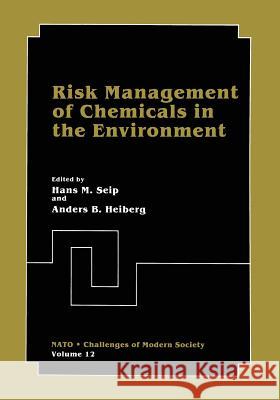
Hans M. Seip; Anders B. Heiberg; Hans M. Seip
Risk Management of Chemicals in the Environment Hans M Anders B Hans M. Seip 9781468456066 Springer - książkaWidoczna okładka, to zdjęcie poglądowe, a rzeczywista szata graficzna może różnić się od prezentowanej.

Risk Management of Chemicals in the Environment

ISBN-13: 9781468456066 / Angielski / Miękka / 2012 / 227 str.

Hans M. Seip; Anders B. Heiberg; Hans M. Seip
cena 201,24
(netto: 191,66 VAT:  5%)

Najniższa cena z 30 dni: 192,74
Termin realizacji zamówienia:
ok. 22 dni roboczych.

Darmowa dostawa!

The Council of the North Atlantic Treaty Organization (NATO) established the "Committee on the Challenges of Modern Society" (CCMS) in 1969. The CCMS was charged with developing meaningful environmental and social programmes for solving existing problems and developing long-range goals for environmental protection. In 1983, at the Fall Plenary of the CCMS, the Norwegian delegate Dr. H.C. Christensen, proposed a Pilot Study on "Risk Management of Chemicals in the Environment." A draft proposal, written by Dr. Kari Kveseth of the Center for Industrial Research in Oslo, was presented. Dr. Christensen also informed the participants at the meeting that Norway was willing to act as the Pilot Country. The project was initially planned for 3 years, but it was later extended through 1987. The inaugural meeting was held in Oslo in April 1984 with participants from Denmark, Greece, France and Italy, in addition to representatives from several Norwegian institutions. The attendees concluded that a Pilot Study, as delineated in the draft proposal, would be useful, and it was decided to work out a detailed project plan based on the proposal.


Kategorie:
Technologie
Kategorie BISAC:
Science > Environmental Science (see also Chemistry - Environmental)
Technology & Engineering > Environmental - Waste Management
Science > Chemistry - Environmental (see also Environmental Science)
Wydawca:
Springer
Seria wydawnicza:
NATO Challenges of Modern Society (Closed)
Język:
Angielski
ISBN-13:
9781468456066
Rok wydania:
2012
Wydanie:
Softcover Repri
Numer serii:
000449120
Ilość stron:
227
Waga:
0.42 kg
Wymiary:
25.4 x 17.78 x 1.3
Oprawa:
Miękka
Wolumenów:
01

1: Pilot Study of Risk Management of Chemicals in the Environment: An Introduction.- 1 Background of the Pilot Study.- 2 Components of Risk Assessment and Risk Management.- 3 Quantitative Decision Analysis Techniques.- 3.1 Cost-benefit analysis.- 3.2 Contingent cost-benefit analysis.- 3.3 Cost-effectiveness analysis.- 3.4 Risk-benefit analysis.- 3.5 Multi-objective decision making techniques.- 4 Public Acceptability.- 5 Outcome of the Pilot Study.- 6 Acknowledgements.- 7 References.- 2: Quantification of Health Risk Due to Chemicals: Methods and Uncertainties.- 1 Introduction.- 2 Methods of Determining Dose-Response Relationships.- 2.1 Epidemiological studies.- 2.2 Indirect methods.- 2.2.1 Long-term tests.- 2.2.2 Short-term tests.- 2.2.3 Extrapolating from animals to humans.- 3 Uncertainties in Health Risk Quantification.- 3.1 Model uncertainty.- 3.2 Parameter uncertainty.- 3.2.1 Sensitivity analysis.- 3.2.2 Probabilistic analysis.- 3.3 Estimation of excess angina attacks caused by exposure to carbon monoxide.- 4 Conclusion.- 5 References.- 3: Methods for Assessing the Risk of Environmental Contamination.- 1 Introduction.- 2 Environmental Risk Analysis.- 2.1 General.- 2.2 Release of a chemical.- 2.3 Transport and fate of chemicals in the environment.- 2.4 Exposure routes.- 2.5 Dose-effect relations.- 2.6 Evaluation of environmental risk analysis tools.- 3 Examples of a simplified approach.- 3.1 Risk analysis of underground storage tanks.- 3.2 Assessing the risk of soil contamination from industrial activities.- 4 Conclusions.- 5 References.- 4: Methods Used in the United States for the Assessment and Management of Health Risk Due to Chemicals.- 1 Introduction.- 2 National Research Council, 1983.- 2.1 Inference guidelines.- 2.2 Guideline development: A history.- 2.3 NAS conclusions and recommendations.- 3 Committee on Science and Technology, 1983.- 4 Office of Science and Technology Policy, 1985.- 5 United States Department of Health and Human Services, 1985.- 6 United States Environmental Protection Agency, 1986.- 6.1 Hazard identification.- 6.2 Dose-response assessment.- 6.3 Exposure assessment.- 6.4 Risk characterization.- 6.5 Summary.- 7 Example of a Recent EPA Risk Assessment.- 8 List of Abbreviations.- 9 References.- 5: Assessment of Ecologic Risks Related to Chemical Exposure: Methods and Strategies Used in the United States.- >1 Current Status.- 2 Future Directions.- 2.1 End points.- 2.1.1 Ecosystem structure end points.- 2.1.2 Ecosystem function end points.- 2.1.3 Population-level end points.- 2.1.4 Physiologic end points.- 2.1.5 End points and ecological risk assessment.- 2.2 Choice of species.- 2.3 Use of models.- 2.4 Resilience and recovery.- 2.5 Development of surrogate systems.- 2.6 Uncertainty.- 2.7 Integrated strategy.- 3 Ecological Risk Assessment Guidelines.- 4 References.- 6: Attitudes toward Risk-Benefit Analysis for Managing Effects of Chemical Exposures.- 1 Introduction.- 2 Data and Methods.- 3 Findings.- 3.1 Risk analysis and benefit-cost analysis.- 3.2 Distribution of risk.- 3.3 Valuation of life.- 4 Conclusion.- 5 Acknowledgement.- 6 Appendix.- 7 References.- 7: Modelling Behaviour of Pollutants in Soil for Risk Assessment Purposes.- 1 Soil Dispersed Contaminants: Behaviour and Risk for Human Exposure.- 2 Processes Occurring in Soil: Theoretical Basis for Modelling.- 2.1 Adsorption and partitioning processes.- 2.2 Water flow in soil.- 2.3 Chemical transport by water flow.- 2.4 Plant uptake.- 2.5 Degradation and transformation processes.- 3 An Empirical Model for the Calculation of Mobility of Chemicals in Soil.- 3.1 Model structure.- 3.2 Sensitivity analysis.- 3.3 Comparison with experimental data: atrazine.- 4 Conclusion.- 5 Acknowledgements.- 6 References.- 8: Environmental and Health Impact Assessment of Soil Pollutants. The Seveso Accident as a Typical Example.- 1 Introduction.- 2 The Seveso accident.- 3 Environmental Persistence of TCDD.- 4 Vertical Distribution of TCDD in soil.- 5 Plant Contamination and Soil-to-Plant Transfer of TCDD.- 6 Soil-to-Air Transfer of TCDD Contaminated Dust.- 7 Discussion and Conclusions.- 8 References.- 9: Mathematical and Biological Uncertainties in the Assessment of a Permissible Blood Lead Concentration.- 1 Introduction.- 2 Uncertainties in the Use of NOAEL.- 3 Mathematical Uncertainty.- 4 Biological Uncertainty.- 4.1 Material and method.- 4.2 Results and comments.- 5 From Risk Assessment to Risk Management.- 6 Acknowledgements l.- 7 References l.- 10: Use of Formal Methods in Evaluating Countermeasures to Coastal Water Pollution. A Case Study of the Kristiansand Fjord, Southern Norway.- 1 Introduction.- 2 The Kristiansand fjord — A Case of Marine Pollution.- 2.1 Pollutant loadings.- 2.1.1 Municipal sewage.- 2.1.2 Factories with effluents flowing into the fjord.- 2.1.3 The river Otra.- 2.1.4 Benthic sediments in Vesterhavn-Fiskåbukta.- 2.2 Observed state of pollution.- 3 Analysis of Countermeasures — Initial Tasks.- 3.1 Effects to be considered — structuring of the abatement problem.- 3.2 Definition of attributes.- 4 Identification of Pollution Control Actions.- 5 Effects of Control Actions.- 5.1 Effect of Action A.- 5.2 Effect of Action B.- 5.3 Effect of Action C.- 5.3.1 Water concentrations.- 5.3.2 Species diversity.- 5.4 Effect of Action D.- 6 Valuation of a Total Cleanup by Use of an Economic Method.- 6.1 Main results.- 6.1.1 One fjord.- 6.1.2 Two fjords.- 6.2 Conclusions.- 7 Valuation of Pollution Control Actions by Use of “SMART”.- 7.1 Methodology.- 7.1.1 The SMART approach.- 7.1.2 Utility function for the Kristiansand fjord.- 7.2 The survey.- 7.2.1 The questionnaire.- 7.2.2 Processing of the data l.- 7.3 Results.- 7.3.1 Step 1: Weighting of environmental factors.- 7.3.2 Step 2: Balancing of costs and benefits.- 7.3.3 Valuation of countermeasures.- 7.3.4 Sediment capping.- 7.3.5 Alternative I versus Alternative II.- 7.4 Assessment of uncertainty.- 7.5 Concluding remarks.- 8 Summary and Conclusions.- 9 Acknowledgement.- 10 References.- 11: Abatement of Air Pollution in Oslo.- 1 Introduction.- 2 Methodological Approach.- 3 Countermeasures.- 4 Objectives and Attributes.- 5 Estimating the Impact of the Countermeasures.- 5.1 The reference state.- 5.2 Exposure assessment and impact assessment.- 5.3 Correction factors l8l.- 6 Valuation of the Impact of the Countermeasures.- 6.1 The evaluation model.- 6.2 Valuations and trade-offs.- 6.3 Elicitation of decision-makers’ preferences.- 7 Results.- 8 Dealing with Uncertainties.- 8.1 Assessing uncertainties.- 8.2 Monte Carlo simulation.- 9 Sensitivity Analysis.- 10 Closing Remarks.- 11 Acknowledgement.- 12 References.- 12: Summary, Conclusions and Recommendations.- 1 Introduction.- 2 Summary of the Individual Chapters in the Report.- 3 Conclusions and Recommendations.- 3.1 General conclusions.- 3.2 Recommendations to the CCMS.- APPENDIX A: Names and addresses of Study Group members.- APPENDIX B: Names and addresses of recipients of CCMS Fellowships who contributed to the Pilot Study.- APPENDIX C: Study Group programme.- APPENDIX D: Work done by recipients of CCMS Fellowships.- APPENDIX E: Questionnaire — Willingness-to-pay survey.- APPENDIX F: Questionnaire — SMART study.- APPENDIX G: Summary report of the Pilot Study on Risk Management of Chemicals in the Environment.


Udostępnij

Facebook - konto krainaksiazek.pl


Opinie o Krainaksiazek.pl na Opineo.pl

Partner Mybenefit

Krainaksiazek.pl w programie rzetelna firma Krainaksiaze.pl - płatności przez paypal

Czytaj nas na:

Facebook - krainaksiazek.pl
  • książki na zamówienie
  • granty
  • książka na prezent
  • kontakt
  • pomoc
  • opinie
  • regulamin
  • polityka prywatności

Zobacz:

  • Księgarnia czeska

  • Wydawnictwo Książkowe Klimaty

1997-2026 DolnySlask.com Agencja Internetowa

© 1997-2022 krainaksiazek.pl
     
KONTAKT | REGULAMIN | POLITYKA PRYWATNOŚCI | USTAWIENIA PRYWATNOŚCI
Zobacz: Księgarnia Czeska | Wydawnictwo Książkowe Klimaty | Mapa strony | Lista autorów
KrainaKsiazek.PL - Księgarnia Internetowa

Polityka prywatnosci - link
Krainaksiazek.pl - płatnośc Przelewy24
Przechowalnia Przechowalnia





