• Wyszukiwanie zaawansowane
  • Kategorie
  • Kategorie BISAC
  • Książki na zamówienie
  • Promocje
  • Granty
  • Książka na prezent
  • Opinie
  • Pomoc
  • Załóż konto
  • Zaloguj się

Optical Characterization of Epitaxial Semiconductor Layers » książka


zaloguj się | załóż konto
Logo Krainaksiazek.pl

koszyk

konto

szukaj
topmenu
Księgarnia internetowa
Szukaj
Książki na zamówienie
Promocje
Granty
Książka na prezent
Moje konto
Pomoc
 
 
Wyszukiwanie zaawansowane
Pusty koszyk
Bezpłatna dostawa dla zamówień powyżej 20 złBezpłatna dostawa dla zamówień powyżej 20 zł

Kategorie główne

• Nauka
 [2946912]
• Literatura piękna
 [1852311]

  więcej...
• Turystyka
 [71421]
• Informatyka
 [150889]
• Komiksy
 [35717]
• Encyklopedie
 [23177]
• Dziecięca
 [617324]
• Hobby
 [138808]
• AudioBooki
 [1671]
• Literatura faktu
 [228371]
• Muzyka CD
 [400]
• Słowniki
 [2841]
• Inne
 [445428]
• Kalendarze
 [1545]
• Podręczniki
 [166819]
• Poradniki
 [480180]
• Religia
 [510412]
• Czasopisma
 [525]
• Sport
 [61271]
• Sztuka
 [242929]
• CD, DVD, Video
 [3371]
• Technologie
 [219258]
• Zdrowie
 [100961]
• Książkowe Klimaty
 [124]
• Zabawki
 [2341]
• Puzzle, gry
 [3766]
• Literatura w języku ukraińskim
 [255]
• Art. papiernicze i szkolne
 [7810]
Kategorie szczegółowe BISAC

Optical Characterization of Epitaxial Semiconductor Layers

ISBN-13: 9783642796807 / Angielski / Miękka / 2011 / 429 str.
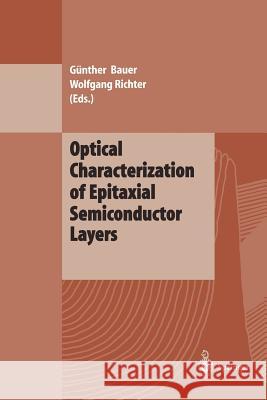
G. Nther Bauer; Wolfgang Richter
Optical Characterization of Epitaxial Semiconductor Layers G. Nther Bauer Wolfgang Richter 9783642796807 Springer - książkaWidoczna okładka, to zdjęcie poglądowe, a rzeczywista szata graficzna może różnić się od prezentowanej.

Optical Characterization of Epitaxial Semiconductor Layers

ISBN-13: 9783642796807 / Angielski / Miękka / 2011 / 429 str.

G. Nther Bauer; Wolfgang Richter
cena 201,72
(netto: 192,11 VAT:  5%)

Najniższa cena z 30 dni: 192,74
Termin realizacji zamówienia:
ok. 22 dni roboczych
Bez gwarancji dostawy przed świętami

Darmowa dostawa!

The characterization of epitaxial layers and their surfaces has benefitted a lot from the enormous progress of optical analysis techniques during the last decade. In particular, the dramatic improvement of the structural quality of semiconductor epilayers and heterostructures results to a great deal from the level of sophistication achieved with such analysis techniques. First of all, optical techniques are nondestructive and their sensitivity has been improved to such an extent that nowadays the epilayer analysis can be performed on layers with thicknesses on the atomic scale. Furthermore, the spatial and temporal resolution have been pushed to such limits that real time observation of surface processes during epitaxial growth is possible with techniques like reflectance difference spectroscopy. Of course, optical spectroscopies complement techniques based on the inter- action of electrons with matter, but whereas the latter usually require high or ultrahigh vacuum conditions, the former ones can be applied in different environments as well. This advantage could turn out extremely important for a rather technological point of view, i.e. for the surveillance of modern semiconductor processes. Despite the large potential of techniques based on the interaction of electromagnetic waves with surfaces and epilayers, optical techniques are apparently moving only slowly into this area of technology. One reason for this might be that some prejudices still exist regarding their sensitivity.


Kategorie:
Technologie
Kategorie BISAC:
Science > Prąd
Technology & Engineering > Electrical
Technology & Engineering > Optics
Wydawca:
Springer
Język:
Angielski
ISBN-13:
9783642796807
Rok wydania:
2011
Wydanie:
Softcover Repri
Ilość stron:
429
Waga:
0.68 kg
Wymiary:
23.5 x 15.5
Oprawa:
Miękka
Wolumenów:
01

1 Introduction.- 2 Analysis of Epitaxial Growth.- 2.1 Vapour Phase Epitaxy: Basics.- 2.2 Gas Phase Diagnostics: Transport.- 2.2.1 Theoretical Considerations.- 2.2.2 Experimental Determination of v and T.- 2.2.2.1 Measurement of Velocities.- 2.2.2.2 Measurement of Temperature.- 2.3 Gas Phase Diagnostics: Reaction Kinetics.- 2.3.1 Optical Techniques.- 2.3.1.1 Absorption Spectroscopy.- 2.3.1.2 Laser Induced Fluorescence.- 2.3.1.3 Spontaneous Raman Scattering.- 2.3.1.4 Coherent Anti-Stokes Raman Scattering.- 2.3.1.5 Other Methods.- 2.3.2 Experimental Results.- 2.3.2.1 Thermal Decomposition of Precursors.- 2.3.2.2 Decomposition Products.- 2.4 Surface Diagnostics.- 2.4.1 Reflectance Anisotropy Spectroscopy (RAS).- 2.4.1.1 Surfaces Under Pregrowth Conditions.- 2.4.1.2 Surfaces During Growth.- 2.4.2 Surface Photo Absorption (SPA).- 2.4.3 Infrared Reflection Absorption Spectroscopy (IRRAS).- 2.4.4 Second Harmonic Generation (SHG).- 2.4.5 Laser Light Scattering (LLS).- 2.5 Conclusions.- 3 Spectroscopic Ellipsometry.- 3.1 Principle of Measurement.- 3.1.1 Null-Ellipsometry.- 3.1.2 Photometric Ellipsometers.- 3.1.3 Description of Light Polarisation.- 3.1.3.1 The Jones Formalism.- 3.1.3.2 Stokes Vectors and Mueller Matrices.- 3.1.4 Rotating Analyser Ellipsometer in the Jones Formalism.- 3.1.5 The Effective Dielectric Function .- 3.2 Experimental Details.- 3.2.1 Rotating Analyser Ellipsometer.- 3.2.2 Photoelastic Modulator Ellipsometer.- 3.2.3 Polarisers.- 3.2.4 Calibration Procedures.- 3.2.5 Experimental Limits.- 3.2.5.1 Angle of Incidence.- 3.2.5.2 Influence of the Windows.- 3.2.6 Trends and New Developments.- 3.3 Interpretation of the Effective Dielectric Function.- 3.3.1 Examples of Dielectric Functions.- 3.3.2 Lineshape Analysis of Optical Gaps.- 3.3.3 Direct Inspection of .- 3.3.4 Single Layers on a Substrate.- 3.3.4.1 The 3-Phase Model.- 3.3.4.2 Determination of Layer Properties.- 3.3.4.3 Ultrathin Layers.- 3.3.5 Inhomogeneous Layers.- 3.4 Characteristic Experimental Examples.- 3.4.1 Interband Critical Points.- 3.4.1.1 Influence of Temperature.- 3.4.1.2 Influence of Defects: Si Implanted GaAs.- 3.4.1.3 Oxide Overlayers.- 3.4.1.4 Size Effects: Microcrystalline Si.- 3.4.2 Semiconductor Heterostructures.- 3.4.2.1 AlGaAs, GaAsP.- 3.4.2.2 InP on InGaAs.- 3.4.2.3 CdS on InP.- 3.4.3 Strained Layers of InGaAs.- 3.4.4 Inhomogeneous Systems: Porous Silicon Layers.- 3.4.5 In-Situ Studies.- 3.4.5.1 Study of GaAs/AlxGa1-xAs Interfaces.- 3.4.5.2 Control of Composition.- 3.4.5.3 Arsenic Layers on Silicon.- 3.4.6 Multilayer Analysis.- 3.5 Sample Related Problems.- 3.5.1 Sample Preparation.- 3.5.2 Multilayer Structures.- 3.5.3 Gradually Varying Composition.- 3.5.4 Anisotropies.- 3.5.5 Quantification of Defects and Strain.- 3.5.6 Depolarisation.- 3.6 Summary.- 4 Raman Spectroscopy.- 4.1 Theory of Raman Spectroscopy.- 4.1.1 Principles of Raman Spectroscopy.- 4.1.2 Electron-Phonon Interaction.- 4.1.3 Resonance Effects.- 4.1.4 Selection Rules.- 4.2 Experimental Setup for Raman Scattering.- 4.2.1 Light Source.- 4.2.2 Raman Spectrometer.- 4.2.3 Multichannel Detector.- 4.2.4 Micro-Raman Spectroscopy.- 4.2.5 In-Situ Experiments.- 4.3 Analysis of Lattice Dynamical Properties.- 4.3.1 Crystalline Order.- 4.3.1.1 Vibrational Modes of Monolayers.- 4.3.1.2 Structure of Thin Overlayers.- 4.3.2 Strain.- 4.3.3 Orientation.- 4.3.4 Composition and Ordering of Mixed Compounds.- 4.3.5 Detection of Reacted Phases.- 4.3.6 Monitoring of Growth.- 4.3.7 Low-Dimensional Effects.- 4.3.7.1 Folded Acoustical Phonons.- 4.3.7.2 Confined Optical Phonons.- 4.3.7.3 Interface Phonons.- 4.4 Analysis of Electronic Properties.- 4.4.1 Electronic Band Structure.- 4.4.2 Impurities.- 4.4.3 Free Carriers.- 4.4.4 Low Dimensional Effects.- 4.5 Band Bending at Interfaces.- 4.5.1 Band Bending Determination by Plasmon-LO-Phonon Modes.- 4.5.2 Band Bending Determination by Electric-Field Induced Raman Scattering.- 4.6 Summary.- 5 Far-Infrared Spectroscopy.- 5.1 Theoretical Foundations.- 5.1.1 Maxwell’s Equations.- 5.1.2 Constitutive Equations and Dispersion Relations.- 5.1.3 Plane Waves in an Isotropic and Homogeneous Medium.- 5.1.4 The Energy Balance.- 5.1.5 Boundary Conditions.- 5.1.6 Coherent and Incoherent Reflection and Transmission of Layered Structures.- 5.1.7 The Dielectric Function ?(?).- 5.1.7.1 The Susceptibility ?PM of Lattice Vibrations.- 5.1.7.2 The Susceptibility ?FC(?) of Free Carriers.- 5.1.8 The Berreman Effect.- 5.1.8.1 The Free Standing Film (?s = 1).- 5.1.8.2 Metal Substrate (??s? ?1).- 5.1.9 Surface Waves.- 5.1.10 Interpretation of Measured Spectra.- 5.2 Fourier Transform Spectroscopy.- 5.2.1 Principle.- 5.2.2 Instrumentation.- 5.3 Determination of Layer Thicknesses.- 5.3.1 Simple Evaluation of Fabry-Perot Interferences.- 5.3.2 Thickness Determination by Fourier Transforms.- 5.3.3 Direct Interferogram Analysis.- 5.3.4 Full Numerical Simulation of Reflectance Spectra.- 5.4 Determination of Carrier Concentrations.- 5.4.1 Semi-Infinite Samples.- 5.4.2 Multilayers.- 5.4.3 Carrier Concentration Profiles.- 5.4.3.1 A Fast Evaluation Scheme for Diffusion Profiles.- 5.5 Confined Electron Systems.- 5.5.1 Properties of Confined Electrons.- 5.5.2 Spectroscopic Techniques.- 5.5.3 Results.- 5.6 Determination of Impurity Concentrations.- 5.6.1 Experimental.- 5.6.2 Impurities in Substrates.- 5.6.2.1 Substitutional Carbon in Silicon.- 5.6.2.2 Interstitial Oxygen in Silicon.- 5.6.2.3 Oxygen Precipitates.- 5.6.3 Impurities in Thin Layers.- 5.7 Shallow Donors and Acceptors.- 5.7.1 Donors and Acceptors in Bulk Materials.- 5.7.2 Donors and Acceptors in Quantum Wells.- 5.8 IR Characterisation of Porous Silicon Layers.- 5.8.1 Effective Medium Theories.- 5.8.2 Examples.- 5.9 Summary.- 6 High Resolution X-Ray Diffraction.- 6.1 Principal Scattering Geometries.- 6.1.1 ? — 2?9-Scan and ?;-Scan (Rocking-curve).- 6.1.2 Double-Crystal Diffraction.- 6.1.3 The 4+1 Crystal Diffractometer.- 6.1.4 Triple-Axis Spectrometer.- 6.1.5 Renninger Scans.- 6.1.6 High-Resolution Multiple-Crystal Multiple-Reflection Diffractometer (HRMCMRD).- 6.2 Kinematical and Dynamical Theory.- 6.3 Thickness Dependence of Bragg Reflections.- 6.4 Strain Phenomena.- 6.4.1 Strains in Epitaxial Layers.- 6.4.2 Partial Relaxation of Strain.- 6.5 Rocking-Curves from Heterostructures.- 6.5.1 Single Heterostructures.- 6.5.2 Composition Gradients.- 6.5.3 Characterisation of Epitaxial Layers Grown Tilted Relative to the Substrates.- 6.6 Multilayer Structures.- 6.6.1 Superlattices.- 6.6.2 Ewald Sphere Construction of SL-Diffraction Diagrams.- 6.6.3 Interpretation of the Fine Structure in X-Ray Diffraction Profiles of SL’s.- 6.6.4 Imperfect MQW’s and Superlattices.- 6.6.4.1 Interdiffusion in MQW’s and SL-Systems.- 6.6.4.2 Imperfect Superlattices: Period, Thickness, Composition Fluctuations.- 6.6.5 Strained-Layer Superlattices: Tilt, Terracing and Mosaic Spread.- 6.7 Scans in the Reciprocal Lattice.- 6.8 New Developments.- 6.8.1 Analysis of Quantum Wire Structures Using HRXRD..- 6.8.2 Real Time X-Ray Diffraction.- 6.9 Grazing-Incidence X-Ray Techniques.- 6.10 Reflection of X-Rays at Grazing Incidence.- 6.11 Specular and Non-Specular Scattering.- 6.12 Grazing-Incidence X-Ray Diffraction.- 6.13 Summary.- 6.14 Concluding Remarks.- References.

The last decade has witnessed an explosive development in the growth of expitaxial layers and structures with atomic-scale dimensions. This progress has created new demands for the characterization of those stuctures. Various methods have been refined and new ones developed with the main emphasis on non-destructive in-situ characterization. Among those, methods which rely on the interaction of electromagnetic radiation with matter are particularly valuable. In this book standard methods such as far-infrared spectroscopy, ellipsometry, Raman scattering, and high-resolution X-ray diffraction are presented, as well as new advanced techniques which provide the potential for better in-situ characterization of epitaxial structures (such as reflection anistropy spectroscopy, infrared reflection-absorption spectroscopy, second-harmonic generation, and others). This volume is intended for researchers working at universities or in industry, as well as for graduate students who are interested in the characterization of semiconductor layers and for those entering this field. It summarizes the present-day knowledge and reviews the latest developments important for future ex-situ and in-situ studies.

Richter, Wolfgang Wolfgang Richter wurde am 16.Marz 1938 in Eisleben... więcej >


Udostępnij

Facebook - konto krainaksiazek.pl


Opinie o Krainaksiazek.pl na Opineo.pl

Partner Mybenefit

Krainaksiazek.pl w programie rzetelna firma Krainaksiaze.pl - płatności przez paypal

Czytaj nas na:

Facebook - krainaksiazek.pl
  • książki na zamówienie
  • granty
  • książka na prezent
  • kontakt
  • pomoc
  • opinie
  • regulamin
  • polityka prywatności

Zobacz:

  • Księgarnia czeska

  • Wydawnictwo Książkowe Klimaty

1997-2025 DolnySlask.com Agencja Internetowa

© 1997-2022 krainaksiazek.pl
     
KONTAKT | REGULAMIN | POLITYKA PRYWATNOŚCI | USTAWIENIA PRYWATNOŚCI
Zobacz: Księgarnia Czeska | Wydawnictwo Książkowe Klimaty | Mapa strony | Lista autorów
KrainaKsiazek.PL - Księgarnia Internetowa

Polityka prywatnosci - link
Krainaksiazek.pl - płatnośc Przelewy24
Przechowalnia Przechowalnia





