• Wyszukiwanie zaawansowane
  • Kategorie
  • Kategorie BISAC
  • Książki na zamówienie
  • Promocje
  • Granty
  • Książka na prezent
  • Opinie
  • Pomoc
  • Załóż konto
  • Zaloguj się

Cohomology Theories for Compact Abelian Groups » książka


zaloguj się | załóż konto
Logo Krainaksiazek.pl

koszyk

konto

szukaj
topmenu
Księgarnia internetowa
Szukaj
Książki na zamówienie
Promocje
Granty
Książka na prezent
Moje konto
Pomoc
 
 
Wyszukiwanie zaawansowane
Pusty koszyk
Bezpłatna dostawa dla zamówień powyżej 20 złBezpłatna dostawa dla zamówień powyżej 20 zł

Kategorie główne

• Nauka
 [2946912]
• Literatura piękna
 [1852311]

  więcej...
• Turystyka
 [71421]
• Informatyka
 [150889]
• Komiksy
 [35717]
• Encyklopedie
 [23177]
• Dziecięca
 [617324]
• Hobby
 [138808]
• AudioBooki
 [1671]
• Literatura faktu
 [228371]
• Muzyka CD
 [400]
• Słowniki
 [2841]
• Inne
 [445428]
• Kalendarze
 [1545]
• Podręczniki
 [166819]
• Poradniki
 [480180]
• Religia
 [510412]
• Czasopisma
 [525]
• Sport
 [61271]
• Sztuka
 [242929]
• CD, DVD, Video
 [3371]
• Technologie
 [219258]
• Zdrowie
 [100961]
• Książkowe Klimaty
 [124]
• Zabawki
 [2341]
• Puzzle, gry
 [3766]
• Literatura w języku ukraińskim
 [255]
• Art. papiernicze i szkolne
 [7810]
Kategorie szczegółowe BISAC

Cohomology Theories for Compact Abelian Groups

ISBN-13: 9783642806728 / Angielski / Miękka / 2011 / 236 str.
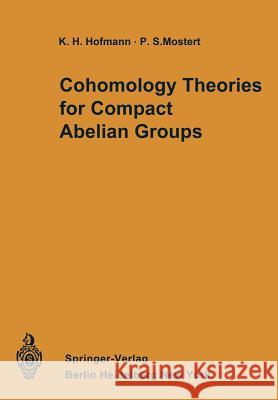
Karl H. Hofmann; Paul S. Mostert; Eric C. Nummela
Cohomology Theories for Compact Abelian Groups Karl H. Hofmann Paul S. Mostert Eric C. Nummela 9783642806728 Springer - książkaWidoczna okładka, to zdjęcie poglądowe, a rzeczywista szata graficzna może różnić się od prezentowanej.

Cohomology Theories for Compact Abelian Groups

ISBN-13: 9783642806728 / Angielski / Miękka / 2011 / 236 str.

Karl H. Hofmann; Paul S. Mostert; Eric C. Nummela
cena 201,72
(netto: 192,11 VAT:  5%)

Najniższa cena z 30 dni: 192,74
Termin realizacji zamówienia:
ok. 22 dni roboczych
Bez gwarancji dostawy przed świętami

Darmowa dostawa!

Of all topological algebraic structures compact topological groups have perhaps the richest theory since 80 many different fields contribute to their study: Analysis enters through the representation theory and harmonic analysis; differential geo metry, the theory of real analytic functions and the theory of differential equations come into the play via Lie group theory; point set topology is used in describing the local geometric structure of compact groups via limit spaces; global topology and the theory of manifolds again playa role through Lie group theory; and, of course, algebra enters through the cohomology and homology theory. A particularly well understood subclass of compact groups is the class of com pact abelian groups. An added element of elegance is the duality theory, which states that the category of compact abelian groups is completely equivalent to the category of (discrete) abelian groups with all arrows reversed. This allows for a virtually complete algebraisation of any question concerning compact abelian groups. The subclass of compact abelian groups is not so special within the category of compact. groups as it may seem at first glance. As is very well known, the local geometric structure of a compact group may be extremely complicated, but all local complication happens to be "abelian." Indeed, via the duality theory, the complication in compact connected groups is faithfully reflected in the theory of torsion free discrete abelian groups whose notorious complexity has resisted all efforts of complete classification in ranks greater than two."


Kategorie:
Nauka, Matematyka
Kategorie BISAC:
Mathematics > Algebra - Abstrakcyjna
Mathematics > Algebra - Liniowa
Wydawca:
Springer
Język:
Angielski
ISBN-13:
9783642806728
Rok wydania:
2011
Wydanie:
Softcover Repri
Ilość stron:
236
Waga:
0.39 kg
Wymiary:
24.41 x 16.99 x 1.3
Oprawa:
Miękka
Wolumenów:
01

I. Algebraic background.- Section 1. On exponential functors.- Definition 1.1. Multiplicative category, exponential functor and polynomial algebra, Hopf algebra — Definition 1.2. Subadditive and sub-multiplicative functors, compatible natural transformations — Lemma 1.3. E2SA and TE1A are algebras when Ei is exponential, S subadditive, T submultiplicative — Lemma 1.4. ? is a morphism of algebras — Lemma 1.5. About coalgebras — Proposition 1.6. E HomR (—, M) ? HomZ (E —, M) is a morphism of graded algebras for E = ?, P — Lemmas 1.10, 1.11. The structure of Hom(PZn, Z) — Lemmas 1.12, 1.13. More about Hom (E—, M) — Proposition 1.14. The structure of Hom (EA, M), E = ?, P — Definition 1.15. Polynomial algebras with divided powers — Proposition 1.16. E Hom (—, M) ? Hom (E —, M) for E = P ? ? — Lemma 1.17. About the natural map ?A Proposition 1.18. The coalgebra Hom (G, Z) — Corollary 1.19. The duality of polynomial algebras and algebras with divided powers — Theorem 1.22. The map PRA ? R ? RB ? Hom ($$\hat PA \otimes {\text{ }} \wedge {\text{ }}\hat B,R$$) — Proposition 1.23. about HomS (K ? L, A) ? HomS (L, Hom (K, A)) for complexes.- Section 2. The arithmetic of certain spectral algebras.- Definition 2.1. Spectral algebra, edge algebra — Lemmas 2.2, 2.3. The derivations d, d?, — Definition 2.4. The functors E2, E3 - Lemma 2.5. The cohomology map preserves multiplication — Lemma 2.6. Definition of the cohomology map ? — Definition 2.7. The first edge algebra and B2P (?) — Definition 2.8. Integral elements in rings, weakly principal ideal rings — Definition 2.10. The formalism of the derivation d? on E2(?) — Definition 2.11. The elementary morphisms — Proposition 2.12. The structure of the edge terms in E3(?) — Lemma 2.13. The elements of ker d?, — Lemma 2.14. The elements of im d? — Proposition 2.16. u ? a8’ ? ua8’: E3II(?) ? a8’ ? E3(?) is injective — Proposition 2.17. The terms next to the edge terms — An explicit example — Corollary 2.18. The terms next to the edge terms for a principal ideal domain as coefficient ring — Lemma 2.20. Passage to the ring of quotients in the coefficient ring — Proposition 2.21. E2(? ? ?) ? E2(?) ? E2(?) — Proposition 2.24, 2.25. Conditions under which d? is exact — Proposition 2.26. The exactness of d? within the ground ring extension — Lemma 2.31. Elementary morphisms yielding the same E3 - Proposition 2.32. The case that ? is a homothety — Proposition 2.33. Elementary morphisms which differ by a scalar — Proposition 2.34. E3(?1 ? ?2) ? E3(?2) if im d(?1) is flat — Proposition 2.35. An inductive process to compute E3(?) if the ground ring is a principal ideal domain — Theorem I. E3(?) is generated as a (P coker ?)-module by M — Definition 2.39. Definition of ? and E2*(?) — Lemma 2.40. The differential modules (E2(?), d’) — Proposition 2.42. About the structure of E3(?) — Propositions 2.43, 2.44. About the PA-module structure of Er(?) — Propositions 2.47, 2.48. Non-injective elementary morphisms.- Section 3. Some analogues of the results about spectral algebras with dual derivations.- Lemma 3.1. The differential and derivative ?? — Definition 3.2, 3.3. The spectral algebras Er[?], Er{?} — Lemma 3.4. E2 [—] is an exponential functor — Lemma 3.5. About ?d + d? — Proposition 3.6. The edge algebra E3II [?] — Definition 3.6a. R-coalgebras, differential graded co-algebras, differential graded Hopf algebras — Proposition 3.7. E2{?} is a differential bi-graded Hopf algebra relative to d?, and ?? — Lemma 3.8. The cofunctor f ? E2 {Hom8 (f, R)} — Lemma 3.9. About the structure of finite abelian groups — Definition 3.10. Standard resolution of a finite abelian group — Lemma 3.11. The uniqueness of standard resolutions —Lemma 3.12. The four term exact sequence derived from an injection — Lemma 3.13. Isomorphic version of ker ?pHom (f, A) — Proposition 3.14. The edge terms in E3 (Hom (f, R)) — Corollary 3.15. The morphism PR Ext (G, R) ?R Hom (? G, R) ? E3 (Hom (f, R)) — Corollary 3.16. The functoriality of this morphism — Propositions 3.17, 3.18. The isomorphisms H (R/Z ? E2(f)) ? E3(f) ? H (E2(f)?)?..- Section 4. The Bockstein formalism.- Lemmas 4.1, 4.2, 4.3, 4.4. Some diagram chasing — Definition 4.5. The definition of pre-Bockstein diagrams and standard Bockstein diagrams — Lemmas 4.6, 4.7, 4.8. About the Bockstein formalism — Proposition 4.9. An isomorphism of exact sequences — Lemma 4.10. More diagram chasing — Proposition 4.11. Sufficient conditions for the Bockstein formalism for complexes — Proposition 4.12. When is the Bockstein differential a derivation? — Corollaries 4.13, 4.14. The standard situation — Proposition 4.15. The Bockstein formalism for the cohomology of groups and complexes — Proposition 4.16. The Bockstein formalism for the spectral algebras E2(?) of Section 2 — Corollary 4.17. A particular case of 4.16..- II. The cohomology of finite abelian groups.- Section 1. Products.- Definition 1.1. The construction of ? — Definition 1.2. The construction of ? — Lemma 1.3. Tensoring resolutions — Corollary 1.4 — Lemma 1.5. The Künneth theorem — Theorem 1.6. The resolution of augmented Hopf algebras — Theorem II. Cohomology and the tensor product of Hopf algebras — Corollary 1.7. About H(G1 × G2, R) — Corollary 1.8. A Künneth theorem for H(G1 × G2, R) — Corollary 1.9. A special case of 1.8 — Corollary 1.10. H(G1 × G2, R) for cyclic G1 — Corollary 1.11. H(G1, R) ? ? ? H(Gn, R) ? H(G1 × ? × Gn, R) — Corollary 1.12. About the annihilator of H+(G1 × G2, R) — Corollary 1.13. About the exponent of H+(G1 × G2, R) — Corollary 1.14. The exponent of H+(G, M) for a finite abelian group G and arbitrary M — Corollary 1.15. H(G, M) ? N ? H(G, M ? N).- Section 2. Special free resolutions for finite abelian groups.- Definition 2.1. Special elements in the group ring of a finite abelian group — Lemma 2.2. About ?: ? ? ? A+ — Lemma 2.3. d? ?d = 0 — Lemma 2.4. The coderivation D = d + ? — Definition 2.5. E(f) and Ê (f) — Lemma 2.6. Ê is exponential — Lemma 2.7. Ê(f) exact — special case — Lemma 2.8. 0 ? Z ? Ê (f) is a resolution — Lemma 2.9. R ?SA Horns (HomS (A, S), R) — Theorem III. Fundamental theorem about the cohomology of finite abelian groups — Lemma 2.10. Hi (G, R/Z) ? Hi+1(G, Z) — Proposition 2.11. Various isomorphisms involving H(G, R/Z) — Lemma 2.12. A categorical lemma — Theorem 2.13. The morphism ?: PR Ext(G, R) ?R Hom(? G, R) ? H(G, R) — Lemma 2.14. A lemma involving the bar resolution — Proposition and Corollaries 2.15-2.18. A relation between the bar resolution and the bi-resolution.- Section 3. About the cohomology of finite abelian groups in the case of trivial action.- Definition 3.1. Recapitulation of the standard resolution — Lemma 3.2. A group theoretical lemma — Proposition 3.3. A special case of Theorem 2.13 — Definition 3.4. The z-constituent of a group — Proposition 3.5. Splitting the z-constituent in H(G, R) — Theorem 3.6. The cohomology of Z (z)n — Corollary 3.7. The Poincaré series for Theorem 3.6 — Corollary 3.8. The additive structure of H (G, Z (z)) for an arbitrary G whose exponent divides z — Proposition 3.9. Decomposing H (G, Z) — Theorem 3.11. A structure theorem for H(G, Z) — Theorem IV. About the structure of the ring H(G, Z) — Corollaries 3.13–3.15. A minimal generating module for H (G, Z) — Theorem V. The complete structure of H(G, R) if R is a field — Example — Proposition 3.16. H(G1 × G2, R) for groups G1, G2 with relatively prime order — Propositions 3.17, 3.18. About the Bocksteins in low dimension — Proposition 3.19. A global version of the previous results.- Section 4. Appendix to Section 3: The low dimensions.- Proposition 4.1. A list for Hi (G, R) for i < 6 — Proposition 4.2 (? G)? ? ?? — Proposition 4.3. A list for Hi (G, R/Z) for i < 4 — A remark about Schur’s multiplicator — Two dimensional cohomology and central extensions.- III. The cohomology of classifying spaces of compact groups.- Section 1. The functor h.- Definition 1.1. The join of two spaces, the iterated join — Proposition 1.2. A Künneth theorem for the join and the relation with the standard Künneth theorem — Corollaries 1.3, 1.4. The acyclicity of iterated joins — Definition 1.5. The spectrum of universal spaces for G and the spectrum of classifying spaces for G. Classifying spaces up to n — Lemma 1.6. The existence of spectra of universal spaces — Definition 1.7. The Milnor spectrum of universal spaces (resp. classifying spaces) for G — Proposition 1.8. Properties of the Milnor spectrum — Definition 1.9. The definition of the functor h — Proposition 1.10. The independence of h from the choice of universal spaces — Proposition 1.11, 1.12. h transforms projective limits into direct limits — Proposition 1.13, 1.14. The Künneth thoerem for h — Corollaries 1.15, 1.16. Comments on h (G’ × G, R) — Propositions 1.17-1.20. The Bockstein formalism for h.- Section 2. The functor h for finite groups.- Definition 2.1. Simplicial objects — Proposition 2.2. Products, equalizers, etc. for simplicial sets — Definition 2.3. Group actions on simplicial sets — Lemma 2.4, 2.5. Free simplicial modules — Proposition 2.6. The equivalence of h(G, R) with H(G, R) for finite G — Corollary 2.7. The computation of h(G, R) for totally disconnected compact G.- IV. Kan extensions of functors on dense categories.- Section 1. Dense categories and continuous functors.- Lemma 1.1. The functor LIM — Lemma 1.2. The functor SD — Definition 1.3. D -continuous functors — Definition 1.4. The comma category — Example 1.5. The category of Lie groups is dense in the category of compact groups — Lemma 1.6. A uniqueness statement for natural transformations — Definition 1.7. Dense subcategories — Example 1.8. Continuation of Example 1.5 — Definition 1.9. Extendable functors — Definition 1.10. Compatible functors — Definition 1.11. Strictly dense subcategories — Proposition 1.12. Extending extendable functors — Definition 1.13. Kan extensions — Theorem 1.14. The Kan extension existence theorem — Theorem 1.15. Density theorem for the category of compact groups.- Section 2. Multiplicative Hopf extensions.- Definition 2.1. Freely generated categories — Theorem 2.2. The existence and uniqueness of Hopf extensions — Corollary 2.3. Hopf extensions of functors on compact abelian Lie groups — Corollary 2.4. Hopf extensions of functors on compact connected Lie groups — Corollary 2.5. A uniqueness theorem for exponential functors on compact abelian groups — Proposition 2.6. The exterior algebra functor for compact abelian groups — Lemma 2.7. The properties of the exterior algebra functor — Lemma 2.8. About the functor Hom (? —, R) — Lemma 2.9. The dual of the exterior algebra of a compact abelian group — Lemma 2.10. R ? Hom (G, K) ? Hom (G, R).- V. The cohomological structure of compact abelian groups.- Section 1. The cohomologies of connected compact abelian groups.- Lemmas 1.1.-1.6. Continuous exponential functors on compact connected abelian groups — Lemmas 1.7, 1.8. Change of coefficients — Theorem 1.9. The structure theorem for cohomology theories on compact connected abelian groups — Theorem 1.10. The singular cohomology on compact connected abelian groups — Corollary 1.11. The algebraic cohomology of a finitely generated abelian group.- Section 2. The space cohomology of arbitrary compact abelian groups.- Theorem VI. The structure theorem for topological cohomology.- Section 3. The canonical embedding of ? in hG.- Theorem 3.1. ? = h2(G, Z)..- Section 4. Cohomology theories for compact groups over fields as coefficient domains.- Lemmas 4.1, 4.2. Exponential functors on compact abelian groups — Theorem VII. The algebraic cohomology of a compact abelian group over a field — Corollary 4.3. The algebraic cohomology of a compact abelian group with real coefficients — Theorem 4.4. The algebraic cohomology over a finite prime field and the Bockstein differential.- Section 5. The structure of h for arbitrary compact abelian groups and integral coefficients.- Proposition 5.1. Splitting a connected group — Proposition 5.2. The cohomology of compact abelian Lie groups — Propositions 5.3, 5.4. The maps induced in cohomology by the inclusion of the connected identity component and its cokernel — Theorem VIII. The principal theorem for integral cohomology — Lemma 5.5. Reducing an abelian group — Lemma 5.6. The cohomology of a p-adic group — Proposition 5.7. Classification of compact abelian groups with compact classifying space.- VI. Appendix. Another construction of the functor h.- Proposition 1. About the graph of < for a topological monoid acting on a space — Proposition 2. Properties of the Dold-Lashof spectrum.- List of notations.

Hofmann, Karl H. Hofmann is Professor at the Technische Hochschule ... więcej >


Udostępnij

Facebook - konto krainaksiazek.pl


Opinie o Krainaksiazek.pl na Opineo.pl

Partner Mybenefit

Krainaksiazek.pl w programie rzetelna firma Krainaksiaze.pl - płatności przez paypal

Czytaj nas na:

Facebook - krainaksiazek.pl
  • książki na zamówienie
  • granty
  • książka na prezent
  • kontakt
  • pomoc
  • opinie
  • regulamin
  • polityka prywatności

Zobacz:

  • Księgarnia czeska

  • Wydawnictwo Książkowe Klimaty

1997-2025 DolnySlask.com Agencja Internetowa

© 1997-2022 krainaksiazek.pl
     
KONTAKT | REGULAMIN | POLITYKA PRYWATNOŚCI | USTAWIENIA PRYWATNOŚCI
Zobacz: Księgarnia Czeska | Wydawnictwo Książkowe Klimaty | Mapa strony | Lista autorów
KrainaKsiazek.PL - Księgarnia Internetowa

Polityka prywatnosci - link
Krainaksiazek.pl - płatnośc Przelewy24
Przechowalnia Przechowalnia





