• Wyszukiwanie zaawansowane
  • Kategorie
  • Kategorie BISAC
  • Książki na zamówienie
  • Promocje
  • Granty
  • Książka na prezent
  • Opinie
  • Pomoc
  • Załóż konto
  • Zaloguj się

Mathematics and Statistics for Science » książka

zaloguj się | załóż konto
Logo Krainaksiazek.pl

koszyk

konto

szukaj
topmenu
Księgarnia internetowa
Szukaj
Książki na zamówienie
Promocje
Granty
Książka na prezent
Moje konto
Pomoc
 
 
Wyszukiwanie zaawansowane
Pusty koszyk
Bezpłatna dostawa dla zamówień powyżej 20 złBezpłatna dostawa dla zamówień powyżej 20 zł

Kategorie główne

• Nauka
 [2950560]
• Literatura piękna
 [1849509]

  więcej...
• Turystyka
 [71097]
• Informatyka
 [151150]
• Komiksy
 [35848]
• Encyklopedie
 [23178]
• Dziecięca
 [617388]
• Hobby
 [139064]
• AudioBooki
 [1657]
• Literatura faktu
 [228597]
• Muzyka CD
 [383]
• Słowniki
 [2855]
• Inne
 [445295]
• Kalendarze
 [1464]
• Podręczniki
 [167547]
• Poradniki
 [480102]
• Religia
 [510749]
• Czasopisma
 [516]
• Sport
 [61293]
• Sztuka
 [243352]
• CD, DVD, Video
 [3414]
• Technologie
 [219456]
• Zdrowie
 [101002]
• Książkowe Klimaty
 [124]
• Zabawki
 [2311]
• Puzzle, gry
 [3459]
• Literatura w języku ukraińskim
 [254]
• Art. papiernicze i szkolne
 [8079]
Kategorie szczegółowe BISAC

Mathematics and Statistics for Science

ISBN-13: 9783031053177 / Angielski / Twarda / 2022
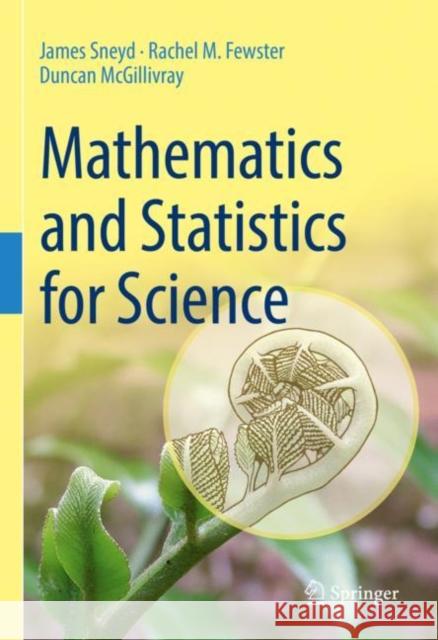
James Sneyd;Rachel M. Fewster;Duncan McGillivray
Mathematics and Statistics for Science James Sneyd, Rachel M. Fewster, Duncan McGillivray 9783031053177 Springer International Publishing - książkaWidoczna okładka, to zdjęcie poglądowe, a rzeczywista szata graficzna może różnić się od prezentowanej.

Mathematics and Statistics for Science

ISBN-13: 9783031053177 / Angielski / Twarda / 2022

James Sneyd;Rachel M. Fewster;Duncan McGillivray
cena 281,76
(netto: 268,34 VAT:  5%)

Najniższa cena z 30 dni: 269,85
Termin realizacji zamówienia:
ok. 22 dni roboczych
Dostawa w 2026 r.

Darmowa dostawa!

Mathematics and statistics are the bedrock of modern science. No matter which branch of science you plan to work in, you simply cannot avoid quantitative approaches. And while you won’t always need to know a great deal of theory, you will need to know how to apply mathematical and statistical methods in realistic scenarios. That is precisely what this book teaches. It covers the mathematical and statistical topics that are ubiquitous in early undergraduate courses, but does so in a way that is directly linked to science.

Beginning with the use of units and functions, this book covers key topics such as complex numbers, vectors and matrices, differentiation (both single and multivariable), integration, elementary differential equations, probability, random variables, inference and linear regression. Each topic is illustrated with widely-used scientific equations (such as the ideal gas law or the Nernst equation) and real scientific data, often taken directly from recent scientific papers. The emphasis throughout is on practical solutions, including the use of computational tools (such as Wolfram Alpha or R), not theoretical development. There is a large number of exercises, divided into mathematical drills and scientific applications, and full solutions to all the exercises are available to instructors.

Mathematics and Statistics for Science covers the core methods in mathematics and statistics necessary for a university degree in science, highlighting practical solutions and scientific applications. Its pragmatic approach is ideal for students who need to apply mathematics and statistics in a real scientific setting, whether in the physical sciences, life sciences or medicine.


Kategorie:
Nauka, Matematyka
Kategorie BISAC:
Mathematics > Matematyka stosowana
Mathematics > Prawdopodobieństwo i statystyka
Wydawca:
Springer International Publishing
Język:
Angielski
ISBN-13:
9783031053177
Rok wydania:
2022
Waga:
2.22 kg
Wymiary:
25.4 x 17.8
Oprawa:
Twarda

Part I Units and Measurement.- 1 Units.- 2 Measurement, rounding and uncertainty.- Part II Functions and Complex Numbers.- 3 Functions.- 4 Exponential and log functions.- 5 Periodic functions.- 6 Linearising functions.- 7 Complex numbers.- Part III Vectors, Matrices and Linear Systems.- 8 Vectors.- 9 Matrices.- 10 Systems of linear equations.- 11 Solving systems of linear equations using matrices.- Part IV Differentiation: Functions of One Variable.- 12 Limits.- 13 Differentiation as a limit.- 14. Differentiation in practice.- 15 Numerical differentiation.- 16 Implicit differentiation.- 17 Maxima and minima.- Part V Differentiation: Functions of Multiple Variables.- 18 Functions of multiple variables.- 19 Partial derivatives.- 20 Extreme of functions of two (or more) variables.- Part VI Integration.- 21 The area under a curve.- 22 Calculating antiderivatives and areas.- 23 Integration techniques.- 24 Numerical integration.- Part VII Differential Equations.- 25 First-order ordinary differential equations.- 26 Numerical solutions of differential equations.- Part VIII Probability.- 27 Probability foundations.- 28 Random variables.- 29 Binomial distribution.- 30 Conditional probability.- 31 Total probability rule.- Part IX Statistical inference.- 32 Hypothesis test.- 33 Hypothesis testing in practice.- 34 Estimation and likelihood.- Part X Discrete Probability Distributions.- 35 Simulation and visualisation.- 36 Mean.- 37 Variance.- 38 Discrete probability models.- Part XI Continuous Probability Distributions.- 39 Continuous random variables.- 40 Common continuous probability models.- 41 Normal distribution and inference.- Part XII Linear Regression.- 42 Fitting linear functions: theory and practice.- 43 Quantifying relationships.- References.- Index.

​James Sneyd is a Professor of Applied Mathematics at the University of Auckland, New Zealand. His research is mostly in mathematical physiology and cell biology, and he is the co-author (with Jim Keener) of the prize-winning book Mathematical Physiology. He lives beside a beach, and it is absolutely untrue that he would ever waste his time playing computer games.


Rachel Fewster is a Professor of Statistics at the University of Auckland, New Zealand. She has over 20 years experience of teaching mathematical statistics to students with diverse interests, for which she has received a national tertiary educator award. She is a leading researcher in statistical methods for wildlife conservation, and has pioneered numerous methods for analysing novel data types generated by emerging technologies for remote sensing and animal recognition. She leads a large citizen science project for New Zealand community conservationists and enjoys the challenge of communicating technical information to diverse audiences in an engaging and accessible manner. She is a recipient of the Campbell Award, the premier award for New Zealand statisticians.

Duncan McGillivray is a Professor of Physical Chemistry at the University of Auckland, New Zealand, and a Fellow of the Royal Society of Chemistry and the New Zealand Institute of Chemistry. He uses a wide range of mathematical tools in his studies of biologically relevant colloids and interfaces using neutron scattering. He is passionate about teaching and learning for science students, and has been involved in teaching at all levels of tertiary study.

Mathematics and statistics are the bedrock of modern science. No matter which branch of science you plan to work in, you simply cannot avoid quantitative approaches. And while you won’t always need to know a great deal of theory, you will need to know how to apply mathematical and statistical methods in realistic scenarios. That is precisely what this book teaches. It covers the mathematical and statistical topics that are ubiquitous in early undergraduate courses, but does so in a way that is directly linked to science.

Beginning with the use of units and functions, this book covers key topics such as complex numbers, vectors and matrices, differentiation (both single and multivariable), integration, elementary differential equations, probability, random variables, inference and linear regression. Each topic is illustrated with widely-used scientific equations (such as the ideal gas law or the Nernst equation) and real scientific data, often taken directly from recent scientific papers. The emphasis throughout is on practical solutions, including the use of computational tools (such as Wolfram Alpha or R), not theoretical development. There is a large number of exercises, divided into mathematical drills and scientific applications, and full solutions to all the exercises are available to instructors.

Mathematics and Statistics for Science covers the core methods in mathematics and statistics necessary for a university degree in science, highlighting practical solutions and scientific applications. Its pragmatic approach is ideal for students who need to apply mathematics and statistics in a real scientific setting, whether in the physical sciences, life sciences or medicine.




Udostępnij

Facebook - konto krainaksiazek.pl


Opinie o Krainaksiazek.pl na Opineo.pl

Partner Mybenefit

Krainaksiazek.pl w programie rzetelna firma Krainaksiaze.pl - płatności przez paypal

Czytaj nas na:

Facebook - krainaksiazek.pl
  • książki na zamówienie
  • granty
  • książka na prezent
  • kontakt
  • pomoc
  • opinie
  • regulamin
  • polityka prywatności

Zobacz:

  • Księgarnia czeska

  • Wydawnictwo Książkowe Klimaty

1997-2025 DolnySlask.com Agencja Internetowa

© 1997-2022 krainaksiazek.pl
     
KONTAKT | REGULAMIN | POLITYKA PRYWATNOŚCI | USTAWIENIA PRYWATNOŚCI
Zobacz: Księgarnia Czeska | Wydawnictwo Książkowe Klimaty | Mapa strony | Lista autorów
KrainaKsiazek.PL - Księgarnia Internetowa

Polityka prywatnosci - link
Krainaksiazek.pl - płatnośc Przelewy24
Przechowalnia Przechowalnia




