Bacterial Population Genetics in Infectious Disease » książka





Bacterial Population Genetics in Infectious Disease
ISBN-13: 9780470424742 / Angielski / Twarda / 2010 / 440 str.
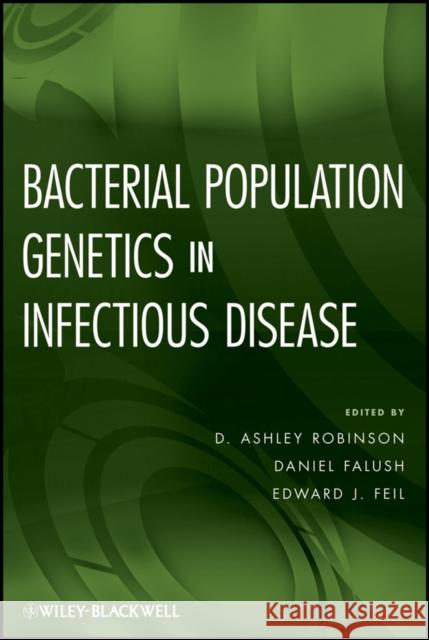
Bacterial Population Genetics in Infectious Disease
ISBN-13: 9780470424742 / Angielski / Twarda / 2010 / 440 str.
(netto: 724,46 VAT: 5%)
Najniższa cena z 30 dni: 748,35
ok. 30 dni roboczych.
Darmowa dostawa!
This book is a unique synthesis of the major concepts and methods in bacterial population genetics in infectious disease, a field that is now about 35 yrs old. Emphasis is given to explaining population-level processes that shape genetic variation in bacterial populations and statistical methods of analysis of bacterial genetic data.
- A "how to" of bacterial population genetics, which covers an extremely large range of organisms
- Expanding area of science due to high-throughput genome sequencing of bacterial pathogens
- Covers both fundamental approaches to analyzing bacterial population structures with conceptual background in bacterial population biology
- Detailed treatment of statistical methods
Wydanie ilustrowane
"I enjoyed reading Chapters 9, 12, and 15 because these topics interested me. Other chapters can be recommended as sources of citations for specialists interested in those particular bacteria." (The Quarterly Review of Biology, 1 December 2011)
"On the whole, this book is of general interest for teachers of microbiology, who need to explain bacteriology in the genomic age, and it may also help clinical microbiologists choose tools for identifying circulating clones. Finally, it can be useful to specialists in the field of emerging bacteria for whom the need to synthesize genomic data is part of their professional routine. I recommend this book most strongly for all of these bacteriology specialists." (Emerging Infectious Diseases Journal, 1 March 2011)
Foreword.
Preface.
Contributors.
Part I Concepts and Methods in Bacterial Population Genetics.
1 The Coalescent of Bacterial Populations.
1.1 Background and Motivation.
1.2 Population Reproduction Models.
1.3 Time and the Effective Population Size.
1.4 The Genealogy of a Sample of Size n.
1.5 From Coalescent Time to Real Time.
1.6 Mutations.
1.7 Demography.
1.8 Recombination and Gene Conversion.
1.9 Summary.
2 Linkage, Selection, and the Clonal Complex.
2.1 Introduction Historical Overview.
2.2 Recombination, Linkage, and Substructure.
2.3 Neutrality versus Selection.
2.4 Clustering Techniques.
3 Sequence–Based Analysis of Bacterial Population Structures.
3.1 Introduction.
3.2 Alignments.
3.3 Phylogenetic Methods.
3.4 Measures of Uncertainty.
3.5 Beyond the Tree Model.
4 Genetic Recombination and Bacterial Population Structure.
4.1 Introduction.
4.2 Constraints on LGT.
4.3 Infl uences of LGT on Sequence Analyses.
4.4 The Detection of Individual LGT Events.
4.5 The Estimation of Homologous Recombination Rates.
4.6 Properly Accounting for LGT During Sequence Analyses.
4.7 Questions Relating Directly to LGT.
5 Statistical Methods for Detecting the Presence of Natural Selection in Bacterial Populations.
5.1 Introduction.
5.2 Natural Selection.
5.3 Statistical Methods for Detecting the Presence of Natural Selection.
5.4 Statistical Methods for Bacterial Populations.
5.5 An Example.
5.6 Discussion and Perspective.
6 Demographic Infl uences on Bacterial Population Structure.
6.1 Bacterial Population Size.
6.2 Measures of Genetic Diversity.
6.3 The Concept of Effective Population Size.
6.4 Inferring Past Demography from Genetic Sequence Data.
6.5 Population Subdivision.
6.6 What is a Bacterial Population?
6.7 Conclusion.
7 Population Genomics of Bacteria.
7.1 Introduction.
7.2 Classical Bacterial Population Genetics.
7.3 The Genomics Era.
7.4 Bacterial Population Genomics.
7.5 Next–Gen Bacterial Population Genomics.
7.6 Next–Gen Genomics Technology.
7.7 Next–Gen Genomic Data Analysis.
7.8 Conclusions/Future Prospects.
8 The Use of MLVA and SNP Analysis to Study the Population Genetics of Pathogenic Bacteria.
8.1 Introduction.
8.2 MLVA and Other DNA Fragment–Based Methods.
8.3 SNP and DNA Sequence–Based Methods.
8.4 Conclusion.
Part II Population Genetics of Select Bacterial Pathogens.
9 Population Genetics of Bacillus: Phylogeography of Anthrax in North America.
9.1 Introduction.
9.2 History of Anthrax in North America.
9.3 The Anthrax Districts after 1944.
9.4 Molecular Genotyping of B. anthracis.
9.5 Genotypes within the Anthrax Districts in North America.
9.6 Phylogenetic Resolution within the WNA Lineage.
9.7 Phylogeographic Resolution within the Ames Lineage.
9.8 Additional B. anthracis Genotypes in North America.
9.9 Conclusions.
10 Population Genetics of Campylobacter.
10.1 Introduction.
10.2 Human Infection.
10.3 Genetic Structure.
10.4 Models of Campylobacter Evolution.
10.5 Clades and Species.
10.6 Conclusion.
11 Population Genetics of Enterococcus.
11.1 Introduction.
11.2 Antibiotic Resistance.
11.3 Vancomycin Resistance.
11.4 VRE: A Zoonosis or Not?
11.5 Population Structure and Genetic Evolution: Similarities and Differences Between E. faecium and E. faecalis.
11.6 What Is Driving GD in E. faecium and E. faecalis?
11.7 The Accessory Genome of E. faecium and E. faecalis.
11.8 Summary, Conclusions, and Future Perspectives.
12 Population Biology of Lyme Borreliosis Spirochetes.
12.1 Introduction.
12.2 Genome Organization of LB Spirochetes.
12.3 Genotyping of LB Spirochetes and Phylogenetic Tools.
12.4 Population Biology and Evolution of LB Spirochetes.
12.5 Do LB Species Exist?
12.6 Future Research Avenues.
13 Population Genetics of Neisseria meningitidis.
13.1 Introduction.
13.2 A Brief History of Typing of Meningococci.
13.3 Species Separation.
13.4 Sampling Strategies.
13.5 The Clonal Complexes of Meningococci.
13.6 Forces Shaping the Meningococcal Metalineage.
13.7 Virulence, a Mysterious Trait.
13.8 Population Effect of Meningococcal Vaccines.
13.9 Antibiotic Resistance and Meningococcal Lineages.
13.10 Concluding Remarks.
14 Population Genetics of Pathogenic Escherichia coli.
14.1 Introduction.
14.2 E. coli Population Genetics: Clonal or not Clonal?
14.3 The E. coli Phylogenetic Structure.
14.4 The Evolutionary History of a Host–Specifi c Obligate Pathogen: The Shigella and EIEC Case Study.
14.5 What Makes You an Opportunistic Pathogen?
14.6 The Virulence Resistance Trade–off.
14.7 Concluding Remarks.
15 Population Genetics of Salmonella: Selection for Antigenic Diversity.
15.1 Introduction.
15.2 Generation Timescale Diversifi cation.
15.3 Antigenic Diversity in Salmonella.
15.4 Why Are Diverse H and O Antigens Maintained in Salmonella?
15.5 Conclusions.
16 Population Genetics of Staphylococcus.
16.1 Introduction.
16.2 Overview of The Staphylococcal Population Structure.
16.3 Staphylococcal Population Structure in Specific Disease Contexts.
16.4 Origin and Maintenance of Staphylococcal Genetic Variation.
16.5 Macroevolutionary Considerations and Concluding Remarks.
Appendix 1 Diversity and Differentiation.
17 Population Genetics of Streptococcus.
17.1 Habitats, Transmission, and Disease.
17.2 Classical Strain Typing.
17.3 Multilocus Sequence Typing (MLST) Based on Housekeeping Genes.
17.4 Species Boundaries and Gene Flow.
17.5 Niche–driving Genes.
17.6 Bacterial Population Dynamics and Selection.
17.7 Machinery of Genetic Change, Revisited.
18 Population Genetics of Vibrios.
18.1 Introduction.
18.2 V. cholerae.
18.3 V. parahaemolyticus .
18.4 V. vulnificus.
18.5 Conclusions.
References.
Index.
D. Ashley Robinson is an Associate Professor of Microbiology at The University of Mississippi Medical Center. Her specialties include bacterial genetics, microbial evolution and antimicrobial resistance, among others.
Daniel Falush is a Research Fellow in the Department of Statistics at the University of Oxford, where he specializes in mathematical biology, particularly mathematical genetics and bioinformatics.
Edward Feil is a Reader in Microbial Evolution at University of Bath. He studies bacterial evolution and genetic recombination as well as the biogeography of pathogenic bacteria.
Covers both fundamental approaches to analyzing bacterial population structures with conceptual background in bacterial population biology
Population genetics is concerned with the causes and effects of genetic variation. While many books give detailed treatments of modern population genetics, for those who study bacterial pathogens, one often has to ask "How does this apply to bacteria?" What has been lacking is a book that describes the fate of genetic variation in bacterial populations and shows how one can generate and analyze bacterial genetic data from a population genetics perspective.
Bacterial Population Genetics in Infectious Disease fills this need, serving as an authoritative primer on the major concepts and methods of an extremely broad range of organisms. The first section provides perspective on the genetic and population processes that shape genetic variation in bacterial populations, as well as the statistical methods of analysis of bacterial genetic data that provide a basis for sound inference. The second section provides detailed reviews on selected important human pathogens, which illustrate the use of analytical techniques and particular evolutionary processes.
Bacterial Population Genetics in Infectious Disease is a must for students and professionals that work in the intersecting fields of genetics, microbiology, infectious diseases, epidemiology, and evolutionary biology.




Czytaj nas na:
1997-2026 DolnySlask.com Agencja Internetowa
KrainaKsiazek.PL - Księgarnia Internetowa


