• Wyszukiwanie zaawansowane
  • Kategorie
  • Kategorie BISAC
  • Książki na zamówienie
  • Promocje
  • Granty
  • Książka na prezent
  • Opinie
  • Pomoc
  • Załóż konto
  • Zaloguj się

GPS for Geodesy » książka


zaloguj się | załóż konto
Logo Krainaksiazek.pl

koszyk

konto

szukaj
topmenu
Księgarnia internetowa
Szukaj
Książki na zamówienie
Promocje
Granty
Książka na prezent
Moje konto
Pomoc
 
 
Wyszukiwanie zaawansowane
Pusty koszyk
Bezpłatna dostawa dla zamówień powyżej 20 złBezpłatna dostawa dla zamówień powyżej 20 zł

Kategorie główne

• Nauka
 [2948695]
• Literatura piękna
 [1824038]

  więcej...
• Turystyka
 [70868]
• Informatyka
 [151073]
• Komiksy
 [35227]
• Encyklopedie
 [23181]
• Dziecięca
 [621575]
• Hobby
 [138961]
• AudioBooki
 [1642]
• Literatura faktu
 [228651]
• Muzyka CD
 [371]
• Słowniki
 [2933]
• Inne
 [445341]
• Kalendarze
 [1243]
• Podręczniki
 [164416]
• Poradniki
 [479493]
• Religia
 [510449]
• Czasopisma
 [502]
• Sport
 [61384]
• Sztuka
 [243086]
• CD, DVD, Video
 [3417]
• Technologie
 [219673]
• Zdrowie
 [100865]
• Książkowe Klimaty
 [124]
• Zabawki
 [2168]
• Puzzle, gry
 [3372]
• Literatura w języku ukraińskim
 [260]
• Art. papiernicze i szkolne
 [7838]
Kategorie szczegółowe BISAC

GPS for Geodesy

ISBN-13: 9783642720130 / Angielski / Miękka / 2011 / 650 str.
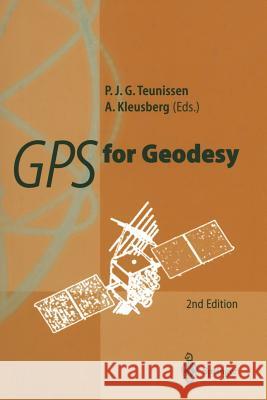
Peter J. G. Teunissen; Alfred Kleusberg
GPS for Geodesy Peter J. G. Teunissen Alfred Kleusberg 9783642720130 Springer - książkaWidoczna okładka, to zdjęcie poglądowe, a rzeczywista szata graficzna może różnić się od prezentowanej.

GPS for Geodesy

ISBN-13: 9783642720130 / Angielski / Miękka / 2011 / 650 str.

Peter J. G. Teunissen; Alfred Kleusberg
cena 523,30
(netto: 498,38 VAT:  5%)

Najniższa cena z 30 dni: 501,19
Termin realizacji zamówienia:
ok. 22 dni roboczych.

Darmowa dostawa!

This monograph contains the revised and edited lecture notes of the International School GPS for Geodesy in Delft, The Netherlands, March 26 through April 1, 1995. The objective of the school was to provide the necessary information to understand the potential and the limitations of the Global Positioning System for applications in the field of Geodesy. The school was held in the excellent facilities of the DISH Hotel, and attracted 60 geodesists and geophysicists from America, Asia, Australia and Europe. The school was organized into lectures and discussion sessions. There were two lecture periods in the morning and two lecture periods in the afternoon, followed by a discussion session in the early morning. A welcome interruption to this regular schedule was a visit to the European Space Research and Technology Centre (ESTEC) in Noordwijk in the afternoon of March 29. A tour of the Noordwijk Space Expo and the ESA satellite test facilities, and presentations by ESTEC personnel of GPS and GNSS related activities at ESTEC, provided a different perspective to space geodesy. The school had the support of the International Association of Geodesy, the Netherlands Geodetic Commission, the Department of Geodetic Engineering of the Delft University of Technology, the Department of Geodesy and Geomatics Engineering of the University of New Brunswick, and the Survey Department of Rijkswaterstaat. This support is gratefully acknowledged. The organization of the International School began in early 1994, with the knowledgeable help of Frans Schroder of the Netherlands Geodetic Commission.


Kategorie:
Nauka, Geografia
Kategorie BISAC:
Science > Earth Sciences - Geography
Science > Geofizyka
Wydawca:
Springer
Język:
Angielski
ISBN-13:
9783642720130
Rok wydania:
2011
Wydanie:
1998. Softcover
Ilość stron:
650
Waga:
0.91 kg
Wymiary:
23.39 x 15.6 x 3.4
Oprawa:
Miękka
Wolumenów:
01

1 Reference Systems.- 1.1 Introduction.- 1.2 Transformations between the Celestial and Terrestrial Frames.- 1.3 Time Systems.- 1.4 Motion of the Earth’s Rotation Axis.- 1.5 Earth Deformation.- 1.6 Conventional Reference Systems.- 1.7 The IGS.- 1.8 Summary.- 2 GPS Satellite Orbits.- 2.1 Introduction.- 2.2 Equations of Motion for GPS.- 2.3 The Perturbing Forces Acting on GPS Satellites.- 2.4 GPS Orbit Types.- 2.5 Summary and Conclusions.- 3 Propagation of the GPS Signals.- 3.1 Introduction.- 3.2 Electromagnetic Waves.- 3.3 The GPS Signals.- 3.4 Propagation of Signals in Refractive Media.- 3.5 Atmospheric Refraction.- 3.6 Signal Multipath and Scattering.- 3.7 Summary.- 4 GPS Receivers and the Observables.- 4.1 Introduction.- 4.2 GPS Receivers.- 4.3 GPS Observables.- 4.4 Observation Measurement Errors.- 4.5 Summary.- 5 GPS Observation Equations and Positioning Concepts.- 5.1 Introduction.- 5.2 GPS Observables.- 5.3 Linear Combinations.- 5.4 Single-Receiver NonPositioning Models.- 5.5 The Linearized Observation Equations for Positioning.- 5.6 Relative Positioning Models.- 5.7 Summary.- 6 GPS Data Processing Methodology.- 6.1 Introduction.- 6.2 Equivalence of Pseudorange and Carrier Phase.- 6.3 Equivalence of Stochastic and Functional Models.- 6.4 Frame Invariance and Estimability.- 6.5 Summary and Conclusions.- 7 Quality Control and GPS.- 7.1 Introduction.- 7.2 Validation of Batch Solutions.- 7.3 Validation of Recursive Solutions.- 7.4 Applications to Some GPS Models.- 7.5 Summary and Conclusions.- 8 GPS Carrier Phase Ambiguity Fixing Concepts.- 8.1 Introduction.- 8.2 Integer Least-Squares Adjustment and Testing.- 8.3 Search for the Integer Least-Squares Ambiguities.- 8.4 The Invertible Ambiguity Transformations.- 8.5 The LSQ Ambiguity Decorrelation Adjustment.- 8.6 Summary.- 9 Active GPS Control Stations.- 9.1 Introduction.- 9.2 Active GPS Control Station Components.- 9.3 Single Channel Observation Equations.- 9.4 Real Time Integrity Monitoring.- 9.5 Active GPS Reference Systems.- 9.6 Summary and Conclusions.- 10 Single-Site GPS Models.- 10.1 Introduction.- 10.2 Pseudorange Relation.- 10.3 Direct Solution of Position and Receiver Clock Offset - Bancroft’s Solution.- 10.4 Dilution of Precision.- 10.5 Combining Phase and Pseudorange for Single-Site Determinations.- 10.6 Summary.- 11 Short Distance GPS Models.- 11.1 Introduction.- 11.2 Short Distance GPS Models.- 11.3 Use of Both Pseudoranges and Phases.- 11.4 Disadvantages of Double Differences.- 11.5 Sequential Versus Batch Processing.- 11.6 Network Adjustment - the Final Step.- 11.7 Summary.- 12 Medium Distance GPS Measurements.- 12.1 Introduction.- 12.2 GPS Models at Medium Distances.- 12.3 Analysis Modes.- 12.4 Network Adjustment.- 12.5 Case Studies.- 1.26 Summary.- 13 Long-Distance Kinematic GPS.- 13.1 Introduction.- 13.2 Data Analysis.- 13.3 Testing the Accuracy of Long-Range Kinematic GPS.- 13.4 Conclusions.- 14 The GPS as a Tool in Global Geodynamics.- 14.1 Introduction.- 14.2 The Partial Derivatives of the GPS Observable with Respect to the Parameters of Global Geodynamics.- 14.3 Geodynamical Parameters not Accessible to the GPS.- 14.4 Estimating Tropospheric Refraction.- 14.5 Miscellaneous Orbit Modelling.- 14.6 Satellite- and Receiver- Clock Estimation.- 14.7 Producing Annual Solutions.- 14.8 Results.- 14.9 Summary and Conclusions.- 15 Atmospheric Models from GPS.- 15.1 Introduction.- 15.2 Distribution of Refractivity in the Atmosphere.- 15.3 Vertical Profiles of Refractivity from Radio Signal Occultation.- 15.4 Models for the Ionosphere.- 15.5 Summary and Conclusions.- 16 The Role of GPS in Space Geodesy.- 16.1 Introduction.- 16.2 Space Geodesy in 1997.- 16.3 Performance of the Major Space Techniques in the Recent Past.- 16.4 Space Geodesy: the Future.- 16.5 SLR Observations to GPS Satellites.- 16.6 Summary.

"GPS for Geodesy" describes the use of Global Positioning System (GPS) measurements for geodetic applications. It covers the modelling and data processing strategies needed for the determination of precise coordinates for position and the monitoring of temporal changes of these coordinates in well-defined reference systems. Starting from the GPS observables, the GPS orbits, the reference frames and the GPS signal propagation characteristics, complete observation equations are presented and discussed for the spectrum of geodetic applications. Models for single-receiver applications are followed by models for multi-receiver applications for which the network scale is used as the criterion. It includes the theory of GPS ambiguity resolution, the contribution of GPS to atmospheric modelling and the use of GPS for geodynamic applications.


Udostępnij

Facebook - konto krainaksiazek.pl


Opinie o Krainaksiazek.pl na Opineo.pl

Partner Mybenefit

Krainaksiazek.pl w programie rzetelna firma Krainaksiaze.pl - płatności przez paypal

Czytaj nas na:

Facebook - krainaksiazek.pl
  • książki na zamówienie
  • granty
  • książka na prezent
  • kontakt
  • pomoc
  • opinie
  • regulamin
  • polityka prywatności

Zobacz:

  • Księgarnia czeska

  • Wydawnictwo Książkowe Klimaty

1997-2026 DolnySlask.com Agencja Internetowa

© 1997-2022 krainaksiazek.pl
     
KONTAKT | REGULAMIN | POLITYKA PRYWATNOŚCI | USTAWIENIA PRYWATNOŚCI
Zobacz: Księgarnia Czeska | Wydawnictwo Książkowe Klimaty | Mapa strony | Lista autorów
KrainaKsiazek.PL - Księgarnia Internetowa

Polityka prywatnosci - link
Krainaksiazek.pl - płatnośc Przelewy24
Przechowalnia Przechowalnia





