• Wyszukiwanie zaawansowane
  • Kategorie
  • Kategorie BISAC
  • Książki na zamówienie
  • Promocje
  • Granty
  • Książka na prezent
  • Opinie
  • Pomoc
  • Załóż konto
  • Zaloguj się

Introduction to Rare Event Simulation » książka


zaloguj się | załóż konto
Logo Krainaksiazek.pl

koszyk

konto

szukaj
topmenu
Księgarnia internetowa
Szukaj
Książki na zamówienie
Promocje
Granty
Książka na prezent
Moje konto
Pomoc
 
 
Wyszukiwanie zaawansowane
Pusty koszyk
Bezpłatna dostawa dla zamówień powyżej 40 złBezpłatna dostawa dla zamówień powyżej 40 zł

Kategorie główne

• Nauka
 [3024499]
• Literatura piękna
 [1802625]

  więcej...
• Turystyka
 [51831]
• Informatyka
 [155501]
• Komiksy
 [36021]
• Encyklopedie
 [21868]
• Dziecięca
 [608303]
• Hobby
 [102470]
• AudioBooki
 [1725]
• Literatura faktu
 [190942]
• Muzyka CD
 [413]
• Słowniki
 [2916]
• Inne
 [434034]
• Kalendarze
 [547]
• Podręczniki
 [165743]
• Poradniki
 [418062]
• Religia
 [502012]
• Czasopisma
 [555]
• Sport
 [60428]
• Sztuka
 [241531]
• CD, DVD, Video
 [3419]
• Technologie
 [227102]
• Zdrowie
 [97362]
• Książkowe Klimaty
 [125]
• Zabawki
 [2526]
• Puzzle, gry
 [4084]
• Literatura w języku ukraińskim
 [272]
• Art. papiernicze i szkolne
 [8602]
Kategorie szczegółowe BISAC

Introduction to Rare Event Simulation

ISBN-13: 9781441918932 / Angielski / Miękka / 2010 / 268 str.
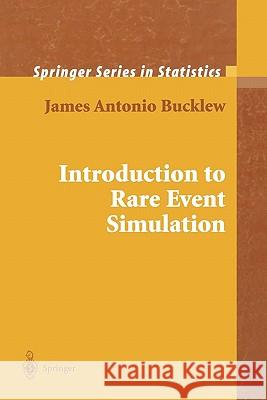
James Bucklew
Introduction to Rare Event Simulation James Bucklew 9781441918932 Not Avail - książkaWidoczna okładka, to zdjęcie poglądowe, a rzeczywista szata graficzna może różnić się od prezentowanej.

Introduction to Rare Event Simulation

ISBN-13: 9781441918932 / Angielski / Miękka / 2010 / 268 str.

James Bucklew
cena promocyjna 358,69
(netto: 341,61 VAT:  5%)
551,84
Rabat: -35%

Najniższa cena z 30 dni: 458,61
Termin realizacji zamówienia:
22 dni roboczych

Darmowa dostawa!
Zobacz inne książki w promocji: Inżynieria od Springer Verlag

This book is an attempt to present a unified theory of rare event simulation and the variance reduction technique known as importance sampling from the point of view of the probabilistic theory of large deviations. This framework allows us to view a vast assortment of simulation problems from a single unified perspective. It gives a great deal of insight into the fundamental nature of rare event simulation. Unfortunately, this area has a reputation among simulation practitioners of requiring a great deal of technical and probabilistic expertise. In this text, I have tried to keep the mathematical preliminaries to a minimum; the only prerequisite is a single large deviation theorem dealing with sequences of Rd- valued random variables. (This theorem and a proof are given in the text.) Large deviation theory is a burgeoning area of probability theory and many of the results in it can be applied to simulation problems. Rather than try to be as complete as possible in the exposition of all possible aspects of the available theory, I have tried to concentrate on demonstrating the methodology and the principal ideas in a fairly simple setting. Madison, Wisconsin 2003 James Antonio Bucklew Contents 1. Random Number Generation . . . . . . . . . . . . . . . . . . . . . 1 . . . . . . . . 1.1 Uniform Generators. . . . . . . . . . . . . . . . . . . . . . . . . . . . . . . . . . . . . 1 1.2 Nonuniform Generation . . . . . . . . . . . . . . . . . . . . . . . . . . . . . . . . . 8 1.2.1 The Inversion Method . . . . . . . . . . . . . . . . . . . . . . . . . . . . 8 1.2.2 The Acceptance---Rejection Method . . . . . . . . . . . . 10 . . . . . 1.3 Discrete Distributions . . . . . . . . . . . . . . . . . . . . . . . . 13 . . . . . . . . . . . 1.3.1 Inversion by Truncation of a Continuous Analog. . . . . . 14 1.3.2 Acceptance---Rejection . . . . . . . . . . . . . . . . . . . . 15 . . . . . . . . .


Kategorie:
Nauka, Biologia i przyroda
Kategorie BISAC:
Mathematics > Prawdopodobieństwo i statystyka
Computers > Computer Simulation
Business & Economics > Operations Research
Wydawca:
Not Avail
Seria wydawnicza:
Springer Series in Statistics
Język:
Angielski
ISBN-13:
9781441918932
Rok wydania:
2010
Numer serii:
000022130
Ilość stron:
268
Waga:
0.40 kg
Wymiary:
23.3 x 15.9 x 1.5
Oprawa:
Miękka
Wolumenów:
01

From the reviews:

"On the whole, Introduction to Rare Event Simulation succeeds at its stated goal, providing a good overview of importance sampling from the perspective of large deviations." Journal of the American Statistical Association, September 2005

"The main purpose of this book is to present a unified theory of rare event simulation and the variance reduction technique known as importance sampling method devised from the point of view of probabilistic theory of large deviations. ... The methodology of importance sampling estimation based on large deviation theory is exposed in a clear setting, concentrating on the main ideas and outlining the variety of applications, from telecommunications to queueing systems." (Silvia Curteanu, Zentralblatt MATH, Vol. 1057(8), 2005)

 "This book deals with a special topic in simulation, the estimation of small probabilities via importance sampling using large deviations theory to design and/or analyze the change of measure. ... serve as a bridge to the quite technical research literature and a help to get started with more challenging examples." (S. Asmussen, Short Book Reviews, Vol. 24(2), 2004)

"The principal method described in this book used to attack the rare event simulation problem is importance sampling, which is a variance reduction technique. ... This Introduction to Rare Event Simulation is in the first place not a book on the theory of rare events as developed in extreme value theory via point processes ... . Instead, it focuses on the mathematics of importance sampling estimators. As such it is mathematically rigorous and very enjoyable." (Michael Falk, Metrika, 2006)

"The central theme of the book is to compute the probability of a so-called rare event. ... Overall the book is pleasant to read. ... The book seems to be well suited to use as a text for a course. ... My general impression of the book is ... predominantly positive and I would definitely recommend this book to be used as course material or as an easily accessible introduction to rare event simulation for anyone with a general knowledge of probability theory." (Henrik Hult, Extremes, Vol. 7, 2004)

"This is a very interesting monograph that attempts to present a unified theory of rare events simulation. Two basic tools used are importance sampling and the theory of large deviations. ... I recommend the book to everybody who is interested in rare events and/or Monte Carlo simulation." (EMS Newsletter, December 2006)

1. Random Number Generation.- 2. Stochastic Models.- 3. Large Deviation Theory.- 4. Importance Sampling.- 5. The Large Deviation Theory of Importance Sampling Estimators.- 6. Variance Rate Theory of Conditional Importance Sampling Estimators.- 7. The Large Deviations of Bias Point Selection.- 8. Chernoff’s Bound and Asymptotic Expansions.- 9. Gaussian Systems.- 10. Universal Simulation Distributions.- 11. Rare Event Simulation for Level Crossing and Queueing Models.- 12. Blind Simulation.- 13. The (Over-Under) Biasing Problem in Importance Sampling.- 14. Tools and Techniques for Importance Sampling.- A. Convex Functions and Analysis.- B. A Covering Lemma.- C. Pseudo-Random Number Generator Programs.- References.

This book presents a unified theory of rare event simulation and the variance reduction technique known as importance sampling from the point of view of the probabilistic theory of large deviations. This perspective allows us to view a vast assortment of simulation problems from a unified single perspective. It gives a great deal of insight into the fundamental nature of rare event simulation.

Until now, this area has a reputation among simulation practitioners of requiring a great deal of technical and probabilistic expertise. This text keeps the mathematical preliminaries to a minimum with the only prerequisite being a single large deviation theory result that is given and proved in the text. Large deviation theory is a burgeoning area of probability theory and many of the results in it can be applied to simulation problems. Rather than try to be as complete as possible in the exposition of all possible aspects of the available theory, the book concentrates on demonstrating the methodology and the principal ideas in a fairly simple setting.

The book contains over 50 figures and detailed simulation case studies covering a wide variety of application areas including statistics, telecommunications, and queueing systems.

James A. Bucklew holds the rank of Professor with appointments in the Department of Electrical and Computer Engineering and in the Department of Mathematics at the University of Wisconsin-Madison. He is a Fellow of the Institute of Electrical and Electronics Engineers and the author of Large Deviation Techniques in Decision, Simulation, and Estimation.


Udostępnij

Facebook - konto krainaksiazek.pl


Opinie o Krainaksiazek.pl na Opineo.pl

Partner Mybenefit

Krainaksiazek.pl w programie rzetelna firma Krainaksiaze.pl - płatności przez paypal

Czytaj nas na:

Facebook - krainaksiazek.pl
  • książki na zamówienie
  • granty
  • książka na prezent
  • kontakt
  • pomoc
  • opinie
  • regulamin
  • polityka prywatności

Zobacz:

  • Księgarnia czeska

  • Wydawnictwo Książkowe Klimaty

1997-2026 DolnySlask.com Agencja Internetowa

© 1997-2022 krainaksiazek.pl
     
KONTAKT | REGULAMIN | POLITYKA PRYWATNOŚCI | USTAWIENIA PRYWATNOŚCI
Zobacz: Księgarnia Czeska | Wydawnictwo Książkowe Klimaty | Mapa strony | Lista autorów
KrainaKsiazek.PL - Księgarnia Internetowa

Polityka prywatnosci - link
Krainaksiazek.pl - płatnośc Przelewy24
Przechowalnia Przechowalnia





