


ISBN-13: 9783319799490 / Angielski / Miękka / 2018 / 327 str.
Introduction.- CPUs, GPUs, CGRAs, Vector Processing, Systolic Arrays, FPGAs.- The von Neuman Model versus data stream processing.- FPGAs for software designers.- Languages, libraries, and compilers for specific problems.- Behavioral Compiler Capabilities and optimization strategies.- Mapping Approaches and Tools for Heterogeneous FPGAs.- Automatic Tool Flows.- Design frameworks, tools, and tool interaction.- Hardware Platforms.- Parallel Architectures and Overlays.- FPGA Virtualization.- Applications from a Programmers Point of View.- Future Directions.
Dirk Koch is a lecturer in the Advanced Processor Technologies Group at the University of Manchester. His main research interest is on run-time reconfigurable systems based on FPGAs, including methods, tools and applications. Current research projects include database acceleration using FPGAs based on stream processing as well as reconfigurable instruction set extensions for CPUs. Dirk was a program co-chair of the FPL2012 conference and he is a program committee member of many FPGA related conferences and workshops. He is author of the book "Partial Reconfiguration on FPGAs," he holds two patents, and he has (co-)authored over 50 conference and journal publications.
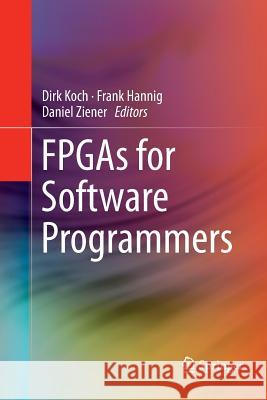
This book makes powerful Field Programmable Gate Array (FPGA) and reconfigurable technology accessible to software engineers by covering different state-of-the-art high-level synthesis approaches (e.g., OpenCL and several C-to-gates compilers). It introduces FPGA technology, its programming model, and how various applications can be implemented on FPGAs without going through low-level hardware design phases. Readers will get a realistic sense for problems that are suited for FPGAs and how to implement them from a software designer’s point of view. The authors demonstrate that FPGAs and their programming model reflect the needs of stream processing problems much better than traditional CPU or GPU architectures, making them well-suited for a wide variety of systems, from embedded systems performing sensor processing to large setups for Big Data number crunching. This book serves as an invaluable tool for software designers and FPGA design engineers who are interested in high design productivity through behavioural synthesis, domain-specific compilation, and FPGA overlays.
1997-2026 DolnySlask.com Agencja Internetowa











