Deep Learning on Windows: Building Deep Learning Computer Vision Systems on Microsoft Windows » książka





Deep Learning on Windows: Building Deep Learning Computer Vision Systems on Microsoft Windows
ISBN-13: 9781484264300 / Angielski / Miękka / 2020 / 338 str.
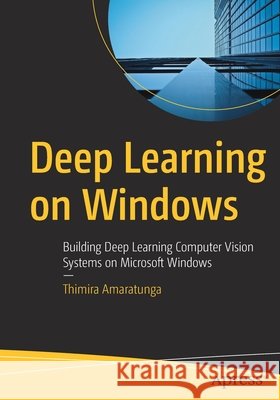
Deep Learning on Windows: Building Deep Learning Computer Vision Systems on Microsoft Windows
ISBN-13: 9781484264300 / Angielski / Miękka / 2020 / 338 str.
(netto: 222,56 VAT: 5%)
Najniższa cena z 30 dni: 224,87
ok. 16-18 dni roboczych.
Darmowa dostawa!
Intermediate
Chapter 1: Where to Start Your Deep Learning
Chapter Goal: Learn about what tools are available for deep learning and computer vision tasks. Learn about what consideration the reader needs to make about the tools, OS, and hardware.
No of pages: 20
Sub - Topics
1. Can We Build Deep Learning Models on Windows?
2. Programming Language – Python
3. Package and Environment Management – Anaconda
4. Python Utility Libraries for Deep Learning and Computer Vision
5. Deep Learning Frameworks
6. Computer Vision Libraries
7. Optimizers and Accelerators
8. What About Hardware?
9. Recommended PC Hardware Configurations
Chapter 2: Setting Up Your Tools
Chapter Goal: Step-by-step instructions on how to install, configure and troubleshoot the required tools.
No of pages: 35
Sub - Topics:1. Installing Visual Studio with C++ Support
2. Installing CMake3. Installing Anaconda Python
4. Setting up the Conda Environment and the Python Libraries5. Installing TensorFlow
6. Installing Keras multi-backend version7. Installing OpenCV
8. Installing Dlib9. Verify Installations
10. Optional Steps11. Troubleshooting
12. SummaryChapter 3: Building Your First Deep Learning Model In Windows
Chapter Goal: A step-by-step coding guide to building the first ‘hello world’ convolutional neural network image classification model.
No of pages: 20
Sub - Topics:
1. What is the MNIST Dataset?2. The LeNet Model
3. Let us Build Our First Model4. Running Our Model
5. What Can You Do Next?Chapter 4: Understanding What We Built
Chapter Goal: Learn the internal workings of a convolutional neural network.
No of pages: 20
Sub - Topics:
1. Digital Images2. Convolutions
3. Non-Linearity Function4. Pooling
5. Classifier (Fully Connected Layer)6. How Does This All Come Together?
Chapter 5: Visualizing ModelsChapter Goal: Understand ways to visualize the internal workings of deep learning models, allowing the reader to use that knowledge to build complex models.
No of pages: 20
Sub - Topics:
1. Why Visualizing Models is Useful
2. Using the plot_model Function of Keras
3. Using Netron to Visualize Model Structures
4. Visualizing Convolutional Filters
Chapter 6: Transfer Learning
Chapter Goal: Building deep learning systems that solves a practical problem is usually made hard due to the difficulty of collecting and managing training data. It is usually also hard to determine a model architecture for a given task from scratch. Here, the readers are introduced to the concept of transfer learning, which provides some solutions for those scenarios.
No of pages: 45
Sub - Topics:
1. The Problem with Little Data2. Using Data Augmentations
3. Build an Image Classification Model with Data Augmentation4. Bottleneck Features
5. Using Bottleneck Features with a Pre-trained VGG16 Model6. Going Further with Model Fine-tuning
7. Fine-tuning our VGG16 Model8. Trying out a Deeper Model – InceptionV3
Chapter 7: Starting, Stopping. and Resuming LearningChapter Goal: Training deep learning models takes time: hours, maybe days. It may not be practical to perform the training in one go. This chapter shows ways on how to manage those situations.
No of pages: 15
Sub - Topics:
1. Managing Long Running Training Jobs
2. Using Model Checkpoints
3. Resuming Training from a Checkpoint
4. Knowing When to Stop Training
5. Building a Robust Training Script
Chapter 8: Deploying Your Application as a Web Application
Chapter Goal: Once the reader has built a deep learning model to perform a certain task, they should investigate options for deploying their model. This chapter gives some ideas for model deployment.
No of pages: 20
Sub - Topics:
1. Getting Your Trained Models to Work
2. Setting up Flask
3. Designing Your Web Application
4. Building Your Deep Learning Web Application
5. Scaling Up Your Web Application
Chapter 9: Having Fun with Computer Vision
Chapter Goal: A chapter on some basic image processing and computer vision options, techniques, and tricks that would help the reader when building various applications with deep learning.
No of pages: 20Sub - Topics:
1. What we Need?
2. Basics of Working with Images
3. Working with Video – Using Webcams
4. Working with Video – Using Video Files
5. Detecting Faces in Images
6. Detecting Faces in Video
7. Simple Real-time Deep Learning Object Identification
Chapter 10: Introduction to Generative Adversarial NetworksChapter Goal: Introducing the idea of Generative Adversarial Networks and their capabilities. Giving a small taste of what they can do with few coding examples.
No of pages: 30
Sub - Topics:
1. Can an AI be Creative?
2. The Story of the Artist and the Art Critic
3. Generative Adversarial Networks
4. Generating Handwritten Digits with DCGAN
5. Can We Generate Something More Complex?
6. What Else Can GANs Do?
Chapter 11: Basics of Reinforcement LearningChapter Goal: Introduce the concept of Reinforcement Learning and how it can be applied to train models to solve problems and introduce the concept of game AI programming.
No of pages: 25
Sub - Topics:
1. What is Reinforcement Learning2. What is OpenAI Gym?
3. Setting up OpenAI Gym4. Solving the CartPole Problem
5. Solving the MountainCar Problem6. What Can You Do Next?
Thimira Amaratunga is an Inventor, a Senior Software Architect at Pearson PLC Sri Lanka with over 12 years of industry experience, and a researcher in AI, Machine Learning, and Deep Learning in Education and Computer Vision domains.
Thimira holds a Master of Science in Computer Science with a Bachelor's degree in Information Technology from the University of Colombo, Sri Lanka. He has filed three patents to date, in the fields of dynamic neural networks and semantics for online learning platforms. Before this, Thimira has published two books on deep learning – ‘Build Deeper: The Deep Learning Beginners’ Guide’ and ‘Build Deeper: The Path to Deep Learning’.
Thimira is also the author of Codes of Interest (www.codesofinterest.com), a portal for deep learning and computer vision knowledge, covering everything from concepts to step-by-step tutorials.
LinkedIn: www.linkedin.com/in/thimira-amaratunga
Build deep learning and computer vision systems using Python, TensorFlow, Keras, OpenCV, and more, right within the familiar environment of Microsoft Windows. The book starts with an introduction to tools for deep learning and computer vision tasks followed by instructions to install, configure, and troubleshoot them. Here, you will learn how Python can help you build deep learning models on Windows.
Moving forward, you will build a deep learning model and understand the internal-workings of a convolutional neural network on Windows. Further, you will go through different ways to visualize the internal-workings of deep learning models along with an understanding of transfer learning where you will learn how to build model architecture and use data augmentations. Next, you will manage and train deep learning models on Windows before deploying your application as a web application. You’ll also do some simple image processing and work with computer vision options that will help you build various applications with deep learning. Finally, you will use generative adversarial networks along with reinforcement learning.After reading Deep Learning on Windows, you will be able to design deep learning models and web applications on the Windows operating system.
You will:
- Understand the basics of Deep Learning and its history
- Get Deep Learning tools working on Microsoft Windows
- Understand the internal-workings of Deep Learning models by using model visualization techniques, such as the built-in plot_model function of Keras and third-party visualization tools
- Understand Transfer Learning and how to utilize it to tackle small datasets
- Build robust training scripts to handle long-running training jobs
- Convert your Deep Learning model into a web application
- Generate handwritten digits and human faces with DCGAN (Deep Convolutional Generative Adversarial Network)
- Understand the basics of Reinforcement Learning




Czytaj nas na:
1997-2026 DolnySlask.com Agencja Internetowa
KrainaKsiazek.PL - Księgarnia Internetowa


