• Wyszukiwanie zaawansowane
  • Kategorie
  • Kategorie BISAC
  • Książki na zamówienie
  • Promocje
  • Granty
  • Książka na prezent
  • Opinie
  • Pomoc
  • Załóż konto
  • Zaloguj się

applied quantitative methods for trading and investment » książka

zaloguj się | załóż konto
Logo Krainaksiazek.pl

koszyk

konto

szukaj
topmenu
Księgarnia internetowa
Szukaj
Książki na zamówienie
Promocje
Granty
Książka na prezent
Moje konto
Pomoc
 
 
Wyszukiwanie zaawansowane
Pusty koszyk
Bezpłatna dostawa dla zamówień powyżej 20 złBezpłatna dostawa dla zamówień powyżej 20 zł

Kategorie główne

• Nauka
 [2946600]
• Literatura piękna
 [1856966]

  więcej...
• Turystyka
 [72221]
• Informatyka
 [151456]
• Komiksy
 [35826]
• Encyklopedie
 [23190]
• Dziecięca
 [619653]
• Hobby
 [140543]
• AudioBooki
 [1577]
• Literatura faktu
 [228355]
• Muzyka CD
 [410]
• Słowniki
 [2874]
• Inne
 [445822]
• Kalendarze
 [1744]
• Podręczniki
 [167141]
• Poradniki
 [482898]
• Religia
 [510455]
• Czasopisma
 [526]
• Sport
 [61590]
• Sztuka
 [243598]
• CD, DVD, Video
 [3423]
• Technologie
 [219201]
• Zdrowie
 [101638]
• Książkowe Klimaty
 [124]
• Zabawki
 [2473]
• Puzzle, gry
 [3898]
• Literatura w języku ukraińskim
 [254]
• Art. papiernicze i szkolne
 [8170]
Kategorie szczegółowe BISAC

applied quantitative methods for trading and investment

ISBN-13: 9780470848852 / Angielski / Twarda / 2003 / 426 str.
Christian L. Dunis; Jason Laws; Patrick Naim
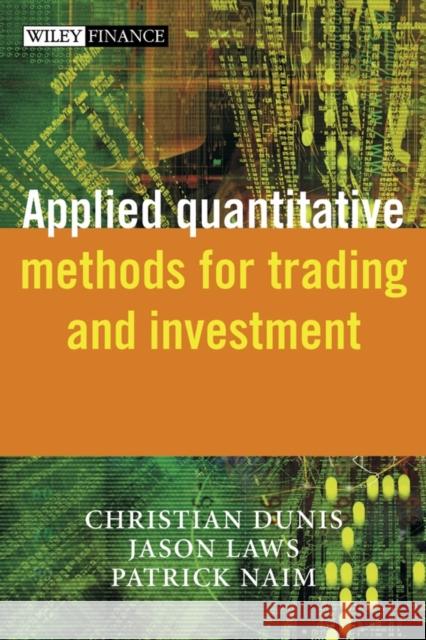
applied quantitative methods for trading and investment  Laws, Jason 9780470848852 John Wiley & Sons - książkaWidoczna okładka, to zdjęcie poglądowe, a rzeczywista szata graficzna może różnić się od prezentowanej.

applied quantitative methods for trading and investment

ISBN-13: 9780470848852 / Angielski / Twarda / 2003 / 426 str.

Christian L. Dunis; Jason Laws; Patrick Naim
cena 507,28 zł
(netto: 483,12 VAT:  5%)

Najniższa cena z 30 dni: 503,12 zł
Termin realizacji zamówienia:
ok. 30 dni roboczych
Bez gwarancji dostawy przed świętami

Darmowa dostawa!

This book provides a manual on quantitative financial analysis. Focusing on advanced methods for modelling financial markets in the context of practical financial applications, it will cover data, software and techniques that will enable the reader to implement and interpret quantitative methodologies, specifically for trading and investment.

  • Includes contributions from an international team of academics and quantitative asset managers from Morgan Stanley, Barclays Global Investors, ABN AMRO and Credit Suisse First Boston.
  • Fills the gap for a book on applied quantitative investment & trading models
  • Provides details of how to combine various models to manage and trade a portfolio

Kategorie:
Nauka, Ekonomia i biznes
Kategorie BISAC:
Business & Economics > Investments & Securities - Analysis & Trading Strategies
Business & Economics > Finance - General
Wydawca:
John Wiley & Sons
Seria wydawnicza:
Wiley Finance (Hardcover)
Język:
Angielski
ISBN-13:
9780470848852
Rok wydania:
2003
Ilość stron:
426
Waga:
0.90 kg
Wymiary:
25.55 x 16.87 x 2.92
Oprawa:
Twarda
Wolumenów:
01
Dodatkowe informacje:
Bibliografia
Obwoluta
Wydanie ilustrowane

About the Contributors.

Preface.

1 Applications of Advanced Regression Analysis for Trading and Investment (Christian L. Dunis and Mark Williams).

Abstract.

1.1 Introduction.

1.2 Literature review.

1.3 The exchange rate and related financial data.

1.4 Benchmark models: theory and methodology.

1.5 Neural network models: theory and methodology.

1.6 Forecasting accuracy and trading simulation.

1.7 Concluding remarks.

2 Using Cointegration to Hedge and Trade International Equities (A. Neil Burgess).

Abstract.

2.1 Introduction.

2.2 Time series modelling and cointegration.

2.3 Implicit hedging of unknown common risk factors.

2.4 Relative value and statistical arbitrage.

2.5 Illustration of cointegration in a controlled simulation.

2.6 Application to international equities.

2.7 Discussion and conclusions.

3 Modelling the Term Structure of Interest Rates: An Application of Gaussian Affine Models to the German Yield Curve (Nuno Cassola and Jorge Barros Luis).

Abstract.

3.1 Introduction.

3.2 Background issues on asset pricing.

3.3 Duffie Kan affine models of the term structure.

3.4 A forward rate test of the expectations theory.

3.5 Identification.

3.6 Econometric methodology and applications.

3.7 Estimation results.

3.8 Conclusions.

4 Forecasting and Trading Currency Volatility: An Application of Recurrent Neural Regression and Model Combination (Christian L. Dunis and Xuehuan Huang).

Abstract.

4.1 Introduction.

4.2 The exchange rate and volatility data.

4.3 The GARCH (1,1) benchmark volatility forecasts.

4.4 The neural network volatility forecasts.

4.5 Model combinations and forecasting accuracy.

4.6 Foreign exchange volatility trading models.

4.7 Concluding remarks and further work.

5 Implementing Neural Networks, Classification Trees, and Rule Induction Classification Techniques: An Application to Credit Risk (George T. Albanis).

Abstract.

5.1 Introduction.

5.2 Data description.

5.3 Neural networks for classification in Excel.

5.4 Classification tree in Excel.

5.5 See5 classifier.

5.6 Conclusions.

6 Switching Regime Volatility: An Empirical Evaluation (Bruno B. Roche and Michael Rockinger).

Abstract.

6.1 Introduction.

6.2 The model.

6.3 Maximum likelihood estimation.

6.4 An application to foreign exchange rates.

6.5 Conclusion.

7 Quantitative Equity Investment Management with Time–Varying Factor Sensitivities (Yves Bentz).

Abstract.

7.1 Introduction.

7.2 Factor sensitivities defined.

7.3 OLS to estimate factor sensitivities: a simple, popular but inaccurate method.

7.4 WLS to estimate factor sensitivities: a better but still sub–optimal method.

7.5 The stochastic parameter regression model and the Kalman filter: the best way to estimate factor sensitivities.

7.6 Conclusion.

8 Stochastic Volatility Models: A Survey with Applications to Option Pricing and Value at Risk (Monica Billio and Domenico Sartore).

Abstract.

8.1 Introduction.

8.2 Models of changing volatility.

8.3 Stochastic volatility models.

8.4 Estimation.

8.5 Extensions of SV models.

8.6 Multivariate models.

8.7 Empirical applications.

8.8 Concluding remarks.

9 Portfolio Analysis Using Excel (Jason Laws).

Abstract.

9.1 Introduction.

9.2 The simple Markovitz model.

9.3 The matrix approach to portfolio risk.

9.4 Matrix algebra in Excel when the number of assets increases.

9.5 Alternative optimisation targets.

9.6 Conclusion.

10 Applied Volatility and Correlation Modelling Using Excel (Frederick Bourgoin).

Abstract.

10.1 Introduction.

10.2 The Basics.

10.3 Univariate models.

10.4 Multivariate models.

10.5 Conclusion.

11 Optimal Allocation of Trend–Following Rules: An Application Case of Theoretical Results (Pierre Lequeux).

Abstract.

11.1 Introduction.

11.2 Data.

11.3 Moving averages and their statistical properties.

11.4 Trading rule equivalence.

11.5 Expected transactions cost under assumption of random walk.

11.6 Theoretical correlation of linear forecasters.

11.7 Expected volatility of MA.

11.8 Expected return of linear forecasters.

11.9 An applied example.

11.10 Final remarks.

References.

12 Portfolio Management and Information from Over–the–Counter Currency Options (Jorge Barros Luis).

Abstract.

12.1 Introduction.

12.2 The valuation of currency options spreads.

12.3 RND estimation using option spreads.

12.4 Measures of correlation and option prices.

12.5 Indicators of credibility of an exchange rate band.

12.6 Empirical applications.

12.7 Conclusions.

13 Filling Analysis for Missing Data: An Application to Weather Risk Management (Christian L. Dunis and Vassilios Karalis).

Abstract.

13.1 Introduction.

13.2 Weather data and weather derivatives.

13.3 Alternative filling methods for missing data.

13.4 Empirical results.

13.5 Concluding remarks.

Index.

CHRISTIAN L. DUNIS is Girobank Professor of Banking and Finance at Liverpool Business School, and Director of its Centre for International Banking, Economics and Finance (CIBEF). He is also a consultant to asset management firms, a Visiting Professor of International Finance at Venice International University and an Official Reviewer attached to the European Commission for the evaluation of applications to finance of emerging software technologies. He is an Editor of the European Journal of Finance, and has widely published in the field of financial markets analysis and forecasting. He has organised the Forecasting Financial Markets Conference since 1994.

JASON LAWS is a Lecturer in International Banking and Finance at Liverpool John Moores University. He is also the Course Director for the M.Sc. in International Banking, Economics and Finance at Liverpool Business School. He has taught extensively in the area of investment theory and derivative securities at all levels, both in the UK and in Asia. Jason is also an active member of CIBEF, and has published in a number of academic journals. His research interests are focussed on volatility modelling and the implementation of trading strategies.

PATRICK NAÏM is an engineer of the École Centrale de Paris. He is the founder and chairman of Elseware, a company specialising in the application of nonlinear methods to financial management problems. He is currently working for some of the largest French institutions and co–ordinating research projects in the field at European level.

This much–needed book, from a selection of top international experts, fills a gap by providing a manual of applied quantitative financial analysis. It focuses on advanced empirical methods for modelling financial markets in the context of practical financial applications.

Data, software and techniques specifically aligned to trading and investment will enable the reader to implement and interpret quantitative methodologies covering various models.

The unusually wide–ranging methodologies include not only the ′traditional′ financial econometrics but also technical analysis systems and many nonparametric tools from the fields of data mining and artificial intelligence. However, for those readers wishing to skip the more theoretical developments, the practical application of even the most advanced techniques is made as accessible as possible.

Depending on the model being described different software will be used.  Data and details will be provided to enable the reader to transfer the routines to a different software package.

The book will be read by quantitative analysts and traders, fund managers, risk managers; graduate students in finance and MBA courses.

Dunis, Christian L. CHRISTIAN L. DUNIS is Girobank Professor of Bankin... więcej >
Laws, Jason Laws is a Lecturer in International Banking and Fi... więcej >


Udostępnij

Facebook - konto krainaksiazek.pl


Opinie o Krainaksiazek.pl na Opineo.pl

Partner Mybenefit

Krainaksiazek.pl w programie rzetelna firma Krainaksiaze.pl - płatności przez paypal

Czytaj nas na:

Facebook - krainaksiazek.pl
  • książki na zamówienie
  • granty
  • książka na prezent
  • kontakt
  • pomoc
  • opinie
  • regulamin
  • polityka prywatności

Zobacz:

  • Księgarnia czeska

  • Wydawnictwo Książkowe Klimaty

1997-2025 DolnySlask.com Agencja Internetowa

© 1997-2022 krainaksiazek.pl
     
KONTAKT | REGULAMIN | POLITYKA PRYWATNOŚCI | USTAWIENIA PRYWATNOŚCI
Zobacz: Księgarnia Czeska | Wydawnictwo Książkowe Klimaty | Mapa strony | Lista autorów
KrainaKsiazek.PL - Księgarnia Internetowa

Polityka prywatnosci - link
Krainaksiazek.pl - płatnośc Przelewy24
Przechowalnia Przechowalnia







