• Wyszukiwanie zaawansowane
  • Kategorie
  • Kategorie BISAC
  • Książki na zamówienie
  • Promocje
  • Granty
  • Książka na prezent
  • Opinie
  • Pomoc
  • Załóż konto
  • Zaloguj się

Writing Training Materials That Work: How to Train Anyone to Do Anything » książka


zaloguj się | załóż konto
Logo Krainaksiazek.pl

koszyk

konto

szukaj
topmenu
Księgarnia internetowa
Szukaj
Książki na zamówienie
Promocje
Granty
Książka na prezent
Moje konto
Pomoc
 
 
Wyszukiwanie zaawansowane
Pusty koszyk
Bezpłatna dostawa dla zamówień powyżej 20 złBezpłatna dostawa dla zamówień powyżej 20 zł

Kategorie główne

• Nauka
 [2952079]
• Literatura piękna
 [1850969]

  więcej...
• Turystyka
 [71058]
• Informatyka
 [151066]
• Komiksy
 [35579]
• Encyklopedie
 [23181]
• Dziecięca
 [620496]
• Hobby
 [139036]
• AudioBooki
 [1646]
• Literatura faktu
 [228729]
• Muzyka CD
 [379]
• Słowniki
 [2932]
• Inne
 [445708]
• Kalendarze
 [1409]
• Podręczniki
 [164793]
• Poradniki
 [480107]
• Religia
 [510956]
• Czasopisma
 [511]
• Sport
 [61267]
• Sztuka
 [243299]
• CD, DVD, Video
 [3411]
• Technologie
 [219640]
• Zdrowie
 [100984]
• Książkowe Klimaty
 [124]
• Zabawki
 [2281]
• Puzzle, gry
 [3363]
• Literatura w języku ukraińskim
 [258]
• Art. papiernicze i szkolne
 [8020]
Kategorie szczegółowe BISAC

Writing Training Materials That Work: How to Train Anyone to Do Anything

ISBN-13: 9781118351680 / Angielski / Miękka / 2003 / 274 str.
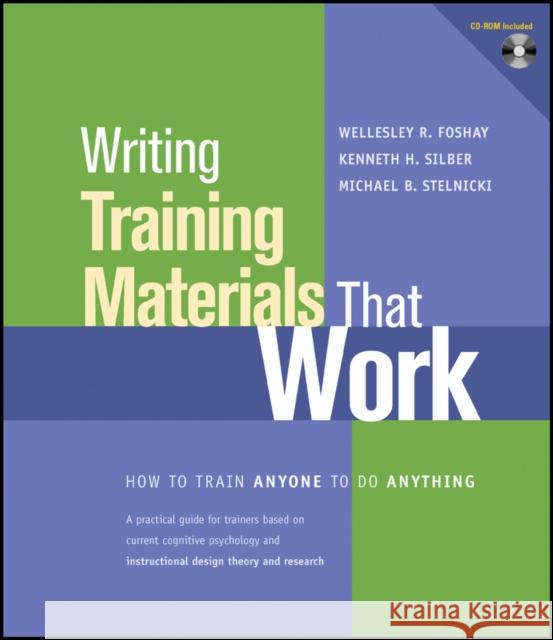
Wellesley R. Foshay; Kenneth H. Silber; Michael Stelnicki
Writing Training Materials That Work: How to Train Anyone to Do Anything Silber, Kenneth H. 9781118351680 John Wiley & Sons Inc - książkaWidoczna okładka, to zdjęcie poglądowe, a rzeczywista szata graficzna może różnić się od prezentowanej.

Writing Training Materials That Work: How to Train Anyone to Do Anything

ISBN-13: 9781118351680 / Angielski / Miękka / 2003 / 274 str.

Wellesley R. Foshay; Kenneth H. Silber; Michael Stelnicki
cena 306,81
(netto: 292,20 VAT:  5%)

Najniższa cena z 30 dni: 304,92
Termin realizacji zamówienia:
ok. 30 dni roboczych
Dostawa w 2026 r.

Darmowa dostawa!

-Writing Training Materials that Work is a solid and practical resource to move our field to a more professional level of practice in which instructional decisions are based on research and valid models of how people learn-
--Ruth Clark, president, Clark Training and Consulting, past president, ISPI

-I can see how this book will be immediately useful to my students. In fact, I can see how it will be immediately useful to me. Thanks for putting it all together between two covers.-
--Allison Rossett, professor, San Diego State University

The explosion of e-learning has attracted huge numbers of practitioners to the field of instructional design (ID), many with little or no actual ID training. And most current texts fail to cover the substantial recent developments in the field. Writing Training Materials that Work is different. In it, the authors identify, synthesize, and summarize the most current best practices in ID. They offer new ways of teaching declarative knowledge (facts, concepts, and principles) and well- to ill- structured procedural knowledge (problem solving). Their recommendations are based on those principles in the cognitive learning and instruction literature that are internally consistent, prescriptive, and have been empirically demonstrated to make a cost-effective difference. The authors' approach is easy to implement and consistently gets results because it focuses on teaching deep understanding and problem-solving, allowing learners to generalize and transfer learning to new situations without re-training. Whether you re an experienced instructional design practitioner who wants to expand your skills or a graduate student in an advanced instructional design course, Writing Training Materials T hat Work will prove to be a readable, usable, and indispensable guide


Kategorie:
Nauka, Ekonomia i biznes
Kategorie BISAC:
Business & Economics > Training
Business & Economics > Zarządzenie zasobami ludzkimi
Wydawca:
John Wiley & Sons Inc
Język:
Angielski
ISBN-13:
9781118351680
Rok wydania:
2003
Ilość stron:
274
Waga:
0.49 kg
Wymiary:
24.61 x 18.9 x 1.47
Oprawa:
Miękka
Wolumenów:
01

List of Figures.

Contents of the CD–ROM.

Acknowledgments.

Preface.

Introduction.

PART I: INTRODUCTION TO THE COGNITIVE APPROACH.

Chapter 1: The Cognitive Approach to Training Development.

The Cognitive Approach to Instructional Design.

The Cognitive Point of View on How Learning Occurs.

Declarative and Procedural Knowledge and Their Subtypes.

Summary.

Chapter 2: A Cognitive Training Model.

A New Cognitive Model.

Learner Tasks and Lesson Elements.

How to Read the Cognitive Training Model.

Differentiating Our Model from Gagne′s.

How to Use the Model.

Summary.

PART II: HOW TO DESIGN LESSONS USING THE COGNITIVE APPROACH.

Chapter 3: How to Begin Any Lesson: The First Three Lesson Elements.

About Using the Lesson Elements Attention, WIIFM, and YCDI to Begin a Lesson.

Using the Lesson Elements Attention, WIIFM, and YCDI to Begin a Lesson.

Summary.

Chapter 4: How to Organize and Present Information: Message Design Principles.

About Using the Lesson Elements to Help Learners Organize the Information.

Summary.

Chapter 5: Teaching Facts.

About Facts.

General Strategies for Teaching Facts.

Using the Lesson Elements to Teach Facts.

Summary.

Chapter 6: Teaching Concepts.

About Concepts.

General Strategies for Teaching Concepts.

Using the Lesson Elements to Teach Concepts.

Summary.

Chapter 7: Teaching Principles and Mental Models.

About Principles and Mental Models.

General Strategies for Teaching Principles and Mental Models.

Using the Lesson Elements to Teach Principles and Mental Models.

Summary.

Chapter 8: Teaching Well–Structured Problem–Solving.

About Well–Structured Problem–Solving.

General Strategies for Teaching Well–Structured Problem–Solving.

Using the Lesson Elements to Teach Well–Structured Problem–Solving.

Summary.

Chapter 9: Teaching Ill–Structured Problem–Solving.

About Ill–Structured Problem–Solving.

Problems Learning Ill–Structured Problem–Solving.

General Strategies for Teaching Ill–Structured Problem–Solving.

Using the Lesson Elements to Teach Ill–Structured Problem–Solving.

Summary.

Chapter 10: Teaching Troubleshooting.

About Troubleshooting.

General Strategies for Teaching Troubleshooting.

Using the Lesson Elements to Teach Troubleshooting.

Summary.

Chapter 11: Teaching Complete Lessons.

Combining Declarative and Procedural Teaching: Two Approaches.

Two Key ID Issues.

Template.

An Example of the Recommended Approach to Combined Lessons.

Summary.

PART III: USING THE COGNITIVE APPROACH: THE RESEARCH ISSUES.

Chapter 12: Issues Underlying the Cognitive Approach to Instructional Design.

Purpose and Approach.

How the Behavioral and Cognitive Approaches Differ.

Summary.

Chapter 13: Issues Underlying Teaching Declarative Knowledge.

How Declarative and Procedural Knowledge Differ.

Facts.

Concepts.

Principles and Mental Models.

Common Errors in Teaching Declarative Knowledge.

Summary.

Chapter 14: Issues Underlying Teaching Procedural Knowledge.

About Procedural Knowledge.

Terminology.

How Learners Solve Problems.

Problem–Solving Strategies.

Teaching Procedural Knowledge to Solve Problems.

Issues in Teaching Ill–Structured Problem Solving.

Issues in Teaching Troubleshooting.

Summary.

Further Reading.

About the Authors.

Index.

How to Use the CD–ROM.

Dr. Wellesley (Rob) Foshay is vice president for instructional design and quality control for PLATO Learning, Inc. He formerly served on the Board of Directors of the International Society for Performance Improvement.

Dr. Ken Silber is associate professor of instructional design at Northern Illinois University in DeKalb, Illinois. He is a performance consulting/ID/change management professional with 30 years of experience in consulting in corporate, nonprofit, and academic settings both in the U.S. and internationally.

Dr. Michael B. Stelnicki is Professor and Chairman of the graduate Human performance and training program at Governors State University in University Park, Illinois. He is a thirty–five year veteran presenter in the field and has worked as a journalist, psychology instructor, instructional television producer/director and consultant to business and industry.

Going far beyond the latest instructional fads or merely theory, Writing Training Materials That Work offers an up–to–date synthesis and summary of "best practices" in instructional design. It provides specific how–to guidelines that are research–based, have been used by practitioners long enough to show they are acceptable and can be implemented in business settings, and perhaps most importantly produce consistently good instructional results. The book includes instructional strategies grounded in cognitive theory and covers a range of key areas, including Declarative Knowledge (facts, concepts, principles, and metal models), Procedural Knowledge (well–structured and ill–structured), Problem Solving including a special chapter on teaching troubleshooting. The authors also provide a variety of illustrative examples, templates, and other useful job aids.

Foshay, Wellesley R. Foshay is vice president for instructional design ... więcej >
Silber, Kenneth H. Silber is associate professor of instructional des... więcej >


Udostępnij

Facebook - konto krainaksiazek.pl


Opinie o Krainaksiazek.pl na Opineo.pl

Partner Mybenefit

Krainaksiazek.pl w programie rzetelna firma Krainaksiaze.pl - płatności przez paypal

Czytaj nas na:

Facebook - krainaksiazek.pl
  • książki na zamówienie
  • granty
  • książka na prezent
  • kontakt
  • pomoc
  • opinie
  • regulamin
  • polityka prywatności

Zobacz:

  • Księgarnia czeska

  • Wydawnictwo Książkowe Klimaty

1997-2025 DolnySlask.com Agencja Internetowa

© 1997-2022 krainaksiazek.pl
     
KONTAKT | REGULAMIN | POLITYKA PRYWATNOŚCI | USTAWIENIA PRYWATNOŚCI
Zobacz: Księgarnia Czeska | Wydawnictwo Książkowe Klimaty | Mapa strony | Lista autorów
KrainaKsiazek.PL - Księgarnia Internetowa

Polityka prywatnosci - link
Krainaksiazek.pl - płatnośc Przelewy24
Przechowalnia Przechowalnia






