• Wyszukiwanie zaawansowane
  • Kategorie
  • Kategorie BISAC
  • Książki na zamówienie
  • Promocje
  • Granty
  • Książka na prezent
  • Opinie
  • Pomoc
  • Załóż konto
  • Zaloguj się

Writing Securities Research 2E » książka


zaloguj się | załóż konto
Logo Krainaksiazek.pl

koszyk

konto

szukaj
topmenu
Księgarnia internetowa
Szukaj
Książki na zamówienie
Promocje
Granty
Książka na prezent
Moje konto
Pomoc
 
 
Wyszukiwanie zaawansowane
Pusty koszyk
Bezpłatna dostawa dla zamówień powyżej 20 złBezpłatna dostawa dla zamówień powyżej 20 zł

Kategorie główne

• Nauka
 [2946600]
• Literatura piękna
 [1856966]

  więcej...
• Turystyka
 [72221]
• Informatyka
 [151456]
• Komiksy
 [35826]
• Encyklopedie
 [23190]
• Dziecięca
 [619653]
• Hobby
 [140543]
• AudioBooki
 [1577]
• Literatura faktu
 [228355]
• Muzyka CD
 [410]
• Słowniki
 [2874]
• Inne
 [445822]
• Kalendarze
 [1744]
• Podręczniki
 [167141]
• Poradniki
 [482898]
• Religia
 [510455]
• Czasopisma
 [526]
• Sport
 [61590]
• Sztuka
 [243598]
• CD, DVD, Video
 [3423]
• Technologie
 [219201]
• Zdrowie
 [101638]
• Książkowe Klimaty
 [124]
• Zabawki
 [2473]
• Puzzle, gry
 [3898]
• Literatura w języku ukraińskim
 [254]
• Art. papiernicze i szkolne
 [8170]
Kategorie szczegółowe BISAC

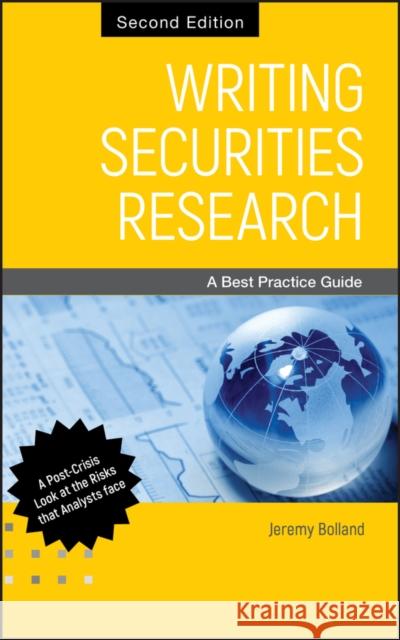
Writing Securities Research 2E

ISBN-13: 9780470826027 / Angielski / Twarda / 2010 / 192 str.
Jeremy Bolland
Writing Securities Research 2E Bolland, Jeremy 9780470826027 John Wiley & Sons - książkaWidoczna okładka, to zdjęcie poglądowe, a rzeczywista szata graficzna może różnić się od prezentowanej.

Writing Securities Research 2E

ISBN-13: 9780470826027 / Angielski / Twarda / 2010 / 192 str.

Jeremy Bolland
cena 327,12 zł
(netto: 311,54 VAT:  5%)

Najniższa cena z 30 dni: 325,33 zł
Termin realizacji zamówienia:
ok. 16-18 dni roboczych
Bez gwarancji dostawy przed świętami

Darmowa dostawa!

The book highlights the major risks that securities analysts (and other securities professionals) face. The various laws, rules and regulations that securities analysts are subject to are broadly split into three categories: research-specific rules and regulations; market-wide laws; and society-wide laws and customs. The risks that arise out of these various levels of rules and regulations, insofar as research analysts and other securities professionals are concerned, include conflicts of interest, fair distribution/front-running of research, insider trading, spreading of rumours, not highlighting investment risks (including corporate governance issues), as well as defamation and copyright issues. We see that if an analyst puts a company in play, a regulator would instantly assume that the analyst is trading on inside information (especially if the information turns out to be true) or is spreading a rumour (especially if it turns out to be false). However, we also see that there is a third option - that the analyst might just have come to his or her conclusion through some good research based on verifiable facts and reasonable assumptions. Definitions of research from around the world are examined. After all, research is generally defined by its content, not by the author's job description. As such, non-Research securities professionals such as brokers and marketers of research as well as investors, journalists and even bloggers and twitterers need to understand what constitutes "research" so that they don't fall into the regulators' purview. As regards the risks to investment views that analysts need to highlight to their investors, the book not only examines economic and financial risks but also examines corporate governance issues such as executive compensation, equal treatment of shareholders, related-party transactions and risk management. To demonstrate the risks that analysts, securities professionals and investors face, the book draws on many cases and examples from around the world, including many from the global financial crisis of 2007-2009. From these cases we see how penalties for those involved in the securities markets have become more serious over the years. They range from fines to imprisonment, and even to execution in some markets. To give a light-hearted angle, many of these cases are accompanied by "Alex" cartoons.


Kategorie:
Nauka, Ekonomia i biznes
Kategorie BISAC:
Business & Economics > Investments & Securities - Analysis & Trading Strategies
Business & Economics > Finance - General
Wydawca:
John Wiley & Sons
Język:
Angielski
ISBN-13:
9780470826027
Rok wydania:
2010
Ilość stron:
192
Waga:
0.64 kg
Wymiary:
23.16 x 16.05 x 2.59
Oprawa:
Twarda
Wolumenów:
01
Dodatkowe informacje:
Obwoluta

Foreword xv

Preface xix

Summary points and recommendations xix

Background xxii

Background to the second edition xxii

Background to the first edition xxvi

The changing regulatory environment xxvii

Introduction xxx

More education rather than more regulation xxx

The need to identify investment risk xxxi

Target readership xxxiii

Commercial benefits to compliance xxxiii

Local differences and specific circumstances xxxiv

Summary xxxiv

Case studies and examples xxxv

Themes xxxvii

Research coverage xxxvii

Sourcing information xxxviii

Reasonable basis for recommendations and risk assessment xxxix

Conflicts of interest xl

Writing in general xli

Acknowledgments xlv

Abbreviations Used in This Book xlvii

Chapter 1: Principles of Research 1

Key points 2

Definition and supervision of research 2

Supervision and control of research 2

Marketing research to the U.S. by foreign broker–dealers 3

Stock–picking tips 8

Continuing education 9

Cheating in tests 10

The realm of research 11

Ambit of securities regulations (bonds) 12

Ambit of securities research regulations (equity and credit research analysts) 13

Ambit of securities regulations (swaps and other derivatives) 16

Ambit of securities research regulations (marketers of research, including hedge fund research) 19

Ambit of securities research regulations (analysts as experts on sales desks) 20

Ambit of securities research regulations (stock–tipping bloggers) 21

Ambit of securities research regulations (media commentators) 23

Minimizing approval and publishing risks 26

Honesty and fair treatment of clients 28

Common securities–related violations cited by the SEC and FINRA of the U.S. 28

Regulations tightening up around the world (Hong Kong) 29

Regulations tightening up around the world (China) 31

Regulations tightening up around the world (Japan) 32

Front–running and selective distribution of research 35

Front–running and selective distribution of research (huddles) 35

Front–running of research 36

Selective distribution of research 37

Selective distribution of research (fact–checking) 39

Selective distribution of research (greater conviction of view) 39

Insider dealing and selective disclosure 41

Use/dissemination of price–sensitive information (general) 44

Use/dissemination of price–sensitive information (U.S.) 47

Use/dissemination of price–sensitive information (U.K.) 48

Use/dissemination of price–sensitive information (Hong Kong) 50

Use/dissemination of price–sensitive information (serial insider trading) 53

Use/dissemination of price–sensitive information (pillow talk) 54

Use/dissemination of price–sensitive information (economists) 56

Specific requests and proprietary information 58

Definition of publishing 59

Unfair portrayal of past recommendations 60

Performance of past recommendations 60

Conflicts of interest and disclosure of interests 62

Catering to investors with specific investment criteria 62

Shari ah law implications for securities research analysts (stocks) 64

Shari ah law implications for securities research analysts (bonds) 65

The virtues of a vice portfolio 67

Analyst surveys 67

Playing the voting game 68

Sourcing information 71

Acknowledging the source 71

Gathering confidential information 72

Receiving confidential information 76

Rumors, speculation and M&A 79

Identifying M&A candidates (putting companies into play) 81

Short selling by hedge funds (abusive rumor–mongering) 84

Defamation libel and slander 88

Defamation 89

Intellectual property copyright and plagiarism 91

Intellectual property 91

Research integrity and consistency 95

The problem 95

Disgruntled clients 95

The principles 96

. . . be consistent or explain apparent inconsistencies 97

Sector/country weightings and universes 100

Consistency of views 101

Top picks (research requirements) 102

Consistency of views 104

Technical analysis 105

Useful qualifications (technical analysis) 106

Coverage universe initiations, terminations and transfers 106

Accountability principles 106

Initiation of coverage 107

Transfer or re–initiation of coverage 107

Co–authorship liability 108

Termination of coverage 109

Under review 110

Publishing new research 111

No recommendation? 111

No recommendations 114

Chapter 2: Reasonable Basis, Valuations and Risk 119

Key points 120

Consistency of recommendations 121

Explanation for inconsistencies 121

Following the market 122

Valuation support 122

Forensic analysis of accounts 122

Channel–stuffing and other activities 123

Cross–industry antitrust issues 124

Disclosures and notes 126

Pro–forma accounting and use of selective data 128

Reasonableness of valuations 128

Highlight valuation changes 129

The appropriate valuation methodology 129

Unrealistic expectations or questionable bases for valuation 130

Excessive valuations 132

Highlighting risks and volatility 133

Appropriateness of sell ratings 134

Short–selling by hedge funds (pushing the envelope?) 135

Management s reaction to negative research (legal action) 137

Management s reaction to negative research (restricting information) 138

Mis–selling and not highlighting risks 139

Highlighting investment risks (credit crisis of 2007/08, U.S.) 139

Highlighting investment risks (credit crisis of 2007/08, global) 142

Highlighting investment risks (general) 144

Evaluating risks and catalysts 146

Catalysts and consensus 147

Market liquidity and contagion risks 147

Foreign exchange and interest rate risks 147

Currency risks 148

Earnings risks 150

Brand theft risk 151

Brand theft 151

Brand usurping 152

Cashflow and liquidity risks 153

Valuation risks 153

Modeling and miscalculation risks 154

Modeling risks 155

Mispricing risks 156

Information risk 157

M&A risks 158

Corporate governance risks 159

Gauging corporate governance risks 159

Social responsibility 161

Corporate governance (social responsibility rankings) 161

Durability of brand names 163

Corporate governance (social responsibility the mass–consumer market) 164

Corporate governance (social responsibility corporate governance excellence) 165

Executive remuneration 167

Corporate governance (executive remuneration) 168

Corporate governance (executive remuneration disclosures) 172

Executive insider trading 174

Corporate governance (executive insider trading) 175

Equal treatment of shareholders 176

Corporate governance (equal treatment of shareholders) 177

Corporate governance (related–party transactions) 179

Corporate governance (equal treatment of shareholders related–party transactions) 181

Corporate governance (vote manipulation) 182

Corporate governance (independent non–executive directors) 184

National interest 184

Corporate governance (national interest) 184

Corporate governance (national interest strategic industries) 187

Corporate governance (national interest sovereign wealth funds) 189

Risk management 189

Corporate governance (false statements by issuers) 190

Corporate governance (risk management and rogue traders) 191

Corporate governance (transparency of operations) 196

Ponzi schemes 197

Corporate governance (risk management and money–laundering, bribery and corruption) 199

Credit rating risks 201

Analyzing risk (credit rating agencies) 201

Due diligence by investment bankers 203

Due diligence (failures) 204

Chapter 3: Independence of Research and Conflicts of Interest 209

Key points 210

Summary 210

Separating research and banking 211

Conflicts of interest (global settlements) 212

Conflicts of interest (collateralized debt obligations) 214

Conflicts of interest (auction–rate securities) 216

Managing contacts between analysts and bankers 217

Disclosures of interests and relationships 219

Conflicts of interest (private trading contrary to recommendations) 220

Analyst certification 221

Conflicts of interest (disclosures) 222

Writing research on banking clients 223

Conflicts of interest (watch lists) 225

Conflicts of interest (managing apparent conflicts) 226

Pre–deal research 230

Conflicts of interest (pre–deal research) 231

Influencing of analysts by issuers 234

Conflicts of interest (bribes) 234

Conflicts of interest (favors) 235

Conflicts of interest (issuers guiding analysts) 236

Conflicts of interest (employment) 237

Independent research firms 238

Alleged conflicts of interest (independent research firms) 239

Paying for sell–side research 242

Transparency in paying for research (inappropriate payments) 245

Paying for credit ratings 246

Chapter 4: Non–research: E–mails, Blogs and Internal Communications 251

Key points 252

Approval of e–mail and media appearances 253

Objective commentary on non–rated companies 254

E–mails 256

E–mails as research 257

Retention of e–mails 259

Internal Use Only 261

Chapter 5: General Writing, Editing and Publishing Considerations 263

Key points 264

Introduction 264

Getting the message across 265

Headlines and covers 265

Standards of taste 266

Bullets, key points and executive summaries 267

Publishing and distribution 267

Writing the text 268

Writing rules 268

Use the right word 269

Vocabulary for attributing forward–looking comments (using will ) 269

Measurements and direction/degree of movement 271

Vocabulary for describing movement and performance 272

Words to avoid or use carefully 273

Bullshit Bingo (vocabulary and phrases) 274

Clarity of communication 275

Clarity, consistency, conformity and continuity 276

Be consistent or explain inconsistencies 277

Editorial departments and style guides 277

Translations into different languages 278

Mistranslations 278

Publishing independent yet integrated reports 279

Sensitivity to politics and religion 280

Sensitivity to politics and religion 280

Correcting errors 281

Courses of corrective action 281

Materiality of the error 282

Publishing of out–of–date story 282

Retractions 283

Helping the reader 286

Index 287

Since writing the first edition of Writing Securities Research: A Best Practice Guide, Jeremy Bolland has been invited regularly to address CFA societies on the risks that their members face as chartered financial analysts. He has also addressed audiences of regulators, lawyers, and law students on the subject.
Jeremy has over 25 years of experience in the world of investments, and has worked in London, Tokyo, and Hong Kong. For the past 16 years he has worked in securities research at global investment banks, including a five–year stint at Morgan Stanley, five years as a director at ING/ING Barings, and most recently five years at HSBC where his final role was Head of Training for Global Research. Jeremy has been a qualified supervisory analyst (SA) since 1997, and as such is authorized to approve securities research for U.S. distribution.
Before entering the securities industry, Jeremy was marketing director and company secretary for a property development company that undertook industrial and commercial projects throughout the U.K. as tax–shelter investments for corporates and high net worth individuals.
Jeremy is also the author of A Guide to Investment in Enterprise Zones (Longman, 1988, 2nd ed. 1990).
Jeremy Bolland grew up in Malaysia, holds an honors degree in Classics from King′s College, London University, and studied Chinese at SOAS and Beijing Normal University.

Writing Securities Research is a comprehensive guide for securities research analysts around the world. Analysts who want to write research that is clear, concise and actionable should carefully read and digest the contents of this book. I would say that it should also be compulsory reading for research managers,compliance officers, editors, securities lawyers, securities regulators and students of investment and finance. Jeremy Bolland′s book helps to equip analysts with many useful tools to help them achieve securities research success.
Dr. Mark Mobius
Executive Chairman of Templeton Asset Management Ltd.

Jeremy has made a major contribution by incorporating and explaining ethical principles in the writing and dissemination of investment research. He uses real–life examples as illustration which enhances the reader′s understanding. This is a practical book for analysts, academics, regulators and students of finance.
Lee Kha Hoon
Asia Pacific Head of Standards and Financial Market Integrity, CFA Institute

For every research analyst, research manager, research counsel and supervisory analyst, a large proportion of his or her role involves the circumnavigation of a dense body of global, often conflicting, regulation. In training sessions, many analysts ask: "But how does this apply to me? Why do the US rules apply if I′m based in Hong Kong? How do I recognize price–sensitive information?" Jeremy has done what no one thought of doing before: he has pulled together the rules and the examples where firms and individuals fell foul of those rules, distilled into a best–practice guide that can be used by the green and the seasoned in any jurisdiction.
Emma Pegler
Global Head of Research Control, HSBC

At a time when the regulatory landscape in the financial world is becoming increasingly complex, it is refreshing to read Jeremy′s book which identifies clearly and concisely the difficult regulatory, legal and ethical issues that research analysts must navigate around the world when producing research for their clients. It is the comprehensive nature of Jeremy′s book and the fact that he provides practical solutions to problems that make it such a useful tool for analysts, institutions, regulators and professional advisers alike.
Alan Linning
Partner, Sidley Austin, and Former Head of Enforcement, Hong Kong Securities and Futures Commission

Recent market events have heralded a new era of scrutiny, with consequences for the world within which securities analysts operate. At the same time, the regulatory environment has become increasingly sophisticated with complex, often competing, global requirements. Jeremy provides comprehensive guidance through all aspects of preparing securities research. The practical, focused case studies will also give real value to anyone who wants to fully appreciate the potential pitfalls that can and do arise. Whether you′re a lawyer or a regulator just starting out in this field, or you have been in it for many years, Jeremy′s research and guidance will offer you real insight.
Elizabeth Clay
Solicitor, White & Case LLP

Securities research in developing markets, especially those in Asia, requires a practical hands–on approach. In markets where transparency is not a given, Jeremy gives analysts the intellectual framework necessary for making sound, honest judgments about any company. These aren′t the lessons they teach you in MBA programs. They′re the real deal!
Steve Vickers
President and CEO of FTI–International Risk

Bolland, Jeremy Jeremy Bolland has over 20 years of experience in ... więcej >


Udostępnij

Facebook - konto krainaksiazek.pl


Opinie o Krainaksiazek.pl na Opineo.pl

Partner Mybenefit

Krainaksiazek.pl w programie rzetelna firma Krainaksiaze.pl - płatności przez paypal

Czytaj nas na:

Facebook - krainaksiazek.pl
  • książki na zamówienie
  • granty
  • książka na prezent
  • kontakt
  • pomoc
  • opinie
  • regulamin
  • polityka prywatności

Zobacz:

  • Księgarnia czeska

  • Wydawnictwo Książkowe Klimaty

1997-2025 DolnySlask.com Agencja Internetowa

© 1997-2022 krainaksiazek.pl
     
KONTAKT | REGULAMIN | POLITYKA PRYWATNOŚCI | USTAWIENIA PRYWATNOŚCI
Zobacz: Księgarnia Czeska | Wydawnictwo Książkowe Klimaty | Mapa strony | Lista autorów
KrainaKsiazek.PL - Księgarnia Internetowa

Polityka prywatnosci - link
Krainaksiazek.pl - płatnośc Przelewy24
Przechowalnia Przechowalnia





