• Wyszukiwanie zaawansowane
  • Kategorie
  • Kategorie BISAC
  • Książki na zamówienie
  • Promocje
  • Granty
  • Książka na prezent
  • Opinie
  • Pomoc
  • Załóż konto
  • Zaloguj się

Words of the World: The Global Language System » książka


zaloguj się | załóż konto
Logo Krainaksiazek.pl

koszyk

konto

szukaj
topmenu
Księgarnia internetowa
Szukaj
Książki na zamówienie
Promocje
Granty
Książka na prezent
Moje konto
Pomoc
 
 
Wyszukiwanie zaawansowane
Pusty koszyk
Bezpłatna dostawa dla zamówień powyżej 20 złBezpłatna dostawa dla zamówień powyżej 20 zł

Kategorie główne

• Nauka
 [2946912]
• Literatura piękna
 [1852311]

  więcej...
• Turystyka
 [71421]
• Informatyka
 [150889]
• Komiksy
 [35717]
• Encyklopedie
 [23177]
• Dziecięca
 [617324]
• Hobby
 [138808]
• AudioBooki
 [1671]
• Literatura faktu
 [228371]
• Muzyka CD
 [400]
• Słowniki
 [2841]
• Inne
 [445428]
• Kalendarze
 [1545]
• Podręczniki
 [166819]
• Poradniki
 [480180]
• Religia
 [510412]
• Czasopisma
 [525]
• Sport
 [61271]
• Sztuka
 [242929]
• CD, DVD, Video
 [3371]
• Technologie
 [219258]
• Zdrowie
 [100961]
• Książkowe Klimaty
 [124]
• Zabawki
 [2341]
• Puzzle, gry
 [3766]
• Literatura w języku ukraińskim
 [255]
• Art. papiernicze i szkolne
 [7810]
Kategorie szczegółowe BISAC

Words of the World: The Global Language System

ISBN-13: 9780745627489 / Angielski / Miękka / 2002 / 272 str.
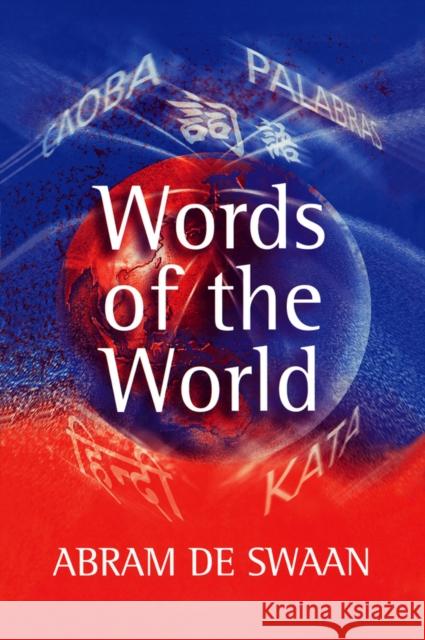
Abram De Swaan; A. De Swaan
Words of the World: The Global Language System de Swaan, Abram 9780745627489 Polity Press - książkaWidoczna okładka, to zdjęcie poglądowe, a rzeczywista szata graficzna może różnić się od prezentowanej.

Words of the World: The Global Language System

ISBN-13: 9780745627489 / Angielski / Miękka / 2002 / 272 str.

Abram De Swaan; A. De Swaan
cena 96,71
(netto: 92,10 VAT:  5%)

Najniższa cena z 30 dni: 96,51
Termin realizacji zamówienia:
ok. 30 dni roboczych
Bez gwarancji dostawy przed świętami

Darmowa dostawa!
inne wydania

This bold and accessible study of human languages and communication explores issues which are at the forefront of today's globalized society.


The human species is divided into more than five thousand language groups that do not understand each other. And yet these groups constitute one coherent world language system, connected by multilingual speakers in a surprisingly powerful way. The chances of a language thriving depend on its position in the system. There are thousands of small, peripheral languages, each connected to one of a hundred central languages. The entire system is held together by one global language: English. A language is a 'hypercollective' good: the more speakers it has, the higher its communication value for each one of them. Thus, when people think that a language is gaining new speakers, that in itself is a reason for them to want to learn it too. That is why, in an age of globalization, only a few languages remain for transnational communication and these often prevail even in national societies.


This important book discusses a number of specific constellations in detail: India, Indonesia, Sub-Saharan Africa, South Africa and the European Union. De Swaan concludes by providing a sober but illuminating view of language policy in multilingual societies. This book will be essential reading for those studying sociology, communication studies and linguistics.


Kategorie:
Nauka, Językoznawstwo
Kategorie BISAC:
Language Arts & Disciplines > Linguistics - General
Wydawca:
Polity Press
Język:
Angielski
ISBN-13:
9780745627489
Rok wydania:
2002
Ilość stron:
272
Waga:
0.39 kg
Wymiary:
22.9 x 15.6 x 1.5
Oprawa:
Miękka
Wolumenów:
01

"Abram de Swaan is the world′s leading political sociologist of language. He has a profound knowledge of the complex history interlinking states and languages and an equally acute understanding of individual incentives to learn languages. Here he applies his insights and methods with surprising results –– to globalization and its implications for the survival of world languages. Words of the World is both a pleasure to read and a remarkable contribution to political sociology." Professor David Laitin, Stanford University

"...de Swaan′s view is original and rich to the extent that it sheds new light on this problem...De Swaan′s analysis is definitely new and fruitful for an understanding of the relations of power and language" Anais Bokobza, European University Institute, Florence, Italy

"De Swaan′s study is an impressive tour de force; it presents an original and refreshing social science perspective, is rich in empirical detail, rigorous in its theoretical elaboration, and written in an elegant and accessible style: a path–breaking study of language change and human communication in an age of globalisation." Johan Heilbron, Multilingual Matters

"...this book is an important contribution to our understanding of the relationship among languages of the world in the era of globalisation. It is a good addition to the growing body of texts used in increasingly popular courses on ′World English(es)′. Alamin Mazuri, The Ohio State University, USA

Preface ix

1 Introduction: the global language system 1

1.1 The global language system: a galaxy of languages 4

1.2 A historical atlas of the world as a language system 6

1.3 Supercentral constellations in the present language system 11

1.4 Scope and approach of this book 17

1.5 Plan of the book 20

2 The political economy of language constellations 25

2.1 Languages as hypercollective goods 27

2.2 The communication potential of a language: the Q–value 33

3 Language, culture and the unequal exchange of texts 41

3.1 Texts as commodities in international exchange 42

3.2 Protectionism and free trade in cultural exchange 47

3.3 Monoglossia, polyglossia and heteroglossia 53

3.4 Discussion 57

4 India: the rivalry between Hindi and English 60

4.1 Characterization of the Indian constellation 61

4.2 State formation, nation–building and language unification 63

4.3 The vicissitudes of language policy in India 69

4.4 Discussion 73

5 The triumph of bahasa Indonesia 81

5.1 Gandhi s dream 81

5.2 The rise of Malay 83

5.3 The demise of Dutch 86

5.4 The rejection of Javanese 90

5.5 Discussion 93

6 Africa: the persistence of the colonial languages 96

6.1 A two–by–three comparison 99

6.2 Three francophone constellations south of the Sahara 102

6.3 Three English–centred constellations south of the Sahara 116

7 South Africa: the survival of the old language regime 127

7.1 The language regime under Apartheid 128

7.2 Language policy after Apartheid 132

7.3 The dynamics of the constellation 136

7.4 Discussion 140

8 The European Union: the more languages, the more English 144

8.1 Civil Europe (1): language unification in national constellations 146

8.2 Civil Europe (2): Q–values in the European Union 151

8.3 Institutional Europe (1): the public level 166

8.4 Institutional Europe (2): the bureaucracy 171

8.5 Discussion 173

9 Conclusions and considerations 176

9.1 Conclusions 177

9.2 Considerations 187

Notes 194

References 225

Index 244

Abram de Swaan is Chairman of the Amsterdam School of Social Research (ASSR) at the University of Amsterdam.

This bold and accessible study of human languages and communication explores issues which are at the forefront of today′s globalized society.

The human species is divided into more than five thousand language groups that do not understand each other. And yet these groups constitute one coherent world language system, connected by multilingual speakers in a surprisingly powerful way. The chances of a language thriving depend on its position in the system. There are thousands of small, peripheral languages, each connected to one of a hundred central languages. The entire system is held together by one global language: English. A language is a hypercollective′ good: the more speakers it has, the higher its communication value for each one of them. Thus, when people think that a language is gaining new speakers, that in itself is a reason for them to want to learn it too. That is why, in an age of globalization, only a few languages remain for transnational communication and these often prevail even in national societies.

This important book discusses a number of specific constellations in detail: India, Indonesia, Sub–Saharan Africa, South Africa and the European Union. De Swaan concludes by providing a sober but illuminating view of language policy in multilingual societies. This book will be essential reading for those studying sociology, communication studies and linguistics.

De Swaan, Abram Abram de Swaan is Chairman of the Amsterdam School... więcej >


Udostępnij

Facebook - konto krainaksiazek.pl


Opinie o Krainaksiazek.pl na Opineo.pl

Partner Mybenefit

Krainaksiazek.pl w programie rzetelna firma Krainaksiaze.pl - płatności przez paypal

Czytaj nas na:

Facebook - krainaksiazek.pl
  • książki na zamówienie
  • granty
  • książka na prezent
  • kontakt
  • pomoc
  • opinie
  • regulamin
  • polityka prywatności

Zobacz:

  • Księgarnia czeska

  • Wydawnictwo Książkowe Klimaty

1997-2025 DolnySlask.com Agencja Internetowa

© 1997-2022 krainaksiazek.pl
     
KONTAKT | REGULAMIN | POLITYKA PRYWATNOŚCI | USTAWIENIA PRYWATNOŚCI
Zobacz: Księgarnia Czeska | Wydawnictwo Książkowe Klimaty | Mapa strony | Lista autorów
KrainaKsiazek.PL - Księgarnia Internetowa

Polityka prywatnosci - link
Krainaksiazek.pl - płatnośc Przelewy24
Przechowalnia Przechowalnia




