• Wyszukiwanie zaawansowane
  • Kategorie
  • Kategorie BISAC
  • Książki na zamówienie
  • Promocje
  • Granty
  • Książka na prezent
  • Opinie
  • Pomoc
  • Załóż konto
  • Zaloguj się

Wireless World: Social and Interactional Aspects of the Mobile Age » książka


zaloguj się | załóż konto
Logo Krainaksiazek.pl

koszyk

konto

szukaj
topmenu
Księgarnia internetowa
Szukaj
Książki na zamówienie
Promocje
Granty
Książka na prezent
Moje konto
Pomoc
 
 
Wyszukiwanie zaawansowane
Pusty koszyk
Bezpłatna dostawa dla zamówień powyżej 20 złBezpłatna dostawa dla zamówień powyżej 20 zł

Kategorie główne

• Nauka
 [2946600]
• Literatura piękna
 [1856966]

  więcej...
• Turystyka
 [72221]
• Informatyka
 [151456]
• Komiksy
 [35826]
• Encyklopedie
 [23190]
• Dziecięca
 [619653]
• Hobby
 [140543]
• AudioBooki
 [1577]
• Literatura faktu
 [228355]
• Muzyka CD
 [410]
• Słowniki
 [2874]
• Inne
 [445822]
• Kalendarze
 [1744]
• Podręczniki
 [167141]
• Poradniki
 [482898]
• Religia
 [510455]
• Czasopisma
 [526]
• Sport
 [61590]
• Sztuka
 [243598]
• CD, DVD, Video
 [3423]
• Technologie
 [219201]
• Zdrowie
 [101638]
• Książkowe Klimaty
 [124]
• Zabawki
 [2473]
• Puzzle, gry
 [3898]
• Literatura w języku ukraińskim
 [254]
• Art. papiernicze i szkolne
 [8170]
Kategorie szczegółowe BISAC

Wireless World: Social and Interactional Aspects of the Mobile Age

ISBN-13: 9781852334772 / Angielski / Miękka / 2001 / 230 str.
Barry Brown; Richard Harper; Nicola Green
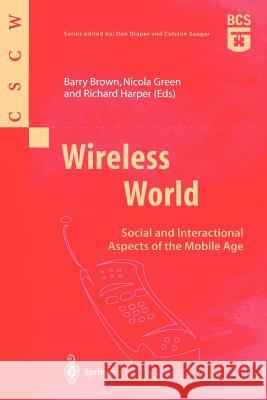
Wireless World: Social and Interactional Aspects of the Mobile Age Brown, Barry 9781852334772 Springer - książkaWidoczna okładka, to zdjęcie poglądowe, a rzeczywista szata graficzna może różnić się od prezentowanej.

Wireless World: Social and Interactional Aspects of the Mobile Age

ISBN-13: 9781852334772 / Angielski / Miękka / 2001 / 230 str.

Barry Brown; Richard Harper; Nicola Green
cena 201,72 zł
(netto: 192,11 VAT:  5%)

Najniższa cena z 30 dni: 192,74 zł
Termin realizacji zamówienia:
ok. 22 dni roboczych
Bez gwarancji dostawy przed świętami

Darmowa dostawa!

Mobile phones are the most successful computer-based consumer product of the age and yet very little is known about how mobile technology is changing the way people interact and cooperate with each other, and how this change can be analysed.
For the first time, Wireless World brings together experts from different disciplines to explore the social factors that are shaping the wireless world and provides an overview of the issues for anyone designing, testing or studying mobile devices. It identifies the major trends, discusses the main claims made about the mobile age, and looks at the issues that affect design, usability and evaluation.
A valuable reference for anyone concerned with the future of mobile communications, this book will be of particular interest to advanced undergraduate and postgraduate students on Mobile Technology courses, practitioners, and researchers working in mobile communications, CSCW and HCI.
..".an inspired and insightful collection of observations of the use of mobile technology...a valuable resource for both researchers and designers alike."
Marge Eldridge, Xerox Research Centre Europe, UK
"Working with the speed of the technologies they study, these researchers and product developers provide a rare opportunity to understand the cultural and social effects of a new technology as it emerges, rather than waiting decades for historical and sociological accounts."
Jonathan Grudin, Microsoft Research, US
.."looks in depth and detail about how people actually use mobiles: how they assemble their lives and re-assemble technologies to fit them. Essential reading for designers, sociologists and anyone just interested in how the "always-connected" world works."
Professor Mike Robinson, University of Jyvaskyla, Finland


Kategorie:
Nauka
Kategorie BISAC:
Technology & Engineering > Social Aspects
Technology & Engineering > Telecommunications
Computers > Information Technology
Wydawca:
Springer
Seria wydawnicza:
Computer Supported Cooperative Work,
Język:
Angielski
ISBN-13:
9781852334772
Rok wydania:
2001
Wydanie:
Softcover Repri
Numer serii:
000005162
Ilość stron:
230
Waga:
0.38 kg
Wymiary:
23.5 x 15.5
Oprawa:
Miękka
Wolumenów:
01
Dodatkowe informacje:
Wydanie ilustrowane

1 Introduction.- 1 Studying the Use of Mobile Technology.- 1.1 Introduction.- 1.2 Understanding the Technology.- 1.3 Tracing the Non-development of the Mobile Phone.- 1.4 Understanding the Technology in Use.- 1.5 Overview of the Book.- Notes.- References.- 2 Locating Mobile Technology.- 2 The Mutable Mobile: Social Theory in the Wireless World.- 2.1 Introduction.- 2.2 Transparency, Visibility, Audibility.- 2.3 Conjuctions of Remote and Co-present Interaction.- 2.4 Mobility and Location.- 2.5 Being Available.- 2.6 Conclusion: Mobile Theory.- Notes.- References.- 3 Who’s Watching Whom? Monitoring and Accountability in Mobile Relations.- 3.1 Introduction.- 3.2 Surveillance and Mobile Technologies.- 3.3 Who’s Watching Whom?.- 3.4 Surveillance and Accountability.- Notes.- References.- 4 The Region as a Socio-Technical Accomplishment of Mobile Workers.- 4.1 Introduction.- 4.2 Pre-assembled Parts.- 4.3 Assembling a Mobile Office.- 4.4 Boundary Work.- 4.5 Out of a Mobile Office.- 4.6 Broken Parts.- 4.7 Summing up a Region.- Notes.- References.- 5 Mobile Communications in the Twenty-first Century City.- 5.1 Introduction: The Arrival of Mass Mobile Communications in the City.- 5.2 Object and Self—:Personal Relationships with Mobile Telephones.- 5.3 City and System.- 5.4 Conclusions: Rethinking the City.- Notes.- References.- 3 From Ethnography to Use.- 6 Seeing the “Rules”: Preliminary Observations of Action, Interaction and Mobile Phone Use.- 6.1 Introduction.- 6.2 Analytical Background.- 6.3 Ethnomethodology, Technology and Situated Practice.- 6.4 Rules, Social Action and Technology Use: The Case of Air Traffic Control.- 6.5 Displaying the ‘Rules’.- 6.6 Non-vocal Responses.- 6.7 Body Movements.- 6.8 The Unanswered Phone.- 6.9 Other Common Sense Considerations.- 6.10 Time.- 6.11 Conversational Topic.- 6.12 Future Research and Future Technology: The Issue of Design.- 6.13 Conclusion.- Notes.- References.- 7 Local Use and Sharing of Mobile Phones.- 7.1 Introduction.- 7.2 Mobile Phone Research.- 7.3 In the Field.- 7.4 Sharing of Mobile Phones.- 7.5 Discussion.- Notes.- References.- 8 Running and Grimacing: The Struggle for Balance in Mobile Work.- 8.1 Introduction.- 8.2 Intel’s Architecture Labs and Mobile Technologies.- 8.3 The Technological Imperative: “Anytime, Anywhere Computing”.- 8.4 Access to Other People.- 8.5 Awareness and Coordination.- 8.6 Creating Information.- 8.7 Conclusion.- Notes.- References.- 9 Blurring the Boundaries: Cell Phones, Mobility, and the Line between Work and Personal Life.- 9.1 Introduction.- 9.2 The Social Meaning and Influence of Settings.- 9.3 One-person, One-number: The Trial of a Personal Phone.- 9.4 Results.- 9.5 Conclusions.- References.- 4 From Use to Design.- 10 Welcome to the Wireless World: Problems Using and Understanding Mobile Telephony.- 10.1 Introduction.- 10.2 Related Work.- 10.3 Method of Study.- 10.4 Findings: Attributes of Wireless Telephony.- 10.5 Conclusions.- References.- 11 Framing Mobile Collaborations and Mobile Technologies.- 11.1 Introduction.- 11.2 Creating the Consumption of Mobile Devices.- 11.3 Understanding Representations of Mobile Workers.- 11.4 Understanding the Practice of Mobile Work.- 11.5 Broadening the Concept of Mobile Work: Reflections on Fieldwork.- 11.6 Putting it all Together: Design Frameworks for Collaboration on the Move.- 11.7 Conclusions and Summary.- Notes.- References.- 12 Exploring the Relationship between Mobile Phone and Document Activity during Business Travel.- 12.1 Introduction.- 12.2 Our Approach.- 12.3 Previous Research.- 12.4 The Study.- 12.5 Findings.- 12.6 Implications for Mobile Technologies.- 12.7 Conclusion.- Notes.- References.- 13 Usability of Portable Devices: The Case of WAP.- 13.1 Introduction.- 13.2 Usability.- 13.3 User Perceptions of a First Generation WAP Service.- 13.4 Results.- 13.5 The Right Approach to Portability.- 13.6 Conclusion.- References.- 14 The Mobile Interface: Old Technologies and New Arguments.- 14.1 Introduction.- 14.2 Current Forms of the Interface.- 14.3 Radical Form Factors.- 14.4 User Perceptions of the Mobile Interface.- 14.5 Interfaces to Social Process.- 14.6 Conclusions.- References.

Brown, Barry Barry Brown is Professor in Human Computer Interac... więcej >


Udostępnij

Facebook - konto krainaksiazek.pl


Opinie o Krainaksiazek.pl na Opineo.pl

Partner Mybenefit

Krainaksiazek.pl w programie rzetelna firma Krainaksiaze.pl - płatności przez paypal

Czytaj nas na:

Facebook - krainaksiazek.pl
  • książki na zamówienie
  • granty
  • książka na prezent
  • kontakt
  • pomoc
  • opinie
  • regulamin
  • polityka prywatności

Zobacz:

  • Księgarnia czeska

  • Wydawnictwo Książkowe Klimaty

1997-2025 DolnySlask.com Agencja Internetowa

© 1997-2022 krainaksiazek.pl
     
KONTAKT | REGULAMIN | POLITYKA PRYWATNOŚCI | USTAWIENIA PRYWATNOŚCI
Zobacz: Księgarnia Czeska | Wydawnictwo Książkowe Klimaty | Mapa strony | Lista autorów
KrainaKsiazek.PL - Księgarnia Internetowa

Polityka prywatnosci - link
Krainaksiazek.pl - płatnośc Przelewy24
Przechowalnia Przechowalnia






